





How ONAN Cooling Removes Heat from a Substation Power Transformer
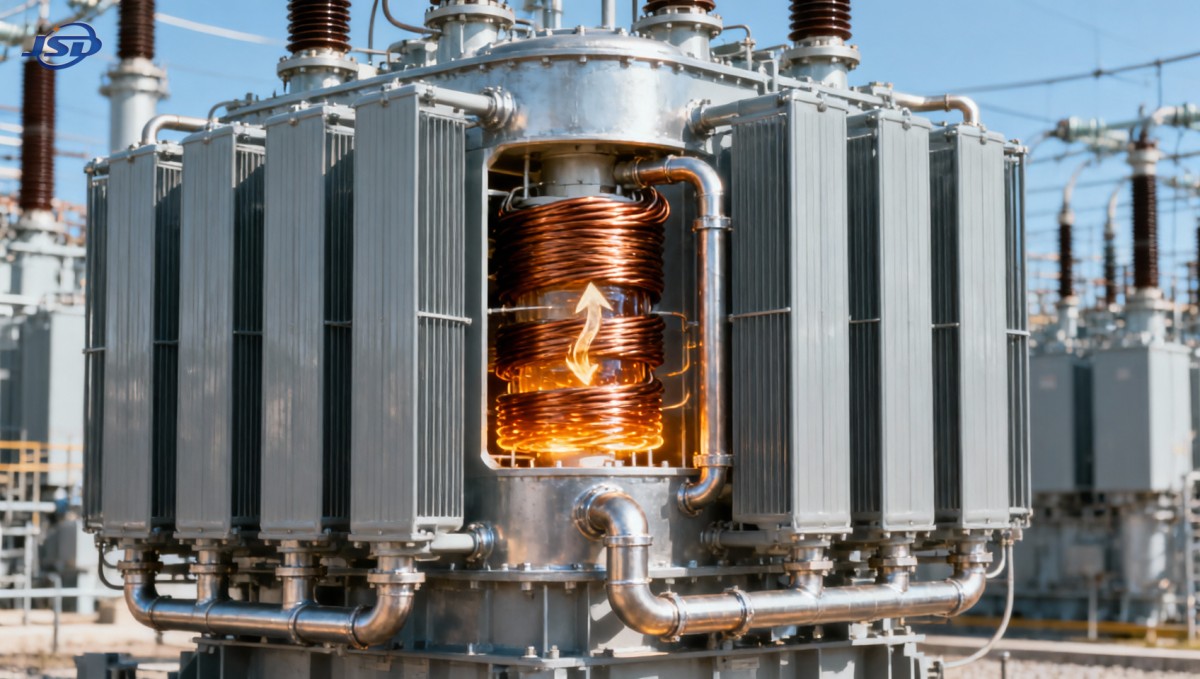
A substation ONAN power transformer can dissipate substantial heat without oil pumps or cooling fans. Its cooling system relies on a continuous passive cycle: insulating oil absorbs heat from the windings and core, rises through internal passages, and releases that heat through the tank and radiators to the surrounding air. As the oil cools, it returns toward the lower part of the transformer.
For technical evaluators, the important question is not simply whether this cycle works. It is whether the complete heat-transfer path can keep winding and oil temperatures within the specified limits under the actual loading, ambient temperature, and installation conditions. Understanding that path makes cooling ratings, temperature-rise reports, and site requirements much easier to assess.
What ONAN means—and what it does not mean
ONAN stands for Oil Natural Air Natural. The first pair of letters describes the internal cooling medium and its circulation method; the second describes the external cooling medium and its movement. In an ONAN arrangement, oil circulates naturally inside the transformer, while air moves naturally around the external cooling surfaces.
“Natural” does not mean that heat removal is uncontrolled or incidental. The transformer’s internal oil passages, radiator geometry, cooling-surface area, and permissible losses are designed together to achieve a defined thermal performance.
ONAN is also a cooling designation, not a complete transformer specification. Two transformers with the same voltage and ONAN rating may differ substantially in losses, temperature rise, impedance, insulation system, physical size, and suitability for a particular site.
Where a transformer carries an ONAN/ONAF rating, the ONAF stage uses forced air, usually from fans, while oil circulation remains natural. The higher rating applies only under the declared operating conditions with the required cooling equipment available. A transformer designed solely for ONAN operation does not automatically gain an approved higher rating if fans are added later.
Following the heat from the winding to the atmosphere
Heat begins with electrical losses
The core generates no-load losses whenever the transformer is energized. These losses depend principally on excitation conditions, including voltage and frequency. Load losses arise in the windings and other conductive components; the resistive component increases approximately with the square of current, with resistance also changing as temperature rises.
Consequently, a modest increase in current can produce a much larger increase in winding heat. Harmonic currents may further increase eddy-current and stray losses. Evaluators assessing industrial or renewable-energy applications should therefore examine the load profile and waveform, not just the average apparent power.
Oil carries heat away from internal surfaces
Heat passes through winding insulation and other solid materials into the surrounding oil. As the oil warms, its density decreases. The resulting buoyancy drives upward flow through available passages around the windings and core.
Cooler, denser oil moves into the lower regions, establishing a circulation loop. This is often described as a thermosiphon effect. Its strength depends on the temperature difference, vertical height, oil properties, and hydraulic resistance of the flow path.
Internal geometry matters because the hottest winding location is not necessarily the location with the best oil access. Duct dimensions, spacers, winding construction, and local loss distribution influence whether heat can leave critical regions efficiently.
Radiators transfer heat to naturally moving air
Hot oil reaches the upper tank region and enters connected radiators where provided. Heat moves from the oil to the radiator wall, through the metal, and then into the surrounding air. The cooled oil returns through the lower connections. Tank walls also contribute to heat rejection, and some distribution designs use corrugated cooling surfaces rather than separate radiator banks.
Air next to a warm surface heats up, becomes less dense, and rises. Cooler air replaces it from below. Thermal radiation also contributes to external heat loss, although its share depends on surface temperature, finish, and surroundings.
The complete cooling path is therefore: winding and core → insulation and oil → tank or radiator metal → ambient air. A restriction anywhere along that path can raise operating temperatures.
Why a large radiator does not tell the whole story
A useful simplified relationship is Q ≈ U × A × ΔT, where Q is the heat rejected, U is an overall heat-transfer coefficient, A is effective cooling area, and ΔT is the driving temperature difference. This relationship helps explain the design, but it is not sufficient to calculate a transformer rating.
Increasing cooling area generally helps. However, tightly packed surfaces may interfere with natural airflow, and additional external area cannot fully compensate for a poorly cooled winding region. Likewise, increasing oil temperature strengthens the temperature difference available for heat rejection, but consumes thermal margin and can accelerate insulation aging.
Natural circulation also depends on oil viscosity. At low temperatures, higher viscosity increases flow resistance. Designers must consider this behavior alongside the insulating liquid’s low-temperature properties and the intended energization and loading conditions.
The lesson for procurement is straightforward: radiator dimensions are useful inspection information, but a temperature-rise test and a credible thermal design are stronger evidence of cooling capability.
The temperatures that matter in a substation ONAN power transformer
Different temperature values answer different questions. Treating them as interchangeable can hide a thermal problem.
Temperature rise and absolute temperature must also be distinguished. A given rise above ambient results in a higher absolute insulation temperature on a hot day than on a cool day. Loading capability therefore depends on both the transformer’s thermal characteristics and its environment.
Oil and solid insulation have thermal inertia, so temperatures do not change instantly when load changes. Short-duration loading may be assessed differently from sustained loading, but thermal lag is not permission to overload without an engineering assessment.
Reading standards and test reports without assuming too much
For liquid-immersed transformers specified under IEC practice, IEC 60076-2 addresses temperature rise, while IEC 60076-7 provides loading guidance for mineral-oil-immersed power transformers. Under IEEE practice, IEEE C57.12.00, IEEE C57.12.90, and IEEE C57.91 are commonly relevant to requirements, testing, and loading guidance, respectively. The applicable edition and contractual requirements should always be identified.
There is no single temperature-rise value that should be applied blindly to every ONAN transformer. Limits and evaluation methods depend on the specified standard, insulation system, cooling medium, and service conditions. Loading guidance written for mineral oil should not be transferred uncritically to another insulating liquid.
When reviewing thermal evidence, check:
- Test basis: Which rating, tap position, losses, and cooling configuration were represented?
- Cooling arrangement: Did the tested radiator configuration match the supplied equipment?
- Measured results: Are top-oil and average winding rises clearly reported, with the required corrections?
- Hot-spot assessment: Was the hot spot calculated, supported by design validation, or measured using embedded sensors?
- Site applicability: Do ambient temperature, altitude, enclosure, and load assumptions match the project?
A compliance statement is a starting point. For a consequential substation application, request the relevant test evidence and clarify whether it covers the supplied unit or an accepted representative design.
Installation conditions can weaken an otherwise sound design
An ONAN transformer needs access to cooler air and a clear route for warmed air to escape. Nearby walls, acoustic barriers, closely spaced equipment, or protective enclosures can restrict circulation or allow heated air to return to the radiator inlet region.
Indoor installations require particular care. Although the transformer has no cooling fans, the room may still need engineered ventilation to remove its heat. Natural transformer cooling does not mean that a sealed room is acceptable.
Altitude is another consideration: lower air density can reduce external cooling performance. Higher-than-specified ambient temperatures, solar exposure, and nearby heat sources can also reduce thermal margin. Any necessary rating adjustment or cooling modification should be agreed with the manufacturer rather than inferred from a generic rule.
During installation and commissioning, confirm radiator valve positions where valves are fitted, oil level, leak tightness, and the completion of required filling and venting procedures. Air trapped in cooling components or an unintentionally isolated radiator can undermine the intended circulation path.
Operational checks: passive cooling still needs attention
Removing pumps and fans eliminates those auxiliary components, but it does not eliminate maintenance. Cooling surfaces can accumulate dirt, oil levels can change, and temperature instruments can drift. Insulating oil and cellulose insulation also age.
The most useful monitoring compares temperature with load and ambient conditions over time. A rising top-oil temperature at similar load and ambient conditions deserves investigation, especially after maintenance or a change to the surrounding installation.
Depending on equipment criticality, checks may include cooling-surface inspection, instrument verification, oil testing, dissolved gas analysis, and review of winding temperature indications. Infrared inspection can help identify unusual external temperature patterns, but it cannot directly establish the internal winding hot spot.
Protection settings and operating limits should follow the agreed thermal design and protection philosophy. Raising an alarm threshold to accommodate persistent overheating does not restore cooling capacity.
Where a dry-type alternative belongs in the evaluation
Some distribution projects require a comparison between liquid-immersed ONAN equipment and dry-type transformers, particularly where installation location, fire precautions, or liquid containment influence the decision. These are different thermal systems: a cast-resin dry-type transformer has no oil circulation loop and normally uses AN or AF cooling terminology, not ONAN.
For such projects, Jinshida Electric Power Technology Co., Ltd. offers the 20kV Three-Phase Cast Resin Dry-Type Distribution Transformer, a separate distribution option with specified low-voltage configurations of 0.4 kV or 0.415 kV and temperature protection and control. Its relevance is as an alternative technology, not as an example of ONAN cooling.
Compare the offered configurations using verified losses, temperature limits, ventilation requirements, enclosure effects, and project-specific standards. Any stated overload capability under forced-air cooling must be evaluated against its declared duration and thermal conditions; it should not be interpreted as an unrestricted continuous natural-air rating.
Make the cooling rating a site-specific decision
A well-selected ONAN transformer balances electrical losses, internal oil circulation, external heat-transfer area, and the environment around it. Its appeal is straightforward: heat removal without pumps or fans, with fewer auxiliary components to support. Its limitation is equally clear: passive cooling depends on temperature differences and unobstructed flow paths.
Before accepting a substation ONAN power transformer, establish three things: the thermal test basis matches the equipment, the loading assessment reflects the actual duty, and the installation allows the cooling system to function as designed. Those checks turn a cooling designation on a datasheet into evidence for reliable substation service.

Get a Quote
Regardless of whether you require general advice or specific support, we are happy to help you.
Send Us Your Inquiry Today

Jinshida Electric remains committed to contributing to global energy development through professional manufacturing and superior service.