





Selecting Hermetically Sealed Power Distribution Transformers for Humid Coastal Sites
At a humid coastal site, a distribution transformer is exposed to a combination of stresses that should not be treated as separate issues: high humidity, salt-laden air, wind-driven rain, rapid temperature shifts, and extended periods of low loading or shutdown. Together, these conditions accelerate external corrosion and can compromise insulation if moisture enters the tank or breathing system. A hermetically sealed design is often the right starting point, but “sealed” alone is not a sufficient specification.
The central selection question is whether the transformer’s sealing system, tank design, protective finishes, accessories, ratings, and maintenance concept are matched to the actual site exposure. A unit suitable for a sheltered coastal substation may not be adequate for an exposed quay, desalination plant, port facility, island grid, or wind farm collector station. The decision should be based on the operating environment and failure consequences, not simply on the distance from the shoreline.
Why coastal humidity changes the transformer selection logic
Moisture is a long-term insulation risk. In an oil-filled transformer, water reduces the dielectric strength of insulating oil and is absorbed by cellulose insulation. Because paper insulation cannot be economically replaced once the transformer is in service, moisture management has a direct bearing on useful life. Thermal cycling can worsen the problem: when a conventional conservator-type transformer cools, air is drawn into the tank through its breather. Even with a properly maintained desiccant breather, repeated air exchange creates an ongoing pathway for moisture ingress.
Salt contamination creates a different but related problem. Chloride deposits settle on radiators, cable boxes, bushings, terminal hardware, control cabinets, and tank surfaces. When those deposits become wet, they form conductive films that can support surface tracking, insulation flashover, corrosion under coatings, and deterioration of electrical contacts. High winds can carry salt spray far inland, while enclosed equipment areas may trap humid air and slow drying. A site described as “coastal” therefore needs a more precise exposure assessment than a simple map reference.
A hermetically sealed power distribution transformer reduces one major exposure route by isolating the insulating liquid from ambient air. The tank is designed to accommodate oil expansion and contraction without a conventional air-breathing conservator. This may be achieved through a flexible corrugated tank, an expansion system, or another sealed-volume arrangement. The benefit is not that all site risks disappear; the benefit is that the oil-paper insulation system is less dependent on the performance of a breather and less exposed to atmospheric moisture over its operating life.
Confirm what “hermetically sealed” means in the offered design
Specifications often use terms such as sealed, fully sealed, hermetic, or maintenance-free loosely. They should be converted into verifiable design requirements before technical approval. The supplier should clearly identify the expansion method, permissible internal pressure and vacuum, leak-test procedure, pressure-relief arrangement, and how the design maintains sealing through the expected ambient temperature range.
A corrugated tank can be a practical solution for distribution ratings because the corrugations flex as oil volume changes. However, the adequacy of the design depends on the allowed duty cycle, oil volume, temperature range, internal pressure limits, mechanical protection, and installation arrangement. A transformer subject to strong solar gain, cyclic loading, or high ambient temperatures may experience larger oil-volume changes than a unit in a moderate inland location. The sealed system must be designed around those conditions rather than assumed to be universally suitable.
Request evidence of factory leak testing and define the acceptance requirement in the purchase specification. A pressure or vacuum retention test, where applicable to the manufacturer’s design, is more meaningful when accompanied by the stated test duration, test medium, acceptance limit, and record format. It is also useful to establish who is responsible for checking oil leakage after transport, erection, cable termination, and energization. Sealing performance can be affected by handling damage, poorly tightened fittings, damaged gaskets, or accessory interfaces even when the factory tank test was satisfactory.
Separate internal moisture protection from external corrosion protection
A sealed tank protects the insulation system from atmospheric exchange; it does not automatically protect the transformer from salt corrosion. These are distinct engineering requirements and should be evaluated separately.
For the external enclosure, the coating system should be specified by its intended corrosivity environment, surface preparation, coating layers, total dry-film thickness, colour, repair procedure, and expected inspection criteria. ISO 12944 is commonly used as a framework for selecting protective paint systems for atmospheric corrosion environments. It does not replace the transformer standard, but it provides a useful language for defining coating duty and avoiding vague requirements such as “marine paint.” The final paint system needs to be compatible with the supplier’s fabrication process, weld geometry, tank temperature, and field repair method.
Examine corrosion-sensitive details, not only the large painted tank surfaces. Bolts, hinges, lifting lugs, radiator connections, grounding pads, nameplates, cable glands, marshalling-box fasteners, and exposed terminals may fail earlier than the tank if their materials or finishes are unsuitable. Stainless steel is not a universal answer; grade selection, galvanic compatibility, crevice design, and isolation from dissimilar metals still matter. Where copper conductors, aluminium cable lugs, galvanized steel supports, and stainless hardware meet, the connection design should prevent galvanic corrosion and preserve contact integrity.
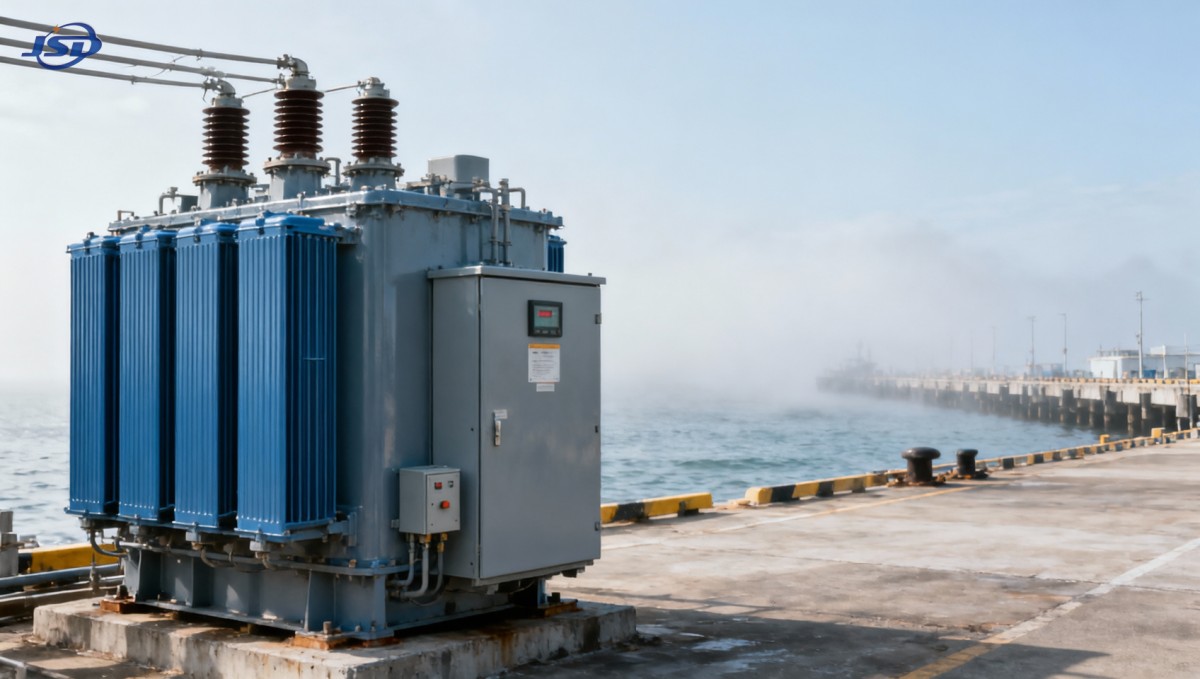
Outdoor control cabinets deserve particular attention. A cabinet with inadequate gasket compression, poorly positioned louvers, unsealed cable entries, or no condensation control can become the weakest part of an otherwise robust transformer installation. Specify the required enclosure protection, corrosion resistance, internal anti-condensation heater arrangement, drainage provisions, and terminal material. The same review applies to local indicators, tap-changer drives, protection interfaces, and SCADA wiring.
Do not specify electrical ratings in isolation from the coastal duty
Rated power, voltage ratio, impedance, vector group, tapping range, and cooling class remain fundamental, but coastal conditions affect how these ratings should be applied. High ambient temperature reduces thermal margin. Direct sun exposure can increase tank and oil temperatures. Restricted airflow behind architectural screens or inside compact substations can impair radiator performance. Salt deposits on fins can also complicate heat rejection and cleaning requirements.
The transformer’s temperature-rise design should therefore be assessed against the project’s stated maximum ambient condition and installation configuration. “Outdoor installation” does not automatically mean full exposure to solar radiation, nor does it describe airflow around radiators. If the transformer sits in a concrete enclosure, near a seawall, beneath a canopy, or beside other heat-generating equipment, these conditions should be provided during bid evaluation. A nominal ONAN rating may be adequate in one layout but require forced-air cooling or a different thermal design in another.
Voltage regulation needs similar attention. Coastal infrastructure may have long feeder runs, fluctuating industrial loads, marine pumps, cranes, refrigeration systems, or renewable generation. The required off-circuit or on-load tap range should be based on the network voltage study rather than selected by habit. Tap changer type, accessible operating position, locking arrangement, and corrosion protection of the mechanism are relevant because an infrequently operated tap switch may still need dependable adjustment after years in a humid environment.
For renewable installations, transformer selection should account for generation profile, harmonic content where converter-connected equipment is involved, fault level, and the operating philosophy during curtailment or low generation. In wind applications, an outdoor unit such as the Transformer for Wind Power Generation, available in 630 kVA–5000 kVA ratings with 10 kV, 20 kV, or 35 kV high-voltage options and 0.69 kV low voltage, illustrates the parameters that must be aligned with the collector system rather than copied from a standard utility distribution specification. IEC 60076 provides the core transformer framework, but project requirements still need to define the environmental and system-specific conditions around it.
Specify bushings, terminals, and interfaces for contamination exposure
External insulation selection is often underestimated. Bushing creepage distance, pollution performance, material choice, terminal orientation, and maintenance access should reflect the severity of contamination expected at the installed location. Salt fog, wind direction, and local sheltering influence the risk. A bushing that performs well in an ordinary outdoor substation may need a higher pollution-duty configuration at an exposed coastal facility.
The project specification should state the applicable pollution assumptions and require coordination with the connected cable terminations, surge arresters, switchgear, and clearances. It is not enough to choose an appropriately rated transformer bushing if the cable box or elbow connector system becomes the lower-performing interface. Where screened separable connectors are used, the complete arrangement should be reviewed for voltage class, test points, earth continuity, sealing, bending space, and installation torque.
Surge protection also requires site-specific consideration. Coastal areas are not automatically high-lightning areas, but exposed installations, overhead connections, and wind-energy infrastructure can have demanding surge conditions. The insulation coordination study should determine arrester rating and placement. This is a system decision, not a transformer accessory selected independently.
Evaluate maintainability without assuming “sealed” means no inspection
The operational advantage of a hermetic design is reduced dependence on breather servicing and lower exposure of oil to ambient humidity. It does not eliminate the need for condition monitoring, visual inspection, torque checks, coating repair, thermographic surveys, and oil assessment when the maintenance strategy calls for it. A sealed transformer may make oil sampling less convenient, so the design should include a suitable sampling point and clear procedure where oil diagnostics are required by the asset owner.
For critical loads, consider how early signs of deterioration will be detected. Oil temperature indication, winding temperature devices where justified, pressure indication, oil level monitoring appropriate to the sealed design, and remote alarm contacts can be valuable when access is limited or outage windows are constrained. The objective is not to load a distribution transformer with unnecessary instrumentation. It is to ensure that the monitoring level matches the consequence of failure and the site’s access conditions.
Spare parts planning should focus on components exposed to weather and handling: gaskets, gauges, fans where fitted, terminal accessories, cabinet heaters, relay contacts, coating repair materials, and compatible hardware. A supplier’s documentation package should include terminal diagrams, routine-test records, nameplate data, accessory manuals, lifting and storage instructions, oil information, torque requirements, and procedures for responding to suspected leakage or abnormal pressure indication.
Turn the site survey into enforceable procurement requirements
Many procurement documents identify “high humidity and salt mist” but leave the transformer manufacturer to interpret the exposure. That creates bid ambiguity and makes technical comparison difficult. The site data should instead state the installation location, nearest saltwater exposure, elevation, ambient temperature range, solar exposure, prevailing wind direction where relevant, flooding risk, enclosure layout, required service life, maintenance access, and expected contamination sources beyond marine salt, such as industrial emissions or dust.
Bid review should test whether each supplier has addressed these requirements in the offered design rather than merely confirming compliance in general terms. Useful clarification points include:
- the sealed-tank expansion principle and documented leak-test method;
- coating specification, surface preparation standard, dry-film thickness, and field repair process;
- materials and corrosion protection for fasteners, radiators, cabinets, terminals, and earthing points;
- bushing pollution-duty characteristics and interface compatibility;
- thermal rating under the declared ambient and ventilation conditions;
- routine tests under IEC 60076 and any additional purchaser tests or inspections;
- transport limits, storage requirements, and inspection responsibilities before energization.
Factory inspection is particularly useful when the project has a demanding coating requirement or multiple units must operate consistently across dispersed sites. Inspection should verify workmanship at welds and edges, gasket seating, cabinet sealing, accessory installation, nameplate accuracy, earthing provisions, test documentation, and packing suited to marine or long-distance transport. Packaging cannot compensate for a weak coating system, but inadequate packaging can damage a compliant unit before it reaches site.
The practical decision: match protection layers to failure consequences
A hermetically sealed power distribution transformer is a strong choice where moisture ingress through air exchange would create an avoidable insulation risk. Its value is greatest when that internal protection is combined with a corrosion-resilient external design, appropriate contamination performance, correct thermal application, and clear acceptance criteria.
The common mistake is to treat the tank sealing concept as a complete coastal specification. Reliable service depends on several protection layers working together: sealed insulation oil, durable external coatings, protected metallic interfaces, suitable bushings and cable connections, controlled cabinet condensation, verified installation quality, and a maintenance plan that remains realistic for the site. When these details are stated before procurement, the project team can compare technically equivalent offers and avoid discovering environmental limitations after commissioning.

Get a Quote
Regardless of whether you require general advice or specific support, we are happy to help you.
Send Us Your Inquiry Today

Jinshida Electric remains committed to contributing to global energy development through professional manufacturing and superior service.