





Why a Power Distribution Transformer for Mining Overheats Underground—and How to Prevent It
Underground mining conditions place exceptional thermal stress on every power distribution transformer for mining. Restricted ventilation, heavy cyclic loads, dust buildup, high ambient temperatures, and insulation deterioration can quickly turn overheating into a serious reliability and safety risk. For after-sales maintenance teams, the urgent question is rarely just “Why is the temperature high?” It is whether the transformer is experiencing a temporary operating condition, a cooling failure, an electrical fault, or the early stages of irreversible insulation damage.
A transformer that runs hot for one shift may still be recoverable. A transformer that repeatedly operates beyond its thermal limits can lose years of insulation life, contaminate its oil, weaken connections, and eventually fail without much warning. In a mine, where a shutdown can interrupt dewatering, ventilation, conveying, and production circuits at the same time, finding the real cause early matters far more than simply resetting an alarm.
Heat is a symptom, not the diagnosis
Transformer temperature is the result of heat generated inside the unit minus heat successfully removed through the tank, oil, radiators, and surrounding air. Underground installations disturb both sides of that equation. Load losses increase with current, while heat dissipation falls when airflow is poor or ambient temperatures rise.
That is why a maintenance visit should not begin with the assumption that the transformer itself is defective. A healthy unit can overheat in an unsuitable location, while a damaged unit may look normal until a high-load period exposes the problem. The most reliable approach is to compare temperature behavior with load, ambient conditions, cooling performance, and electrical test results.
For field teams, a useful first distinction is this:
- Whole-unit overheating usually points to overload, inadequate ventilation, high ambient temperature, or impaired cooling surfaces.
- A localized hot spot at a bushing, cable termination, tap changer, radiator inlet, or connection often indicates resistance heating, poor contact pressure, imbalance, or an internal circulation issue.
- Rapid temperature rise at ordinary load deserves urgent investigation because it can signal low oil level, restricted oil flow, internal faults, or a failed cooling component.
The underground causes that are easiest to miss
1. The load profile is harsher than the nameplate suggests
Mine loads are rarely smooth. Crushers, hoists, pumps, conveyor drives, compressors, welding equipment, and large motor starts create peaks that may not be visible in a once-per-shift current reading. A transformer may appear to operate below rated capacity on average while repeatedly carrying severe short-duration peaks. Harmonic-producing variable-frequency drives can add further eddy-current and stray losses, especially where the original transformer selection did not account for harmonic loading.
Review logged current rather than relying only on operator estimates. If no permanent monitor is installed, use a portable power analyzer long enough to capture production cycles, motor starts, and shift changes. Check all three phases. Persistent phase imbalance increases winding loss and can create unequal hot-spot temperatures even when total kVA seems acceptable.
Also verify the actual voltage ratio and tap setting. A tap position that is unsuitable for the incoming supply can cause elevated excitation current or poor secondary voltage regulation. This is not the most common cause of high temperature, but it is a straightforward item to confirm before opening the tank or planning major repairs.
2. Ventilation around the transformer has quietly deteriorated
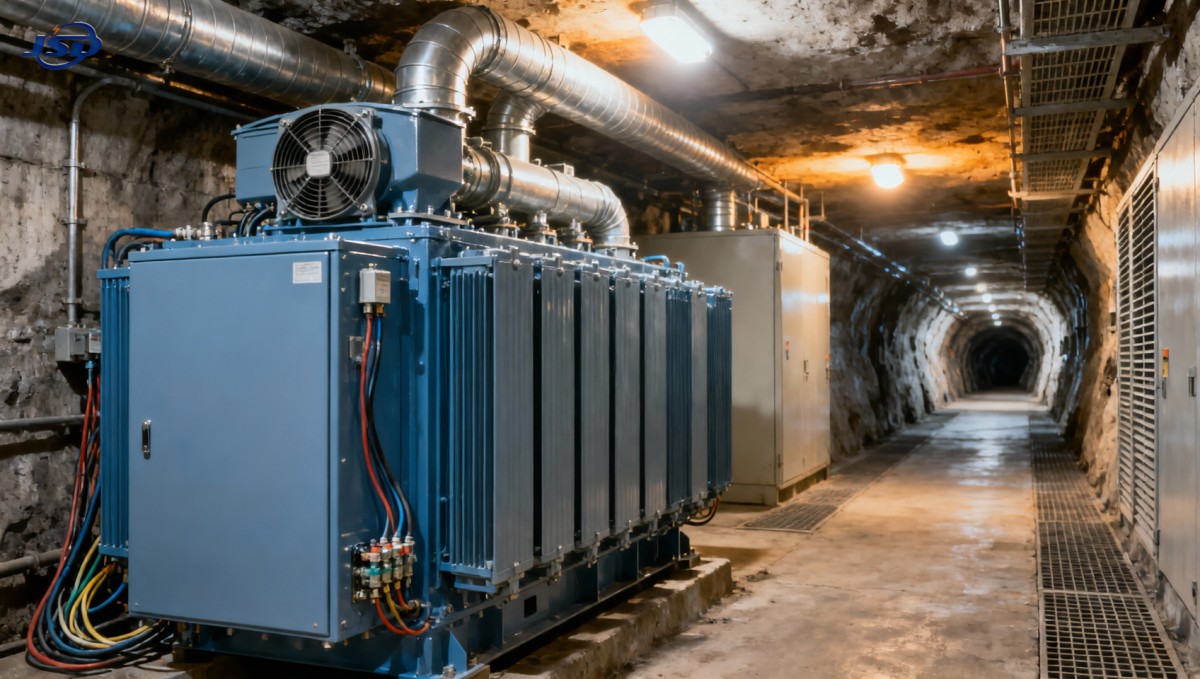
In an underground substation, warm air often has nowhere to go. Heat accumulates in transformer bays, electrical rooms, and enclosed containers, particularly when extraction fans are undersized, dampers are closed, filters are blocked, or new equipment has been installed nearby. A room that was acceptable during commissioning may become thermally inadequate after production expands.
Do not judge ventilation only by whether a fan is running. Confirm airflow direction, fan rotation, air volume, intake obstruction, discharge recirculation, and the temperature difference between the room inlet and the transformer area. A fan that pulls hot exhaust air back toward the radiators can make the situation worse.
Dust is equally important. Fine coal, mineral dust, and oily deposits form an insulating layer on radiators, tank fins, fan guards, and ventilation grilles. The transformer may still be electrically sound, but its ability to reject heat falls shift after shift.
3. Oil cooling is compromised
For an oil-filled unit, the oil is both dielectric medium and heat-transfer path. Low oil level, leaks, degraded oil, blocked radiator valves, restricted cooling passages, or a malfunctioning pump or fan system can all raise temperature. In naturally cooled designs, poor oil circulation can be harder to see because there may be no obvious rotating component failure.
Inspect the conservator or level indicator according to the transformer design, looking for trends rather than a single reading. Search for oil marks around gaskets, valves, bushings, radiator flanges, and cable-box interfaces. A small leak is not only a housekeeping concern; prolonged oil loss reduces cooling margin and may expose insulation to moisture and oxygen.
Oil test results should be interpreted as part of the thermal story. Moisture, oxidation, acidity, dielectric strength, dissolved gases, and particulate contamination can indicate whether overheating is aging the insulation system or whether an internal issue may be generating abnormal heat. Dark oil alone does not prove a fault, but ignoring a deteriorating trend can turn a manageable service intervention into a rewinding job.
4. Loose or damaged connections are creating resistance heat
External connections are among the most practical places to investigate because they can produce intense heat while leaving the bulk oil temperature only moderately elevated. Common trouble points include LV cable lugs, busbar joints, bushing terminals, neutral connections, earth bonds, and switchgear interfaces.
Thermal imaging is valuable here, provided the transformer is under meaningful load. Compare identical phases and similar joints, then confirm suspected findings with an approved isolation procedure and torque check. Never tighten a connection solely because it appears discolored: determine why it loosened. Vibration, incorrect lug selection, aluminum-to-copper interface problems, corrosion, inadequate contact area, and conductor creep can all recur after a simple retorque.
5. The insulation system is already paying for earlier overheating
Insulation aging is cumulative. Repeated high temperatures harden and weaken cellulose insulation, while thermal expansion and contraction stress leads, clamps, and joints. Eventually, maintenance personnel may encounter a transformer that overheats at a load it previously handled without difficulty. The immediate trigger may be a blocked radiator or a new load, but the reduced thermal resilience often reflects a longer history.
Warning signs include increasing oil acidity, declining dielectric strength, abnormal dissolved-gas trends, repeated alarms, unusual odor, unexplained oil darkening, or a temperature rise that is disproportionate to the load. These findings should prompt a planned engineering review, not just another fan replacement.
A practical troubleshooting sequence for after-sales teams
When the alarm occurs, preserve evidence before changing operating conditions if site safety permits. Record top-oil and winding temperatures, ambient temperature, load on each phase, input and output voltage, tap position, fan or pump status, and the time of the event. Ask what was running at that moment. The answer is often more useful than a generic “high temperature” notification.
- Make the condition safe. Follow the mine’s isolation, gas-monitoring, arc-flash, and access procedures. If temperature is approaching the manufacturer’s emergency limit, oil is leaking, protective devices have operated, or there is smoke or abnormal noise, remove the transformer from service as site procedures require.
- Compare load with temperature history. Determine whether the event follows a production peak, a motor-start sequence, or a sustained overload. Examine phase current and power quality where possible.
- Inspect the cooling path. Check room ventilation, fan operation, grilles, radiators, oil level, valves, leaks, and dust accumulation. Measure ambient temperature near the unit rather than elsewhere in the tunnel.
- Scan for local hot spots. Use infrared inspection on cable terminations, bushbars, bushings, cooling equipment, and accessible tank surfaces under load.
- Test before returning to normal duty. Depending on the event severity, this may include insulation resistance, winding resistance, turns-ratio testing, oil sampling, and dissolved gas analysis. Compare findings against baseline records whenever possible.
- Correct the cause and verify the result. After cleaning, retorquing, improving ventilation, adjusting load, or repairing cooling equipment, trend temperatures through a representative operating cycle. A successful repair should be demonstrated, not assumed.
Prevention is mostly about operating margin
The best prevention program treats thermal margin as something to manage deliberately. Keep a clean, dated record of load, ambient temperature, oil temperature, winding temperature where available, alarms, oil test results, and infrared findings. Over time, this creates a baseline for each installation. A transformer in a deep, hot section of a mine should not be expected to behave like an identical transformer on the surface.
Cleaning schedules should reflect actual dust conditions rather than a fixed calendar alone. In heavy-dust areas, inspect cooling fins, fan guards, ventilation filters, and room intakes more frequently. Confirm that access doors and partitions have not changed the intended airflow pattern. Where water spray, humidity, or corrosive contaminants are present, include enclosure seals, cable entries, and terminal corrosion in routine checks.
Load management also protects asset life. Stagger large motor starts where process conditions allow, assess harmonic levels after installing new VFD-driven equipment, and redistribute load if one phase consistently runs higher. If the mine’s future demand exceeds the transformer’s practical thermal capability, add capacity or revise the distribution arrangement instead of relying on repeated overload operation.
For replacement projects or new underground substations, selection should consider more than kVA and voltage. Enclosure protection, cable-entry design, cooling method, insulation fluid, expected ambient temperature, ventilation layout, harmonic duty, altitude where relevant, and maintainability all affect long-term performance. An oil-immersed transformer with an appropriately designed enclosure and cooling arrangement may offer stable service, but only when the site conditions are honestly accounted for in the specification.
For example, Jinshida Electric Power Technology supplies solutions such as the 20kV/0.4kV Oil-Immersed Power Distribution Transformer for industrial distribution applications, including mines. Its available capacity range of 50 kVA to 5000 kVA, IP65 protection option, and FR3 vegetable oil option may be relevant where dust, moisture protection, and environmental considerations influence equipment selection. Any overload allowance should be treated as a monitored, short-term operating provision rather than normal operating capacity; site engineers must confirm the applicable voltage class, cooling arrangement, protection scheme, and temperature limits for the specific installation.
Do not normalize repeated alarms
One of the costliest maintenance habits in mining is accepting a recurring high-temperature alarm because production has not yet stopped. Repeated alarms are not “normal mine conditions”; they are evidence that the transformer’s thermal margin is being consumed. Even if protection has not tripped, insulation may be aging faster than expected and a marginal connection may be worsening under every load cycle.
A dependable power distribution transformer for mining is supported by disciplined field observation: clean cooling surfaces, realistic load data, functioning ventilation, sound electrical joints, and test records that reveal deterioration before it becomes an outage. For after-sales teams, that discipline turns overheating from a late-stage emergency into a condition that can be diagnosed, corrected, and prevented with confidence.

Get a Quote
Regardless of whether you require general advice or specific support, we are happy to help you.
Send Us Your Inquiry Today

Jinshida Electric remains committed to contributing to global energy development through professional manufacturing and superior service.