





ONAN vs. ONAF Cooling for Three-Phase Transformers with Variable Loads
ONAN vs. ONAF Cooling for Three-Phase Transformers with Variable Loads
Selecting transformer cooling for variable loads requires more than comparing nameplate ratings. A three phase onan transformer offers passive cooling without fan power consumption, while ONAF adds forced-air cooling to support higher loading where the transformer is designed and rated for it. The right choice depends on load duration, ambient temperature, thermal limits, maintenance requirements, and lifecycle cost.
The practical question is not simply which cooling method provides more capacity. It is whether the transformer can carry the actual duty cycle, including unfavorable weather and equipment failures, without unacceptable insulation aging or operational restrictions. That distinction matters in industrial plants, distribution substations, and renewable energy projects where demand changes throughout the day.
What changes when fans are added?
ONAN means Oil Natural Air Natural. Heat moves from the windings into the insulating oil, which circulates naturally through the transformer and its cooling surfaces. Natural convection and radiation then release heat to the surrounding air. No powered oil pump or radiator fan is required for this cooling mode.
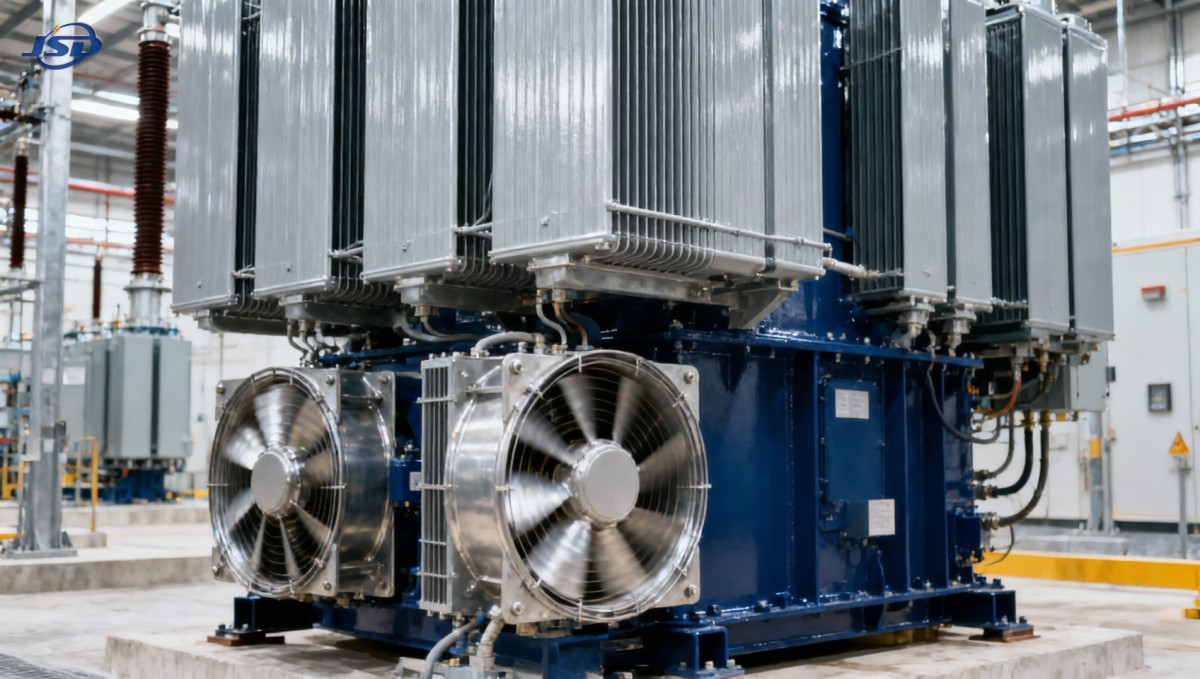
ONAF means Oil Natural Air Forced. Oil circulation remains natural, but fans increase airflow across the cooling surfaces. This improves heat rejection and can allow a higher continuous rating under specified conditions. Many transformers have separate ONAN and ONAF ratings, allowing natural cooling during lighter loading and fan-assisted operation when required.
However, installing fans does not automatically create an approved higher rating. Windings, internal connections, bushings, tap changers, radiators, and other current-carrying components must support the proposed duty. Ask for the declared ratings and supporting thermal verification rather than assuming a standard percentage increase.
A useful cooling arrangement drawing should show radiator positions, fan airflow, maintenance access, and clearance from nearby walls. These details can explain why a design performs differently in an open substation than inside a restricted enclosure.
Read the load profile before choosing the cooling mode
Maximum demand is only one part of the specification. Two sites with the same peak apparent power may need different transformers if one reaches that peak briefly and the other sustains it throughout a production shift. The initial thermal condition matters too: a peak following several hours of heavy loading is different from a peak after an overnight cooling period.
Collect time-series load data rather than relying only on monthly energy bills. Include seasonal variations, planned expansion, motor starting, power factor, phase imbalance, and harmonic content where relevant. Transformer loading is evaluated in current and apparent power; a demand figure in kW alone can conceal the effect of reactive power.
For illustration, a short production surge after a lightly loaded period may be manageable through thermal inertia, subject to a validated loading assessment. A repeated afternoon plateau during hot weather may justify ONAF operation or a larger ONAN unit. Neither conclusion can be reached from peak demand alone.
Renewable energy installations add another complication. Solar export may peak when ambient temperature is high, while wind generation can produce extended high-output periods. Bidirectional power flow is not itself a cooling classification issue, but the resulting current profile, converter harmonics, and installation conditions belong in the thermal evaluation.
Distinguish rated capacity from temporary overload
An ONAF rating is not the same as an emergency overload allowance. The former is a declared operating rating under specified conditions; the latter requires assessment of temperature, duration, prior loading, and acceptable aging. IEC 60076-7 provides loading guidance for mineral-oil-immersed transformers, while IEEE C57.91 is another relevant reference where applicable. Use the standard, edition, and insulation system required by the project.
Top-oil temperature is useful, but it does not fully describe winding hot-spot temperature. A thermal model or suitable monitoring arrangement should address both. Repeated overloads that appear harmless at the tank thermometer can still consume insulation life.
The site can outweigh the nameplate comparison
Ambient temperature must be defined at the cooling-air inlet, not taken blindly from a regional weather average. Nearby equipment, direct solar exposure, restricted ventilation, and recirculated hot air can make the transformer’s immediate environment more demanding. Altitude also affects cooling and insulation requirements and should be declared during specification.
ONAN avoids dependence on fan operation, but it still needs an effective path for heat to leave the installation. ONAF cannot compensate indefinitely for poor room ventilation: fans moving already-heated air across radiators may provide less benefit than expected.
Dust, salt contamination, and corrosive atmospheres affect radiator condition, fan reliability, and maintenance frequency. Where nighttime noise limits are important, assess transformer sound and fan contribution together. A cooling solution that meets thermal requirements but violates site acoustic constraints is not a complete solution.
Compare the operating consequences, not just purchase price
Fan electricity is only one lifecycle cost. Compare guaranteed no-load and load losses at consistent reference conditions, then evaluate annual energy losses against the expected duty cycle. Winding resistive losses increase approximately with current squared at a given resistance, so operating a smaller transformer heavily may offset savings in initial cost.
A larger ONAN transformer may reduce loading stress but can involve higher purchase cost, more space, and different no-load losses. A dual-rated ONAN/ONAF unit may offer flexibility, yet introduces auxiliary equipment and maintenance. The better economic choice depends on actual loss guarantees, fan operating hours, electricity cost, and outage consequences—not cooling labels alone.
Specify what happens when forced cooling is unavailable
For a critical installation, ask a direct question: what load can remain connected after loss of the fan supply? The transformer’s ONAN rating is the reference point, but the transition also depends on its existing temperature and the speed of load reduction. Loss of fans does not mean instant failure, nor does thermal inertia justify indefinite operation above the remaining cooling capability.
- Define fan stages, start and stop settings, hysteresis, and manual test functions.
- Monitor auxiliary supply health and actual fan operation, not only the start command.
- Agree alarm, load-shedding, and trip logic with the protection and process teams.
- Confirm whether partial fan loss has a documented reduced rating.
- Check fan replacement access, spare parts, and restoration time.
Redundant fans help only when the arrangement is engineered and verified for that purpose. Multiple fans sharing one vulnerable supply or control circuit may still have a common failure point. This deserves particular attention where operators plan to use the ONAF rating for normal daily production.
Sometimes the better answer is to reshape the peak
Where high demand is brief or temporary, load scheduling or energy storage can be evaluated alongside transformer cooling upgrades. Storage connected on the load side may reduce transformer demand during discharge, provided the electrical arrangement and controls support that function. Charging must be scheduled carefully, or it simply creates another peak.
For temporary construction, emergency support, or selected peak-management duties, the 100kW/215kWh Mobile Trailer Energy Storage System provides a trailer-mounted LiFePO4 platform with a 100kW PCS and 400V AC output. Its BMS and EMS provide battery supervision and energy management, but site-specific transformer demand control and protection coordination still need confirmation.
The stated energy capacity is not the same as usable AC energy. Available duration depends on state-of-charge limits, conversion losses, temperature, and operating reserves. Its intelligent air cooling is also separate from transformer ONAN or ONAF cooling. Storage cannot replace a required continuous transformer rating unless its power, energy, recharge window, and availability satisfy the complete duty.
Turn the comparison into an engineering specification
Before accepting a quotation, request declared ONAN and ONAF ratings, applicable ambient and altitude conditions, temperature-rise limits, loss guarantees, fan power, noise data, cooling drawings, and the proposed thermal verification. Include the load profile and any harmonic assessment. Confirm which tests are included, which documents accompany delivery, and whether future fan installation is genuinely supported by the original design.
Jinshida Electric Power Technology Co., Ltd. focuses on the R&D, manufacturing, and application of transmission and distribution equipment for grid, industrial, renewable energy, and infrastructure projects. In a cooling evaluation, that scope is relevant when transformer design, site integration, manufacturing quality, and service requirements are reviewed together. The useful deliverable is a documented match between the proposed equipment and the operating duty, not a generic promise of reliability.
Choose a three phase onan transformer when natural cooling covers the required duty with an acceptable thermal margin and simpler operation is valuable. Choose a properly rated ONAN/ONAF design when fan-assisted capacity solves a defined loading requirement and the site can maintain it. If the decision remains close, compare both proposals against the hottest credible operating period and the cooling-failure scenario; those checks often reveal the more defensible choice.

Get a Quote
Regardless of whether you require general advice or specific support, we are happy to help you.
Send Us Your Inquiry Today

Jinshida Electric remains committed to contributing to global energy development through professional manufacturing and superior service.