





LiFePO4 Battery Energy Storage Systems: When Are They Better Than Other Chemistries?
It usually starts with a practical argument, not a chemistry lesson. A project team needs storage for a substation support function, a renewable smoothing application, or backup power inside an industrial power system. Someone asks for “the best battery,” and the discussion quickly turns into a comparison sheet full of energy density, cycle life, cost, response speed, and safety notes. On paper, several options can appear acceptable. In actual deployment, the wrong choice can mean more cooling design, tighter fire protection requirements, shorter replacement intervals, or operating limits that only become obvious after commissioning.
That is why many evaluators spend more time on use conditions than on headline battery specifications. For power and industrial applications, the question is often not whether lithium-based storage is useful, but when lifepo4 battery energy storage systems are the better fit than other chemistries. The answer usually becomes clearer when you look at duty cycle, thermal environment, maintenance expectations, and the consequences of abnormal operation rather than focusing only on nameplate capacity.
Where selection mistakes usually happen
A common mistake is to compare storage technologies as if every project had the same operating pattern. In reality, a battery used for short-duration peak shaving behaves differently from one supporting feeder stability, black-start preparation, PV ramp control, or process continuity in a factory. Another mistake is treating battery choice separately from the rest of the electrical system. In transformer and distribution work, storage is never fully isolated from switchgear, protection, thermal design, load behavior, and power quality targets.
Evaluators also run into trouble when they assume a chemistry that looks stronger in one category must be stronger overall. A battery with higher energy density may still be less attractive if the installation is space-tolerant but safety-sensitive. A chemistry with low upfront appeal may become more reasonable when long cycle life, reduced maintenance interruptions, and simpler thermal management are considered together.
A more useful way to compare chemistries
When choosing among LiFePO4, other lithium-ion variants, lead-acid, sodium-based systems, or flow batteries, it helps to stop asking which chemistry is “best” in general. A better question is: which chemistry creates the fewest design compromises for this duty?
For many technical evaluations, the comparison comes down to six practical areas:
- How the battery behaves under heat, overload, and fault-adjacent conditions
- How often it will cycle, and at what depth of discharge
- Whether available space is limited by building, container, or yard layout
- How complex the cooling, monitoring, and maintenance strategy will become
- How tightly it must integrate with distribution equipment and control logic
- What operational interruptions are acceptable over the service life
On that basis, LiFePO4 often moves ahead when the project team values predictable behavior over aggressive energy density targets.
When LiFePO4 clearly becomes the safer decision
If the installation environment is electrically complex and operationally conservative, LiFePO4 deserves serious attention. One reason is thermal stability. In projects where storage sits near critical distribution assets, inside industrial electrical rooms, or in enclosed BESS layouts where heat management matters, lower thermal sensitivity can simplify design decisions. It does not remove the need for protection, battery management, or ventilation planning, but it can reduce how narrowly the whole system must be tuned.
This matters more than people expect. Once a storage project moves from concept into equipment arrangement, cable routing, transformer loading review, and protection coordination, the chemistry choice starts affecting other engineering decisions. If a battery demands stricter thermal controls or more conservative operating margins, those effects can spread beyond the battery enclosure itself.
In that context, lifepo4 battery energy storage systems are often preferred where project owners care about stable long-term operation and lower sensitivity to thermal stress. That preference becomes stronger in sites where maintenance access is limited, where operators do not want frequent intervention, or where the consequence of a shutdown is operationally inconvenient even if not catastrophic.
Cycle-heavy applications are often where the difference shows up
Some projects do not use storage occasionally; they work the battery every day. Renewable smoothing, load shifting between tariff periods, repeated short discharge events, and certain process support applications can all create high cycling demands. In these situations, cycle life is not a secondary feature. It is a major economic and operational factor.
LiFePO4 is often better suited when repeated cycling is expected over a long period and the owner wants to avoid early replacement planning. This does not mean every cycle-duty project must use it. Flow batteries, for example, may still be attractive for some long-duration and large-scale use cases, and other lithium chemistries may be considered if space is extremely constrained. But for many medium-duration, frequently cycled systems, LiFePO4 reaches a practical balance between usable life, system complexity, and operating confidence.
That balance matters in distribution-related projects because battery replacement is rarely a standalone event. It can affect outage planning, controls recommissioning, protection review, and service continuity. A chemistry that reduces the frequency of those disruptions may be worth more than a narrower comparison of initial capacity suggests.
When another chemistry may be the better choice
LiFePO4 is not automatically the right answer. If the project is heavily constrained by footprint or weight, a higher energy-density lithium chemistry may deserve consideration. That is especially true where installation volume is the primary bottleneck and the design team has the resources to manage the added thermal and safety complexity appropriately.
For low-cycle standby applications with tight capital limits, lead-acid may still remain in the discussion, particularly where the operating profile is simple and replacement logistics are acceptable. For very long discharge durations, some non-lithium technologies can become more attractive depending on site configuration and system goals. In other words, LiFePO4 wins many real-world evaluations because its compromises are manageable, not because it dominates every single technical category.
Questions that usually decide the issue faster
When teams get stuck between chemistry options, the debate often improves if they move away from general claims and ask a few pointed engineering questions.
How forgiving must the system be?
If the storage system is supporting infrastructure where abnormal conditions, ambient temperature variation, or operator response time must all be considered carefully, a more stable chemistry has obvious value. LiFePO4 is often selected because evaluators prefer a battery that is less demanding in normal operation and less uncomfortable to integrate near important electrical assets.
Is the battery replacing a process problem or supporting one?
Some batteries are expected to handle irregular load behavior, intermittent renewable output, or frequent dispatch commands. If the operating profile is not gentle, a chemistry known for durability and repeatable cycling may reduce future headaches.
What happens when maintenance is delayed?
In ideal planning, every inspection and environmental control action happens on time. In real facilities, maintenance windows move, access gets delayed, and operations take priority. A battery chemistry that tolerates practical operating conditions without becoming fragile can be easier to live with over the long term.
Integration with power equipment changes the answer
Storage evaluations in the transformer sector rarely end at the battery cabinet. Voltage level, conversion equipment, feeder arrangement, and step-up or step-down requirements all affect the final architecture. A battery may be appropriate in isolation but awkward in the wider electrical chain.
For that reason, chemistry selection should be reviewed alongside the distribution interface. In some projects, upstream and downstream equipment choices influence the acceptable charge-discharge profile, harmonic management strategy, and transient response expectations. Where storage is supporting medium-voltage distribution or tied to broader network upgrades, system compatibility deserves the same attention as cell chemistry.
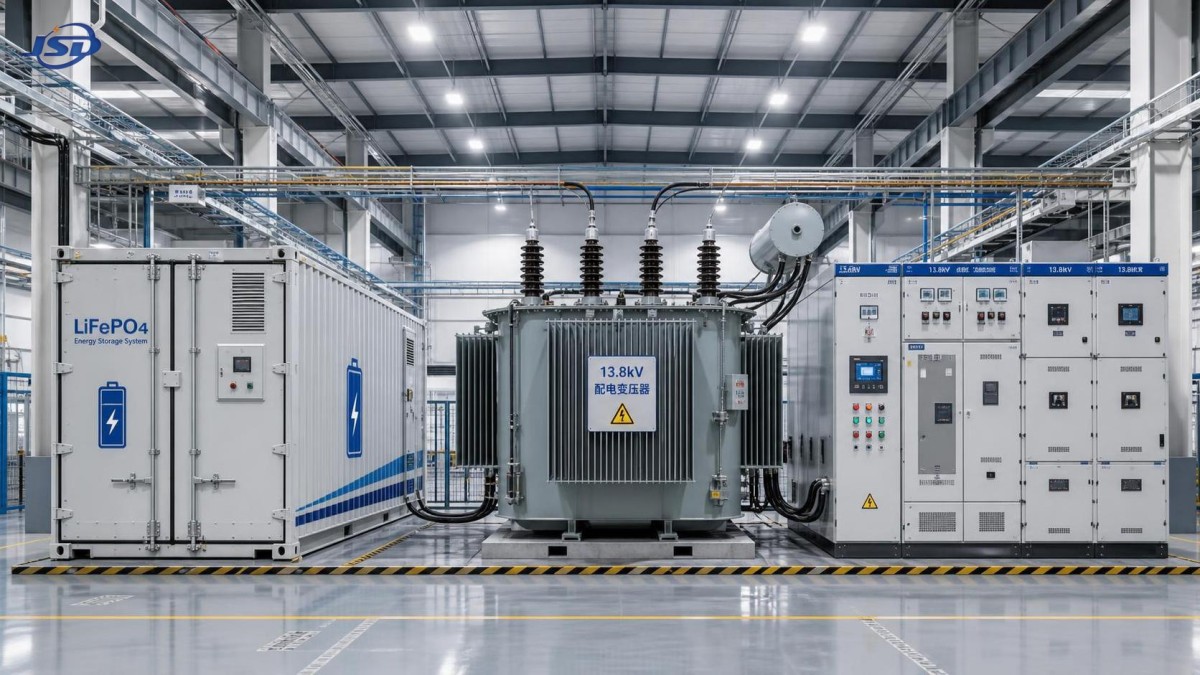
In practical planning, teams may be reviewing storage placement together with related equipment such as a 13.8kV Distribution Transformer. That does not determine the battery chemistry by itself, but it is a reminder that storage should be selected as part of an electrical system, not as a standalone procurement item.
Signs LiFePO4 is probably the better fit
You are often leaning in the right direction with LiFePO4 if several of these conditions are present at once: the project expects regular cycling, the installation environment makes thermal stability important, the owner wants low-maintenance operation, and the system supports loads or assets where reliability is valued more than squeezing the highest possible energy into the smallest footprint.
It is also a strong candidate when the team wants a chemistry with a broad track record in stationary storage evaluation because that usually makes design reviews, operations planning, and risk discussion more straightforward. In technical selection work, familiarity should not replace engineering judgment, but it does help reduce avoidable uncertainty.
A practical review process before making the call
If you are comparing storage chemistries now, try reviewing them in the order the project will actually experience them.
Start with the operating profile. Define whether the battery is mostly standby, daily cycling, fast-response support, or mixed duty. Then look at environmental conditions, including enclosure type, ventilation approach, and expected temperature variation. After that, review how the battery interacts with protection philosophy, conversion equipment, and distribution assets. Only then does it make sense to compare size, replacement expectations, and maintenance burden.
This order matters because it prevents a common trap: choosing a chemistry based on an attractive specification and then spending the rest of the design process compensating for its weaknesses.
It is also worth asking whether the site team prefers a system that is optimized tightly around peak performance or one that is easier to operate with fewer special conditions. In many industrial and utility-adjacent applications, the second option is more practical. That is one reason lifepo4 battery energy storage systems continue to be selected so often for stationary power uses.
Where the evaluation usually lands
For technical decision-making, LiFePO4 tends to be the better choice when safety margin, cycle durability, thermal behavior, and operational simplicity matter more than maximum compactness. It is especially persuasive in projects where storage has to work reliably inside a broader distribution environment rather than simply deliver the highest theoretical energy density.
Other chemistries still have valid use cases, and some projects will justify them. But if your evaluation keeps returning to concerns about heat, maintenance burden, repeated cycling, and integration risk, LiFePO4 is often not the flashy option so much as the sensible one. And in power infrastructure work, the sensible option is frequently the one that causes fewer problems after the specification meeting is over.

Get a Quote
Regardless of whether you require general advice or specific support, we are happy to help you.
Send Us Your Inquiry Today

Jinshida Electric remains committed to contributing to global energy development through professional manufacturing and superior service.