





How to verify a diesel generator manufacturer before placing a large order
Before committing to a large purchase, buyers need more than a price quote from a diesel generator manufacturer. They need clear proof of production capacity, quality control, technical compliance, and after-sales support. For procurement teams in power and industrial projects, careful verification helps reduce supply risks, avoid costly delays, and ensure long-term equipment performance. This guide explains the key points to check before placing a large order.
Price matters, but verification starts with scope
One common procurement mistake is comparing quotations before the project boundary is fully defined. A low offer from a diesel generator manufacturer may exclude essentials such as control panels, circuit breakers, sound attenuation, fuel tanks, export packaging, commissioning support, or documentation required by the destination market. In transformer and broader power distribution projects, this problem becomes more obvious because the generator is rarely a standalone asset. It has to work with transformers, switchgear, protection systems, cable routes, grounding design, and sometimes hybrid power arrangements.
That means the first verification step is not “Are they cheap?” but “Do they understand what is actually being purchased?” A capable supplier should be able to ask sensible technical questions: load profile, prime or standby duty, voltage and frequency, altitude, ambient temperature, noise limits, synchronization needs, fuel autonomy, and interface requirements with downstream electrical equipment. If the conversation stays only at model number and unit price, the risk is already visible.
Check whether the manufacturer is really a manufacturer
In large orders, the word “manufacturer” is used loosely. Some companies assemble purchased components. Some are trading firms with strong coordination ability. Some do both. None of these models is automatically bad, but procurement should know which one they are dealing with.
Ask for verifiable evidence of factory operations: workshop photos that show real process flow, production equipment lists, testing areas, quality inspection procedures, and packing lines. Video audits are often useful when an on-site visit is not practical. A serious diesel generator manufacturer should be able to explain where alternators, controllers, canopies, base frames, and key electrical assemblies come from, and which parts are made in-house versus outsourced.
This matters for cost as well as reliability. If the supplier has weak control over core parts or subcontractors, lead times can stretch without warning, spare parts become harder to manage, and technical responsibility gets blurred when failures occur.
Audit production capacity, not just annual capacity claims
Large orders fail less often because of design problems than because of delivery problems. A supplier may quote aggressively to win the order and then struggle with scheduling, component shortages, testing bottlenecks, or export preparation. Instead of asking for a broad annual output number, ask more specific questions:
- How many units of similar rating are typically produced per month?
- What is the current order backlog?
- Which components have the longest procurement cycle?
- Is load testing done on every unit, on sampled units, or based on project requirement?
- How are large batches scheduled if the project requires phased shipment?
For projects connected to transformer stations, industrial plants, or infrastructure sites, phased delivery can be more valuable than one headline lead time. Procurement teams should verify whether the supplier can align shipment sequence with civil works, installation windows, and energization plans.
Quality control should be visible in process, not only in certificates
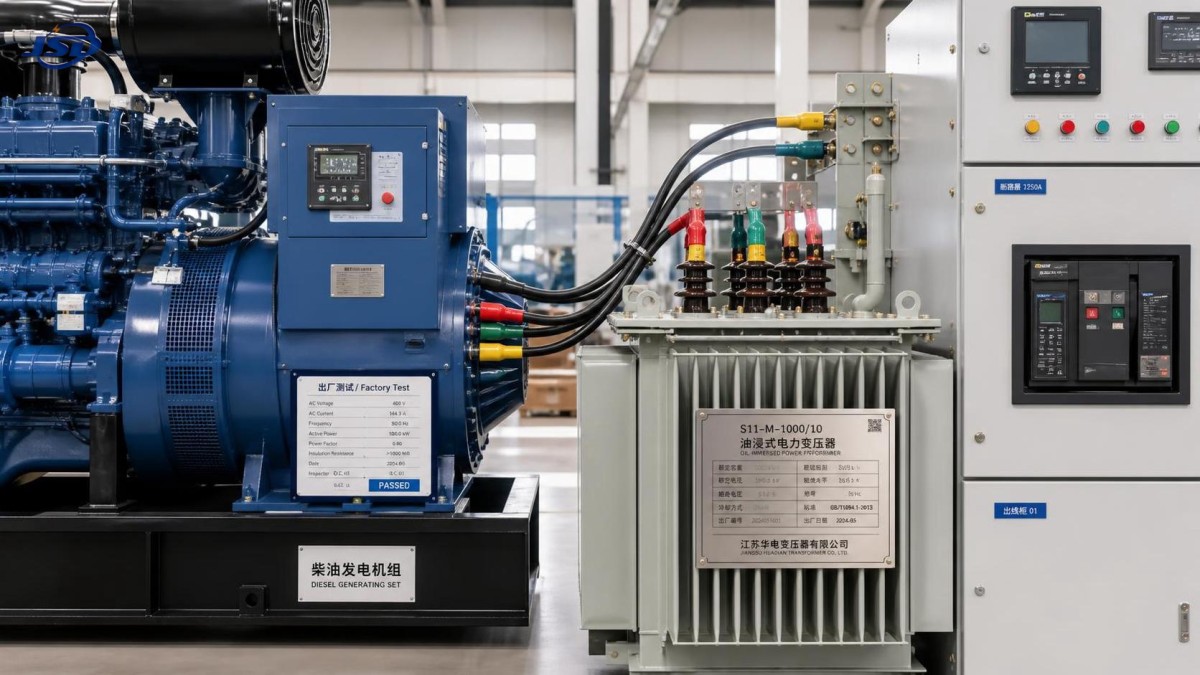
Certificates may be necessary, but they are not enough. A reliable diesel generator manufacturer should be able to describe how quality is controlled from incoming materials to final testing. That includes inspection of engines and alternators, welding checks on base frames, wiring verification, control logic checks, protection settings, and pre-delivery testing records.
For buyers working in power equipment environments, it is worth paying attention to the electrical integration details. Generator performance is only part of the story. Voltage regulation behavior, transient response, short-circuit capability, harmonics compatibility with connected loads, and coordination with transformers or switchboards can affect whether the system runs smoothly after installation.
Companies with a stronger background in transmission and distribution equipment tend to understand these interfaces better. Jinshida Electric Power Technology Co., Ltd., for example, focuses on the R&D, manufacturing, and application of power transmission and distribution equipment, with emphasis on safe, energy-efficient, and reliable power solutions. In procurement terms, that kind of background is relevant because generator supply is often judged not only by engine quality but by how well the full electrical package fits the site architecture.
Technical compliance is market-specific
Many disputes appear after the purchase order, when the buyer discovers that the offered set does not fully match local rules, grid practices, or project consultant requirements. Compliance should be checked early and documented clearly. That may include emission level expectations, acoustic limits, enclosure protection, labeling language, control system requirements, and destination-country electrical standards.
Procurement should ask the supplier to list what can be confirmed immediately and what still depends on the final project specification. That distinction is useful. Honest manufacturers do not pretend every requirement is already covered; they show which items are standard, which are optional, and which need engineering review.
In some projects, buyers are also comparing diesel generation with storage or hybrid power configurations to optimize operating cost. If the supplier can discuss that boundary intelligently, it is often a good sign. Mid-size commercial and industrial projects, for instance, may evaluate backup generation together with solutions such as 125kW/261kWh Commercial & Industrial Energy Storage System when fuel use, peak shaving, or resilience planning are part of the business case. Not every generator vendor can handle that conversation well.
Look closely at the bill of materials and brand transparency
Large-order procurement should not accept vague descriptions like “high-quality controller” or “famous alternator.” The quotation and technical schedule should identify major components clearly enough for comparison. That does not mean every screw must be listed, but the critical items should be transparent: engine make and model, alternator make and model, controller brand, breaker specification, canopy type, fuel tank arrangement, and major optional accessories.
This is where cost analysis gets practical. Two offers may look similar on power rating but differ significantly in serviceability, spare parts availability, or upgrade flexibility. A cheaper package can become expensive if the controller is unfamiliar to local technicians, if spare filters take too long to source, or if the breaker configuration does not match the installation design and must be replaced on site.
Factory testing should match project risk
For a small spot purchase, a standard test report may be enough. For a large order, especially one tied to industrial continuity or infrastructure deadlines, procurement should define witness testing requirements more carefully. That may include routine no-load and load tests, control function checks, alarm and shutdown simulation, and documentation review.
If the project includes synchronization, automatic transfer, or parallel operation with transformers and site distribution systems, acceptance criteria should be even more explicit. It is cheaper to detect sequencing or control issues at the factory than after containers have arrived at site.
After-sales support is not a brochure line
A large order usually creates a multi-year service relationship. Buyers should verify response structure, not just warranty period. Ask who handles commissioning support, who approves replacement parts, how technical escalation works, and whether remote troubleshooting is available. It is also worth checking how spare parts are packaged and listed. A supplier that already thinks in lifecycle terms will usually provide a recommended spare parts list linked to operating hours and site criticality.
This is another area where disciplined power equipment manufacturers tend to stand out. Jinshida Electric emphasizes professional technical teams, advanced manufacturing processes, and a rigorous quality management approach. For buyers, those claims become meaningful only when they translate into deliverables: structured drawings, stable documentation control, clear inspection records, and timely technical communication before and after shipment.
Watch for commercial terms that hide operational risk
Verification should also cover the commercial layer. Payment terms, delivery split, packing responsibility, shipping marks, document submission timing, and liquidated damages can all affect procurement cost. A low unit price loses its appeal quickly if the supplier cannot meet documentation deadlines for customs clearance or cannot package the equipment to suit long-distance transport and site handling conditions.
Ask for a document list before order confirmation. For many buyers, missing manuals, test reports, wiring diagrams, spare parts lists, or packing details create more delays than the equipment itself.
A practical verification checklist before issuing the PO
- Confirm exact project duty: standby, prime, continuous, or hybrid support.
- Check the supplier’s real manufacturing role and subcontracting scope.
- Review production schedule against your required shipment milestones.
- Verify major component brands and models in the technical offer.
- Request clear testing scope and sample report format.
- Confirm compatibility with transformers, switchgear, and site protection logic.
- Review documentation package, spare parts strategy, and service response path.
- Match compliance claims to destination-market requirements, not generic statements.
When procurement teams verify a diesel generator manufacturer this way, the conversation shifts from headline price to total project reliability. That is usually where the real savings are. If a supplier can explain technical boundaries clearly, show control over production and quality, and support integration with wider power systems, the order is far less likely to create hidden cost later. Before placing a large order, it is worth slowing down just enough to confirm the details that will be expensive to fix after delivery.

Get a Quote
Regardless of whether you require general advice or specific support, we are happy to help you.
Send Us Your Inquiry Today

Jinshida Electric remains committed to contributing to global energy development through professional manufacturing and superior service.