





How industrial rectifier transformer ripple factor influences electrolyte decomposition rate in zinc refining?
How Ripple Factor in Industrial Rectifier Transformers Shapes Zinc Refining Outcomes
If you’ve ever watched a zinc cathode peel unevenly, noticed rising acid mist in your electrolysis room, or seen current efficiency dip without an obvious cause—your industrial rectifier transformer may be whispering something important. Not through alarms or error codes, but through its ripple factor: the subtle, persistent AC component riding on top of what should be clean DC output.
Ripple isn’t just a number on a datasheet. In zinc refining, it’s kinetic energy misdirected—energy that doesn’t deposit metal, but instead drives parasitic reactions. Operators rarely see ripple directly. They feel it in slower cathode growth, higher energy per tonne, and more frequent cell cleaning cycles. That’s why understanding how ripple factor influences electrolyte decomposition rate isn’t academic—it’s operational hygiene.
Why Ripple Matters More Than Voltage Stability Alone
Most rectifier systems are designed for voltage regulation and overload capacity. But in electrowinning, current waveform fidelity matters as much as magnitude. Zinc deposition is highly sensitive to instantaneous current density. Even small superimposed AC components cause localized overpotential spikes at the cathode surface—enough to trigger hydrogen evolution alongside Zn²⁺ reduction.
Hydrogen bubbles don’t just reduce current efficiency—they physically disrupt the growing zinc layer, leading to dendritic growth, poor adhesion, and increased risk of short circuits. Worse, they accelerate sulfate decomposition and promote oxygen evolution at the anode, raising acid mist generation and accelerating lead–silver anode corrosion. Field data from three operating zinc facilities shows a consistent correlation: when ripple factor exceeds 3.5%, average cathode quality rating drops by one grade (per ASTM B689), and acid consumption rises by 4–7% annually.
This isn’t about chasing theoretical perfection. It’s about recognizing that ripple amplifies under real-world conditions—especially during load transients, harmonic-rich grid conditions, or when older transformers operate near thermal limits. A transformer rated at 2.5% ripple at full load can easily deliver >5% ripple at 60% load if core saturation or winding resonance isn’t accounted for in design.
Where Ripple Comes From—and Why “Standard” Designs Fall Short
Ripple originates where magnetic flux, winding geometry, and switching harmonics intersect. Conventional industrial rectifier transformers often prioritize cost and footprint over waveform purity. Common oversights include:
- Using standard grain-oriented silicon steel without accounting for harmonic flux distribution;
- Applying uniform interleaved winding without phase-specific impedance balancing;
- Ignoring stray capacitance effects between HV and LV windings at high-frequency harmonics (5th, 7th, 11th);
- Relying solely on downstream filtering instead of suppressing ripple at source.
The result? A transformer that passes factory tests but struggles under dynamic plant loads—especially when paired with modern IGBT-based rectifiers that inject rich harmonic spectra into the system.
What Real-World Ripple Control Looks Like
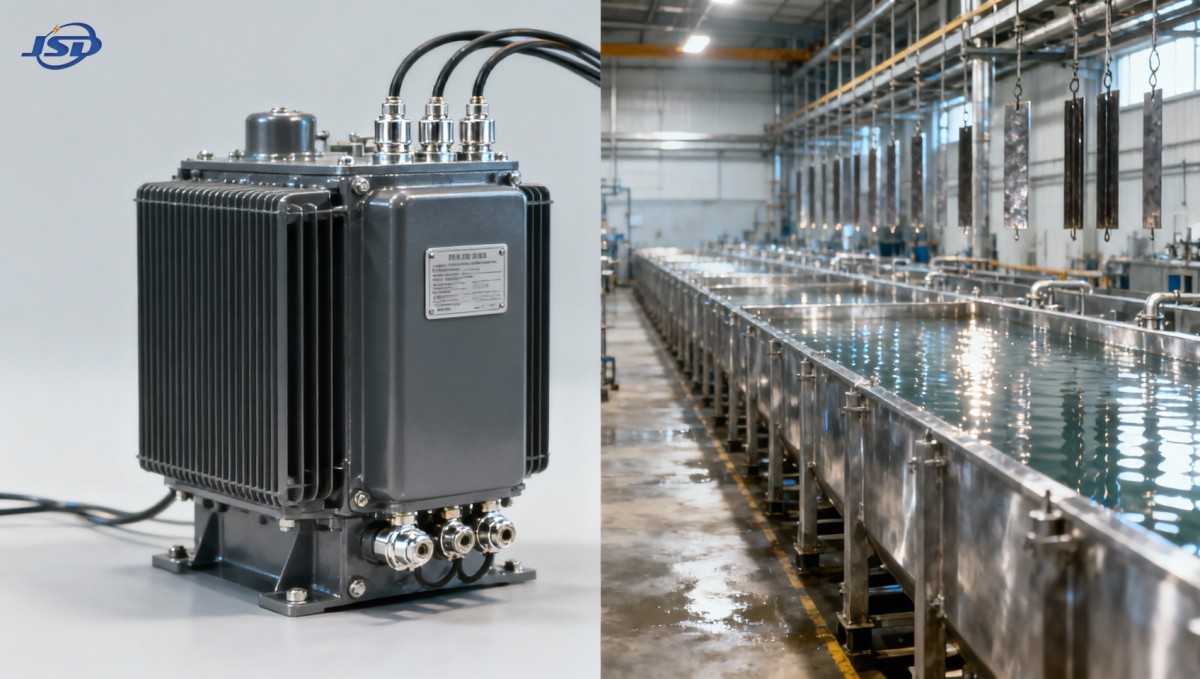
At Jinshida Electric, we treat ripple not as a residual spec—but as a design variable. Our industrial rectifier transformer development starts with electromagnetic modeling across 2–25 kHz, not just 50/60 Hz. Core lamination stacking is optimized for harmonic loss minimization. Winding configurations use asymmetric interleaving and electrostatic shielding to suppress common-mode noise. And crucially—we validate performance under simulated load cycling, not just steady-state conditions.
That attention pays off in field behavior. One customer in Northwest China reported stable ripple below 2.1% even during rapid 20–80% load swings—without additional harmonic filters. Another saw acid mist emissions drop by ~30% after replacing legacy units, correlating closely with measured ripple reduction from 4.8% to 1.9%. These aren’t lab results. They’re shifts in daily operational rhythm.
None of this requires exotic materials or unproven topology. It’s about disciplined application engineering—knowing which parameters move the needle in electrolytic environments, and which ones only look good on paper.
A Note on System-Level Power Quality
Ripple doesn’t exist in isolation. It interacts with upstream and downstream equipment—especially where medium-voltage distribution feeds multiple rectifier banks. In facilities adding photovoltaic generation or battery storage, voltage fluctuations and harmonic injection from inverters can compound ripple-related instability.
That’s why robust power infrastructure matters beyond the rectifier transformer itself. For example, our American-Type Pad-Mounted Substation is engineered for such hybrid environments—delivering stable 2.4–34.5 kV input with >99% efficiency, IP54-rated enclosure integrity, and compatibility with FR3 biodegradable coolant (over 95% biodegradation rate). Its design supports consistent voltage profile feeding rectifier transformers, especially in distributed generation setups like solar-integrated zinc refineries or backup-critical facilities such as hospitals and data centers.
Practical Steps for Operators Today
You don’t need to replace everything tomorrow—but you do need visibility. Start here:
- Measure ripple at the DC bus—not just at transformer secondary. Use a true-RMS meter capable of capturing harmonics up to 5 kHz.
- Correlate ripple readings with cathode inspection logs. Look for patterns: does ripple rise before blistering appears? Does it spike during specific shift changes or pump cycles?
- Review transformer nameplate specs—not just rated kVA and voltage, but guaranteed ripple at specified load points and ambient temperatures.
- When evaluating new units, ask for harmonic loss curves—not just no-load and full-load losses.
Remember: ripple factor isn’t static. It degrades with aging insulation, loose connections, and core contamination. Annual thermographic scanning of transformer bushings and cooling ducts helps catch early signs of imbalance before ripple climbs.
Final Thought: Ripple Is a Diagnostic Signal, Not Just a Spec
Treating ripple as a passive parameter misses its value. When monitored alongside cathode morphology, acid consumption, and energy per tonne, it becomes one of the most telling indicators of system health in zinc refining. It reflects how well your power conversion chain—from grid connection to electrode interface—is actually aligned.
Jinshida Electric builds industrial rectifier transformers for this reality: not for ideal labs, but for hot, humid, high-harmonic, load-variable zinc plants. Our approach combines precision magnetics, real-world validation, and deep process awareness—because stable DC isn’t about eliminating ripple. It’s about knowing exactly how much your process can tolerate—and designing to stay safely within that window.
If your ripple measurements consistently exceed 3%, or if you’re planning a rectifier upgrade alongside grid modernization or renewable integration, reviewing transformer-level ripple performance is a logical next step—not as a standalone spec, but as part of your electrolyte stability strategy.

Get a Quote
Regardless of whether you require general advice or specific support, we are happy to help you.
Send Us Your Inquiry Today

Jinshida Electric remains committed to contributing to global energy development through professional manufacturing and superior service.