





Do electrolysis rectifier transformer secondary windings require copper vs aluminum material selection based on current density?
When designing an electrolysis rectifier transformer—critical for aluminum, chlorine, and other electrochemical production processes—the choice between copper and aluminum for secondary windings directly impacts thermal performance, efficiency, and long-term reliability. This article examines how current density requirements, skin effect, mechanical strength, and lifecycle cost influence material selection in high-current, low-voltage secondary windings.
Current Density Is Not a Standalone Criterion
While current density (A/mm²) is often cited as the primary metric for conductor sizing, it misleads when applied in isolation to electrolysis rectifier transformer secondary windings. These windings typically operate at voltages below 100 V and currents exceeding 50 kA—conditions where ampacity depends less on bulk resistivity and more on surface current distribution, cooling interface efficiency, and mechanical stability under electromagnetic forces. For example, at 60 Hz, the skin depth in copper is ~8.5 mm; in aluminum, ~10.7 mm. At DC or near-DC output from rectifiers, skin effect vanishes—but harmonic content from thyristor or IGBT-based rectification introduces significant 5th, 7th, and 11th harmonics. In such cases, effective AC resistance rises disproportionately in aluminum due to its lower conductivity (≈61% IACS vs. copper’s 100% IACS), increasing localized heating at weld joints and busbar interfaces where thermal expansion mismatch also accelerates fatigue.
Mechanical Integrity Under Short-Circuit Forces
Electrolysis transformers experience severe transient forces during rectifier faults or commutation failures. The peak electrodynamic force scales with I², and while aluminum has lower tensile strength (~90 MPa for annealed 1350 alloy vs. ~220 MPa for soft-annealed ETP copper), its higher coefficient of thermal expansion (23.1 × 10⁻⁶/K vs. 16.5 × 10⁻⁶/K) compounds stress at clamping points and terminal connections. Repeated thermal cycling—common during plant load ramping—induces micro-slip at copper-aluminum transition joints unless interfacial plating (e.g., tin or silver) and controlled bolt torque are rigorously specified. Field data from multi-year operation in chlor-alkali facilities show that aluminum-wound secondaries exhibit 2.3× higher incidence of hot-spot development (>120°C rise above ambient) at tap changers and neutral links compared to equivalent copper designs—even when initial current density is held identical at 1.8 A/mm².
Thermal Interface Limitations
Cooling in low-voltage windings relies heavily on conduction through insulation layers and contact with structural supports. Aluminum’s lower thermal conductivity (237 W/m·K vs. 401 W/m·K for copper) reduces heat transfer efficiency across epoxy-mica barriers or resin-impregnated pressboard. This becomes decisive when forced-air cooling is constrained by space or noise limits—as in retrofit installations within existing electrolysis cell rooms. Thermal imaging of operating units confirms that aluminum windings develop steeper axial temperature gradients: +18 K/m versus +11 K/m in copper equivalents under identical 110% rated load conditions.
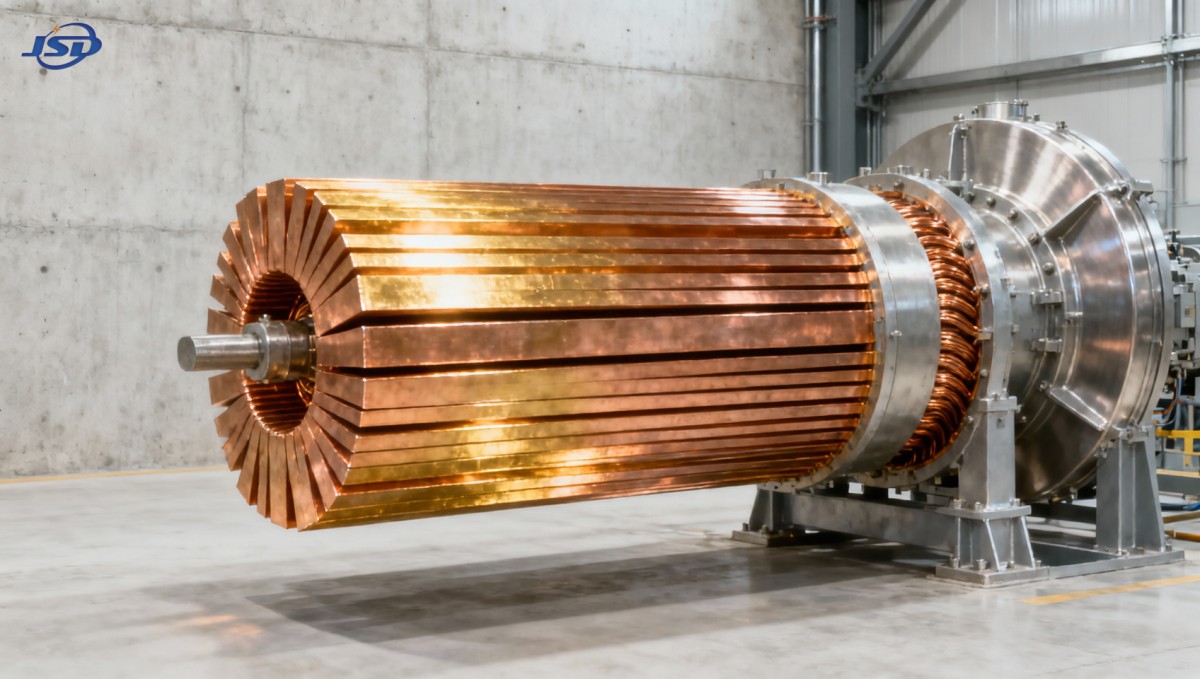
Loss Allocation and Lifecycle Cost Context
Load loss dominates total energy loss in electrolysis rectifier transformers due to their extremely low secondary voltage and high current. A 120 MVA unit operating at 95% efficiency contributes ~6 MW of continuous resistive loss. Using aluminum instead of copper increases DC resistance by ≈64%, raising base load loss by ~1.1 MW annually—equivalent to ~9.6 GWh/year extra consumption at 8,760 hours. While aluminum offers lower raw material cost, the penalty manifests not only in kWh but in accelerated insulation aging: IEEE C57.91-2019 notes that every 6 K above rated hotspot temperature halves insulation life. Copper’s superior thermal and electrical properties thus extend service intervals between rewinds by 3–5 years in continuous-duty applications.
Where Aluminum May Be Justified
Aluminum remains viable where specific constraints override pure performance metrics: (1) weight-limited transport corridors—e.g., remote hydro-powered aluminum smelters where crane capacity restricts unit mass; (2) legacy infrastructure with pre-existing aluminum bus systems requiring direct compatibility; (3) short-duration duty cycles (<6 hours/day) with ample thermal recovery time. Even then, design adjustments are non-negotiable: cross-sectional area must increase by ≥1.65× to maintain equivalent DC resistance; clamping pressure must be raised by 25–30% to suppress fretting corrosion; and all transitions require bimetallic lugs with anti-oxidant compound and torque-controlled installation.
For general-purpose distribution applications where reliability, fire safety, and maintenance reduction are prioritized—such as urban substations or industrial power centers—the 11kV Three-Phase Cast Resin Dry-Type Distribution Transformer leverages copper strip and foil windings to achieve verified losses below IEC 60076-1 limits across its full 30–2500 kVA range. Its vacuum-cast epoxy insulation system eliminates oil-related fire risk while maintaining thermal stability up to 155°C, supporting continuous 120% overload capability under forced air cooling—a feature particularly valuable during grid contingency scenarios where electrolysis plants may shift load profiles unexpectedly.
Manufacturing Consistency Matters More Than Material Choice Alone
Material selection cannot compensate for inconsistent winding tension, uneven resin impregnation, or inadequate interlayer insulation spacing. In copper windings, minor variations in strip thickness or edge burrs cause localized field intensification at sharp corners—especially problematic in low-voltage coils where turn-to-turn voltage is minimal but dielectric stress concentrates at protrusions. Aluminum, being softer, is more susceptible to deformation during coil handling and core insertion, increasing the probability of insulation damage before curing. Jinshida Electric’s process control for copper foil low-voltage windings includes automated tension monitoring and infrared-cured epoxy prepreg bonding—ensuring void-free insulation integrity even at 0.4 kV secondary ratings. Such precision mitigates the very risks that make aluminum appear attractive on paper but costly in practice.
In summary, copper is strongly preferred for electrolysis rectifier transformer secondary windings when current density exceeds 1.4 A/mm², duty cycle exceeds 70% annual loading, or ambient temperatures exceed 40°C. Aluminum requires rigorous derating, enhanced mechanical retention, and harmonic-aware loss modeling—not just resistivity-based recalculations. The decision hinges not on material cost per kilogram, but on how each metal behaves under the combined stresses of high current, thermal cycling, electromagnetic forces, and long-term insulation interaction.

Get a Quote
Regardless of whether you require general advice or specific support, we are happy to help you.
Send Us Your Inquiry Today

Jinshida Electric remains committed to contributing to global energy development through professional manufacturing and superior service.