





Is isolation rectifier transformer mandatory for medical equipment power supply in EU hospitals?
Is an Isolation Rectifier Transformer Mandatory for Medical Equipment Power Supply in EU Hospitals?
Yes — not universally mandated by a single “yes/no” regulation, but functionally and legally indispensable for most patient-connected medical devices deployed in EU hospitals. Under the EU Medical Device Regulation (MDR 2017/745) and the harmonized safety standard IEC 60601-1:2012+AMD1:2020, galvanic isolation with reinforced insulation is a non-negotiable requirement for any equipment where electrical circuits may contact patients directly or indirectly. An Isolation and Rectifier Special Transformer delivers precisely that: certified isolation, voltage stabilization, and leakage current suppression — making it not merely advisable, but operationally essential for compliance, risk mitigation, and clinical continuity.
Why Regulatory Compliance Demands More Than Basic Isolation
EU hospitals operate under strict conformity assessment pathways. MDR requires Class IIa, IIb, and III devices to undergo notified body review — and IEC 60601-1 is the cornerstone standard referenced across all classifications. Clause 8.6 explicitly mandates “reinforced insulation” between patient-connected parts and earth or other accessible conductive surfaces. This isn’t satisfied by simple double insulation or basic isolation transformers. It requires validated dielectric strength (≥4 kV AC), creepage/clearance distances per pollution degree 2, and critically — low earth leakage current (<100 µA for normal condition; <500 µA for single-fault condition).
Standard power transformers rarely meet these thresholds. Their interwinding capacitance and magnetic coupling can generate leakage currents far exceeding safe limits — especially when feeding high-frequency switching rectifiers common in modern imaging systems, dialysis units, or surgical lasers. Only purpose-built isolation rectifier transformers, designed with electrostatic shielding, split windings, and optimized core geometry, consistently achieve sub-50 µA leakage at full load while maintaining >10 MΩ insulation resistance.
What Business Evaluators Actually Need to Assess — Not Just “Is It Required?”
For procurement, technical evaluation, and infrastructure planning teams, the real question isn’t binary compliance — it’s operational resilience, lifecycle cost, and vendor accountability. You need to evaluate three dimensions: regulatory traceability, system-level integration risk, and long-term service assurance.
First: Does the transformer carry EN 61558-2-16 certification? This EU-specific standard for “transformers for industrial applications with rectifier loads” covers thermal performance under harmonic-rich waveforms, short-circuit withstand, and mandatory partial discharge testing — unlike generic IEC 60076 transformers. Jinshida Electric’s Isolation and Rectifier Special Transformer is engineered to EN 61558-2-16 and fully compatible with IEC 60601-1 Annex BB test protocols.
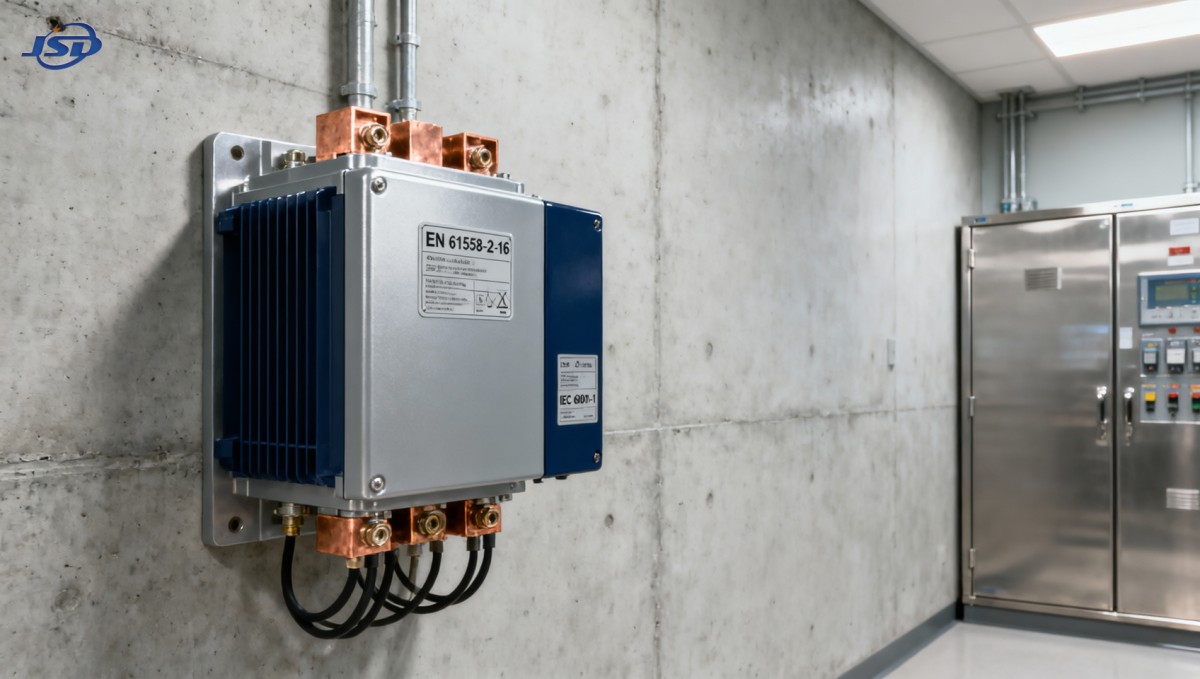
Second: Can it handle real-world rectifier loads? Medical-grade rectifier systems (e.g., in MRI gradient amplifiers or linear accelerator power supplies) generate 5th, 7th, and 11th harmonics at up to 30% amplitude. Generic transformers overheat, saturate, or fail prematurely. Jinshida’s models feature K-factor-rated design (K-13/K-20), copper-wound cores with low hysteresis loss, and forced-air cooling options (AN) — ensuring stable output even during sustained peak demand.
Integration Realities: Where “Mandatory” Becomes Practical Necessity
Consider a typical hospital central power distribution upgrade: integrating new PET-CT scanners, digital angiography suites, or ICU ventilator banks. Each device draws highly distorted current. Without proper isolation rectification upstream, harmonic resonance can destabilize UPS systems, trip RCDs in adjacent wards, and introduce noise into ECG monitoring circuits — causing false alarms or missed diagnostics.
An isolation rectifier transformer acts as both barrier and buffer: it breaks ground loops, blocks common-mode noise, and provides a clean, floating DC bus reference. Its rated capacity range (50kVA–5000kVA), customizable LV outputs (e.g., ±12V, ±24V, 400V DC), and dual-voltage HV inputs (6kV/10kV/20kV/35kV) allow seamless integration into existing medium-voltage hospital substations — without costly redesign of switchgear or cable routing.
Choosing a Supplier: Beyond Certificates to Proven Healthcare Delivery
Certifications are necessary — but insufficient. A supplier must demonstrate domain-specific validation: type-test reports from accredited labs (e.g., TÜV SÜD or DEKRA), field references from EU-accredited hospitals, and rapid response to custom requirements like enhanced IP rating (IP54 for humid radiology basements) or seismic bracing (EN 1998-1). Jinshida Electric maintains ISO 13485-certified quality management specifically for medical-supporting power equipment, with traceable copper sourcing, 100% turn-to-turn and hipot testing per unit, and 30-year design life validation under continuous 85°C winding temperature rise.
Crucially, their engineering team co-develops solutions — not just supplies components. For a recent neurosurgery center in Berlin, Jinshida delivered a 1250kVA Dyn11-configured isolation rectifier transformer with integrated harmonic filters and real-time thermal monitoring — reducing installation time by 40% versus off-the-shelf alternatives and enabling full MDR declaration of conformity within 6 weeks.
Conclusion: It’s Not About Mandate — It’s About Risk-Aware Decision Making
No EU directive states “thou shalt use an isolation rectifier transformer.” But the convergence of MDR’s general safety obligation (Article 10), IEC 60601-1’s reinforced insulation requirement, EN 61558-2-16’s application-specific performance criteria, and real-world clinical risk makes omission indefensible for patient-connected systems. For business evaluators, the decision isn’t whether to specify one — it’s how rigorously to validate its design, certification, and integration readiness.
Opting for a generic transformer risks non-conformity findings during MDR surveillance audits, unplanned downtime during clinical operations, and liability exposure if leakage-related incidents occur. Choosing a purpose-engineered solution — like Jinshida Electric’s Isolation and Rectifier Special Transformer — transforms compliance from a paperwork hurdle into a strategic advantage: predictable uptime, lower total cost of ownership, and demonstrable commitment to patient safety and regulatory excellence.
Hot News
- 00
0000-00
How U.S. DOE efficiency rules affect distribution transformer manufacturers - 00
0000-00
How american type pad mounted transformer seismic qualification affects installation in California utility grids? - 00
0000-00
Do european compact substation transformer EMC compliance tests include conducted emissions up to 30MHz?
0000-00
Contact Us

Get a Quote
Regardless of whether you require general advice or specific support, we are happy to help you.
Send Us Your Inquiry Today

Jinshida Electric remains committed to contributing to global energy development through professional manufacturing and superior service.