





Container Battery Storage for Solar Integration: Main Technical Challenges
Container Battery Storage for Solar Integration: Where the Real Technical Risks Sit
As solar plants get larger, container battery storage has moved from being a niche add-on to a practical part of project design. It helps smooth PV intermittency, support time shifting, reduce curtailment risk, and improve dispatch flexibility. On paper, that sounds straightforward. In actual engineering review, it rarely is.
The main technical challenge is not simply “adding batteries to solar.” It is building a storage system that can survive heat, cycling stress, grid disturbances, control complexity, and maintenance realities without creating new failure points upstream or downstream. For technical evaluators, the important question is less about whether storage fits the project concept, and more about whether the containerized system can remain safe, controllable, and predictable across years of operation.
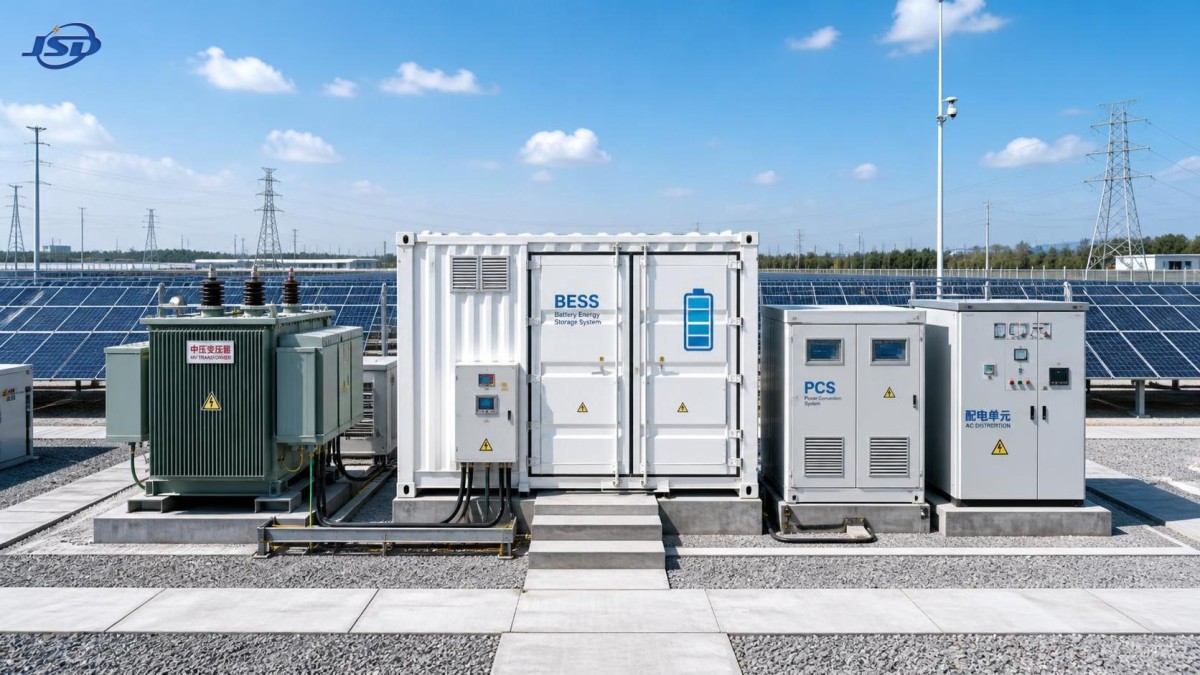
This becomes even more relevant in projects tied to substations, MV transformers, and distribution equipment. A battery container may be delivered as a compact product, but once it is integrated with inverters, transformers, protection devices, and plant-level control, it behaves like part of a much larger power system. That is where many evaluation mistakes begin.
Thermal management is often the first serious filter
In solar-coupled applications, the battery does not operate in a gentle indoor environment. Containers are frequently exposed to strong solar radiation, high daytime ambient temperature, dust, and uneven site airflow. An energy storage system can look acceptable in a datasheet review yet become difficult to manage once cell temperature spread starts widening in the field.
What matters is not only whether the system uses air cooling or liquid cooling, but whether the thermal path is matched to the charging and discharging profile. A project designed mainly for one daily charge-discharge cycle has different thermal stress from a system performing frequent ramp control or peak shaving with high partial-load fluctuation. If the HVAC design, rack arrangement, duct routing, and control logic are not aligned with the real duty cycle, the result is usually accelerated cell imbalance and uneven aging.
Evaluators should pay close attention to temperature consistency inside the container, not just nominal cooling capacity. A system can have enough total cooling power and still perform poorly if hot spots form near upper racks, cable interfaces, or door-side dead zones. In practice, thermal management should be reviewed together with enclosure sealing, filter maintenance strategy, and site climate. Dust-clogged filters and neglected air paths can quietly degrade performance long before a protection alarm appears.
Fire safety is not a box-ticking exercise
Safety discussion around container battery storage is often reduced to whether the system has fire suppression. That is too narrow. The real issue is whether the design can detect abnormal conditions early, isolate faults quickly, and prevent one cell-level event from escalating into a module-, rack-, or container-level incident.
For solar integration, charging patterns can be highly variable due to irradiance changes, inverter commands, and grid dispatch instructions. That means the battery management system needs to handle more than standard SOC estimation. It also needs robust monitoring of cell voltage deviation, temperature trend, insulation status, and communication health. A technically weak BMS may appear fine during factory testing but show gaps when the plant experiences repeated fast charge acceptance, partial cycling, or intermittent standby periods.
Another point that deserves more scrutiny is fault coordination between the battery container, PCS, transformer, and upstream protection. If a DC-side abnormality triggers a shutdown, what happens on the AC side? Can the fault be isolated without creating nuisance trips for nearby feeders or auxiliary systems? In utility-scale and industrial sites, protection selectivity matters. A storage unit that trips safely but unnecessarily destabilizes the local power section is still a design problem.
System integration is where many “good components” become a difficult project
A solar-plus-storage installation is rarely limited by the battery cabinet itself. More often, limitations appear at the interfaces: PCS compatibility, transformer sizing, auxiliary load design, grounding arrangement, EMS logic, and plant communication architecture.
This is especially true when the project connects to medium-voltage distribution through step-up transformers. Transformer selection is not just about matching rated power. Evaluators should also consider harmonic behavior, transient response, inrush coordination, and temperature rise under combined solar and battery operating modes. Storage can change the load profile seen by the transformer, sometimes making it more dynamic rather than more stable. If that is overlooked, the bottleneck may shift from the battery to the transformer bay or switchgear section.
Companies with a background in transmission and distribution equipment tend to see this interface risk more clearly. Jinshida Electric Power Technology Co., Ltd., for example, works across power equipment R&D, manufacturing, and application, which is relevant because containerized storage should not be assessed as a standalone product alone. In grid construction, industrial manufacturing, new energy, and infrastructure projects, the storage unit has to fit the behavior of the wider electrical system, not the other way around.
That is why technical review should include at least three layers: internal battery design, AC/DC conversion and protection, and plant-level coordination with transformers and distribution equipment. Missing any one of these usually leads to avoidable commissioning delays.
Control strategy can decide whether storage creates value or confusion
Many problems blamed on hardware are actually control problems. Solar integration can require different priorities at different times: smoothing output, limiting export, shifting energy, supporting reactive power strategy, or maintaining backup reserve. Those functions can conflict with each other if dispatch logic is vague.
A common issue is overpromising multi-function operation without clarifying priority order. If the same battery is expected to do peak shaving, PV ramp rate control, and emergency reserve support, one function will usually constrain another. The control system must define which command wins, how SOC boundaries are protected, and how fast transitions are handled. Otherwise, the battery may cycle inefficiently or miss the operational target that justified the investment in the first place.
This is where a practical solution package can be useful, provided the evaluator checks the control assumptions behind it. For example, a compact option such as the 500kW/1MWh Air Cooling Container Energy Storage System may suit projects that need a standardized building block, but suitability still depends on dispatch goals, climate conditions, PCS matching, and local grid code requirements. A neat container format does not remove the need for control coordination.
Long-term reliability is not visible in a short factory test
Most systems look stable during FAT. The harder question is what happens after repeated seasonal cycling, auxiliary system wear, and partial maintenance over several years. In container battery storage, long-term reliability is shaped by many small engineering decisions: cable routing quality, connector vibration resistance, corrosion protection, HVAC redundancy, sensor placement, and software fault handling.
Technical evaluators should be cautious with any review that focuses too heavily on initial capacity and too little on serviceability. Can filters, fans, modules, and fire system components be accessed without complicated downtime? Is there a clear spare parts strategy? Are alarms classified in a way that field teams can act on them quickly? A container that is difficult to maintain may still perform well in the first year, then become an operational burden later.
Reliability also depends on how conservative the operating window is. Aggressive utilization can improve short-term economics but may increase degradation risk. There is no universal right answer here; it depends on whether the project values throughput, reserve availability, or life extension. That trade-off should be explicit during technical selection instead of being hidden behind a generic lifecycle claim.
Site conditions still matter more than many buyers expect
Containerized systems are often marketed as fast-deployment assets, and that is partly true. But “containerized” does not mean site-independent. Foundation flatness, drainage, salt mist exposure, altitude, ambient temperature range, cable trench layout, and maintenance access can all change the final performance envelope.
For solar plants in remote or harsh environments, air cooling may be entirely reasonable, but only if dust control and periodic maintenance are realistically achievable. If not, the cooling concept that looks simpler on paper may become more sensitive in operation. Similarly, if the project is tied to a transformer and distribution section with limited expansion margin, the evaluator should check whether future storage augmentation will stress existing equipment or protection settings.
This is one reason experienced power equipment manufacturers tend to emphasize quality management and process control rather than only headline specifications. In projects where the storage unit must coordinate with transformers, switchgear, and plant electrical balance, manufacturing consistency and interface discipline are not side topics. They are part of risk control.
What a careful technical review should really ask
Before approving a solar-integrated storage solution, it helps to push beyond brochure language and ask a few uncomfortable but useful questions:
- How does the thermal design behave under the site’s actual solar load and ambient profile?
- What is the fault isolation path from cell to rack to container to AC connection point?
- How are PCS, transformer, and plant protection settings coordinated during abnormal events?
- Which operating objective has priority when multiple dispatch commands conflict?
- What maintenance tasks are routine, and can they be executed easily on the actual site?
If those questions do not have clear answers, the project is not necessarily wrong, but it is not yet technically mature.
In the end, the challenge with container battery storage for solar integration is not choosing a fashionable configuration. It is making sure the storage block, power conversion path, transformer interface, and operating strategy behave like one coherent system. When evaluators focus on that system view, many downstream problems become visible early enough to solve them. When they do not, the project may still be built, but the hidden risks usually show up during commissioning, summer peak operation, or the second year of maintenance.

Get a Quote
Regardless of whether you require general advice or specific support, we are happy to help you.
Send Us Your Inquiry Today

Jinshida Electric remains committed to contributing to global energy development through professional manufacturing and superior service.