





Battery Storage Container Standards: What to Check Before Site Acceptance
Site acceptance for a battery storage container is one of those moments where small oversights can turn into expensive, high-risk problems later. A door that does not seal properly, an unclear grounding point, a missing fire suppression certificate, or ventilation settings that look acceptable on paper but fail under field conditions—these are not minor details. For quality control teams and safety managers, acceptance is the last practical barrier before energization and operation.
That is why a serious inspection goes well beyond a visual walkaround. A battery energy storage enclosure is a compact system where structural safety, electrical protection, thermal management, access control, and compliance documentation all intersect. If even one part is weak, the entire installation may carry operational risk from day one.
In practice, the best acceptance teams do not ask only whether the container “works.” They ask whether it is ready to work safely, predictably, and in line with the standards that matter for the project, the site, and the local authority having jurisdiction.
Start with the standards framework, not the paint finish
Different projects reference different codes, but most battery container acceptance reviews should begin with a standards map. This helps inspectors avoid a common problem: checking isolated items without confirming which requirement actually governs them.
Depending on the region and application, the review may involve electrical codes, fire safety requirements, enclosure ratings, transport-related structural criteria, and battery system standards. In many projects, teams will look at a combination of UL, IEC, NFPA, local grid interconnection rules, and customer-specific technical specifications. The key point is not to memorize every standard number during the walkdown. It is to confirm that the supplier’s design, test reports, and as-built condition align with the approved compliance basis.
For example, if the container is part of a broader power distribution package, acceptance should also consider how its interfaces connect with upstream or downstream equipment. In some utility or industrial applications, that means checking not only the battery enclosure itself but also related transformer arrangements, protection coordination, and cable routing discipline. This is where system-level thinking matters more than box-level inspection.
What the container body must prove before you sign off
The outer shell of a battery storage container often looks straightforward, but it carries multiple responsibilities at once: mechanical protection, weather resistance, fire compartmentation support, access security, and environmental durability. Quality teams should inspect the enclosure for deformation, corrosion points, coating damage, weld quality, door alignment, lock integrity, and water ingress vulnerability.
Pay close attention to corners, roof seams, cable penetrations, door frames, and lifting points. These are frequent weak spots in transportable enclosures. If the unit has already been shipped long distance, signs of vibration stress or handling impact should not be ignored simply because the container still appears “intact.” A dent near a sealing edge, for instance, may compromise ingress protection or create uneven door pressure.
Ask for evidence that the enclosure rating claimed by the supplier matches the delivered configuration. A battery storage container may have passed a design test originally, but field modifications—extra gland plates, changed louvers, additional sensors, replacement hardware—can reduce the effective protection level if not controlled.
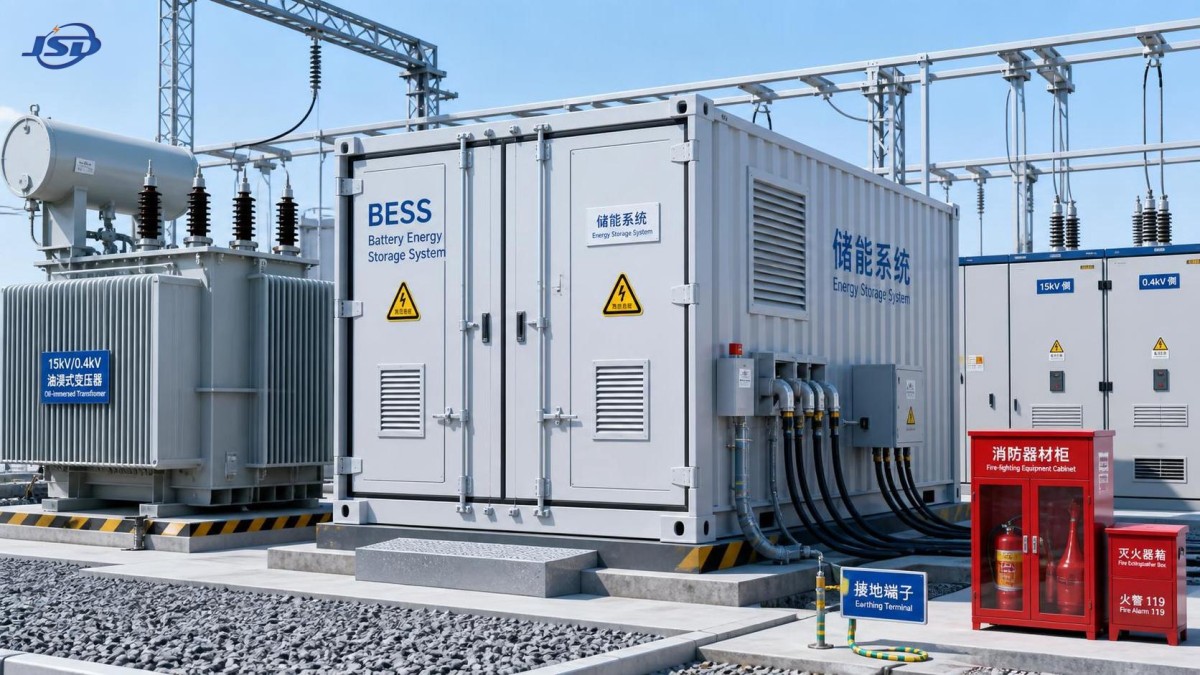
Fire protection is not a checklist item to rush through
For safety managers, this is usually the section that deserves the most discipline. Fire detection and suppression in battery systems should be verified as an integrated function, not as separate installed components. Smoke, gas, heat, or off-gas detection devices must be present in the correct locations, correctly labeled, powered, and linked to the intended alarm and shutdown logic.
It is not enough to see a suppression cylinder and assume the job is done. Confirm the agent type, release logic, manual release provisions, abort functions if applicable, nozzle placement, pressure condition, and maintenance access. Review whether the system design matches the battery chemistry and project hazard analysis. Teams should also verify signage for fire response, emergency isolation, and restricted entry.
Another practical point: inspect whether the container layout leaves enough space for emergency intervention. Overcrowded internal arrangements may complicate maintenance, increase cable damage risk, and obstruct response actions during abnormal conditions.
Thermal management and ventilation: where many hidden risks live
A battery system can pass a basic power-on test and still fail later because airflow, heat rejection, or HVAC control was not properly validated during acceptance. This is especially important in hot climates, dusty environments, coastal sites, or places with wide temperature swings.
Inspectors should confirm the installed cooling or ventilation equipment matches approved drawings and equipment lists. That includes fan direction, filter access, duct routing, damper movement, condensate drainage, sensor placement, and control sequences. If doors are opened for inspection, teams should be careful not to confuse temporary conditions with actual operating airflow paths.
What matters most is whether the thermal management system can maintain battery conditions inside the manufacturer’s allowable range under expected site loads. A well-run site acceptance process checks not just presence, but response: alarm thresholds, fan start points, HVAC failover logic, and communication of abnormal thermal conditions to the supervisory system.
Watch for a subtle but serious issue: poorly separated power and control compartments. Heat build-up in cable zones, inverter interfaces, or auxiliary power areas can affect sensor accuracy and shorten component life long before any major event occurs.
Electrical inspection should move from isolation to integration
Electrical acceptance starts with fundamentals: insulation condition, cable termination quality, torque confirmation where required, protective earth continuity, labeling consistency, and segregation of AC, DC, and low-voltage control wiring. But the stronger inspections do not stop there. They trace how the container actually behaves as part of a connected energy system.
Verify that DC circuits are clearly identified, accessible only as intended, and protected against inadvertent contact. Check busbar barriers, terminal covers, creepage and clearance where visible, and the condition of cable glands and gland plates. If there are pre-charged circuits or residual energy hazards, warning labels and discharge provisions should be confirmed on site, not assumed from drawings.
Grounding deserves special attention. Inspect the main grounding bar, bonding of doors and removable panels, continuity across painted surfaces where bonding is claimed, and external earthing connection points. Weak grounding practices can undermine both safety and protection performance.
In many installations, the battery container works alongside power distribution assets that shape fault response and system stability. For projects linked with medium- and low-voltage distribution equipment, teams often review interface compatibility with transformer and switchgear sections. In that context, a well-matched distribution component such as the 15kV/0.4kV Oil-Immersed Power Distribution Transformer may be part of the broader reliability chain, especially where stable auxiliary supply and coordinated protection are critical to battery system operation.
Control, communication, and interlocks must be tested as real functions
One of the easiest mistakes during acceptance is treating control hardware as a documentation exercise. Yet many operational failures begin with a mismatch between installed devices and programmed logic. Emergency stop circuits, door interlocks, HVAC alarms, gas detection signals, fire release status, battery management system alarms, and remote shutdown functions should all be tested in a controlled manner.
For QC personnel, this is where witness testing becomes valuable. You are not only checking whether a lamp turns on; you are confirming that the right event triggers the right response, appears at the right local and remote interface, and leaves the system in the right safe state.
Time synchronization, communication protocol settings, and signal naming consistency also matter more than they first appear. A misnamed alarm point can delay fault diagnosis. An unverified remote command path can create confusion during emergency response. Acceptance should therefore include a point-to-point verification philosophy for critical signals, especially those tied to shutdown, fire, ventilation, and battery abnormality alarms.
Documentation is part of the equipment quality
A battery storage container should not be considered ready if the hardware looks complete but the paperwork remains vague. Site acceptance should confirm the availability and consistency of as-built drawings, wiring diagrams, single-line diagrams, protection settings, equipment nameplate records, test reports, certificates, operation manuals, maintenance instructions, spare parts lists, and commissioning records.
For safety and compliance teams, documentation review is often where hidden deviations surface. A sensor model installed on site may not match the approved bill of materials. A fire system may carry different setting values from the submitted documentation. Cable tags may differ from terminal schedules. These are not paperwork annoyances; they affect maintenance accuracy, incident investigation, and future modification control.
Make sure the deviation list, punch list, and concession records are transparent. If items remain open, they should be risk-ranked, ownership should be assigned, and closure criteria should be defined before final acceptance.
Environmental and site-specific conditions should influence acceptance criteria
No battery container operates in a vacuum. Coastal corrosion, desert dust, heavy rain, seismic zones, high altitude, freezing weather, and industrial pollution each change what “acceptable” really means in the field. A container that appears compliant in factory testing may need closer review at site for filters, anti-condensation measures, heater function, stainless hardware suitability, or coating durability.
This is particularly relevant for teams working on integrated energy and distribution projects. Manufacturers with experience across power equipment applications often understand that reliability does not depend on a single component alone, but on how enclosure design, thermal behavior, electrical interfaces, and maintenance access support the real operating environment. That practical mindset is especially valuable when battery systems connect into substations, industrial plants, or renewable energy infrastructure with strict uptime expectations.
A short list of acceptance mistakes worth avoiding
Some problems repeat across projects, even when the equipment is technically advanced. One is relying too heavily on factory acceptance results without rechecking transport-sensitive items on site. Another is focusing on major equipment while overlooking “small” installation details such as sealing, labeling, bonding straps, drain paths, or sensor orientation.
There is also a tendency to accept unresolved software or communication issues because the mechanical package looks complete. That is risky. A container can be physically delivered yet functionally unfinished. The same caution applies to temporary site wiring, bypassed interlocks, disabled alarms, or incomplete integration with upstream power assets, whether switchgear, protection relays, or a 15kV/0.4kV Oil-Immersed Power Distribution Transformer in a related distribution segment.
What a good site acceptance decision really looks like
Good acceptance is not about making the inspection harder than necessary. It is about making the operating life of the system safer and more predictable. For quality control personnel, that means evidence-based verification. For safety managers, it means confirming that engineered protections are truly ready to perform under abnormal conditions—not merely installed for appearance.
When reviewing a battery storage container, the most reliable approach is to combine standards awareness with field realism. Check the structure, but also the interfaces. Confirm the devices, but also the logic. Review the certificates, but also the as-built condition. If those layers align, acceptance becomes more than a formal milestone; it becomes a meaningful control point that protects people, assets, and long-term project performance.

Get a Quote
Regardless of whether you require general advice or specific support, we are happy to help you.
Send Us Your Inquiry Today

Jinshida Electric remains committed to contributing to global energy development through professional manufacturing and superior service.