





How safety standards are changing for grid scale battery storage projects
When people ask how safety rules are changing for grid scale battery storage, what they usually want to know is simpler than the standards themselves: what now gets checked, what can fail a project, and what needs to change in design, procurement, inspection, and operation. The short answer is that safety expectations are moving upstream. Regulators, insurers, utilities, and owners are no longer satisfied with basic equipment compliance alone. They want proof that the full system can prevent, detect, contain, and respond to abnormal conditions before a small fault becomes a site-level event.
That shift matters because many early discussions around battery energy storage focused on capacity, dispatch value, and project economics. Safety was sometimes treated as a downstream review item. In practice, it now sits much closer to the center of project approval and long-term asset protection. For teams responsible for quality and risk control, this changes the work. It is no longer enough to confirm that a battery container, inverter, or transformer arrived with paperwork. You need to understand how standards apply across the whole installation and where the interfaces between systems create hidden risk.
A useful way to read the market is this: safety standards are becoming more system-based, more evidence-based, and more operationally focused. Fire testing, gas detection, thermal runaway mitigation, spacing rules, emergency response planning, commissioning records, and remote monitoring all carry more weight than they did a few years ago.
What is actually changing in grid scale battery storage safety standards?
The biggest change is not one single rule. It is the move from component acceptance to integrated system acceptance.
In older project thinking, a supplier could point to certifications for individual equipment and assume that the project was largely covered. That is no longer a safe assumption. Current safety practice expects project teams to look at battery racks, battery management systems, HVAC, fire detection, suppression strategy, enclosure design, DC collection, inverter behavior, transformer interface, site layout, and control logic as one operating environment. A compliant part inside a poorly coordinated system can still produce an unsafe installation.
There is also stronger attention on failure progression. Standards and project reviews increasingly ask: if one cell fails, what stops propagation? If off-gassing starts, how quickly is it detected? If abnormal heat builds in one zone, what action is automatic and what depends on operator response? If fire occurs, is the design trying to suppress it, contain it, vent it, or isolate it? These are practical questions, and they affect both certification strategy and daily quality control.
Another visible trend is that local authorities and insurers are asking for more project-specific documentation. Even when international or national standards are referenced, site acceptance often depends on local code interpretation, utility requirements, fire authority expectations, and emergency access conditions. This is where many teams get caught. They assume a factory certificate solves a site approval problem. It usually does not.
In plain terms: grid scale battery storage projects are now judged less by brochure claims and more by traceable engineering decisions, test evidence, and site readiness.
Thermal runaway is driving much of the change
If one topic has pushed standards to evolve faster than others, it is thermal runaway. Not because every project will experience it, but because the consequence of poor control can be severe.
Many quality teams still make one common mistake here: they focus heavily on preventing the initial fault but spend too little time on what happens after the first fault. Modern safety reviews usually look at both. Prevention still matters, of course. Cell quality, manufacturing consistency, battery management logic, cooling performance, insulation condition, and installation workmanship all affect the chance of an initiating event. But current standards and guidance increasingly emphasize propagation resistance and emergency management as well.
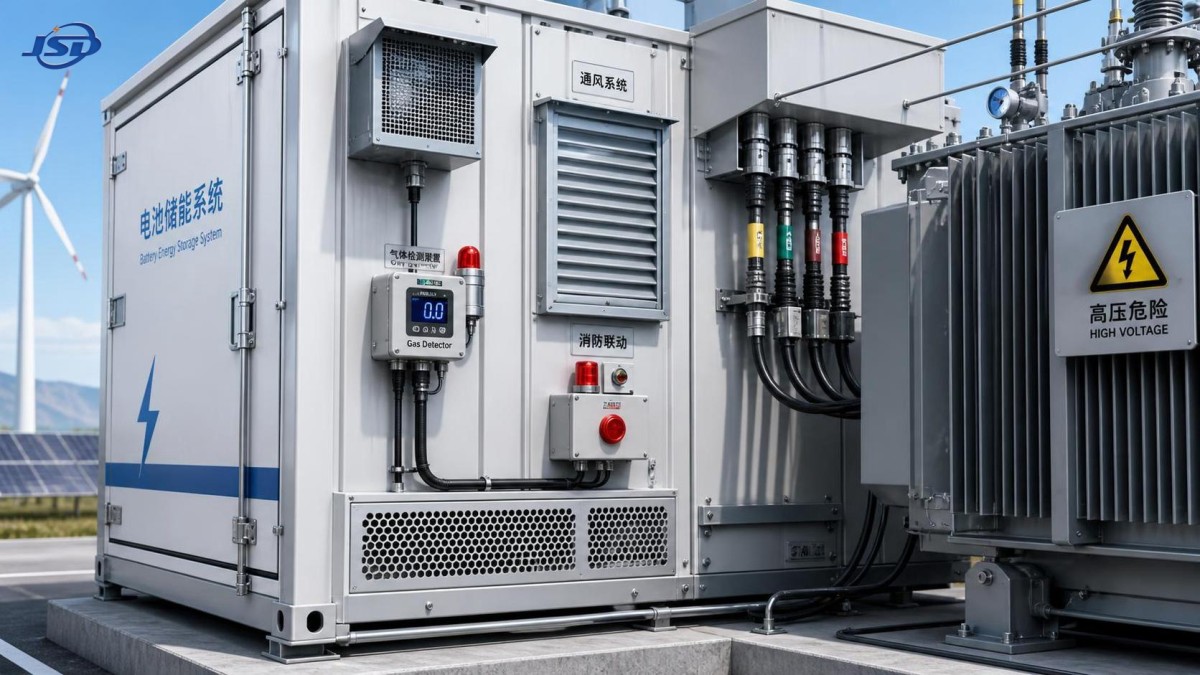
That means battery rooms and containerized systems are being evaluated for gas buildup, pressure effects, fire spread pathways, ventilation response, shutdown coordination, and post-event access. In other words, “Does it work under normal operation?” is no longer enough. “How does it fail, and how does the site survive that failure?” has become part of the safety baseline.
For safety managers, this has a practical implication: inspection checklists need to cover design intent, not just visible defects. A clean cabinet, a correct cable tag, and a complete nameplate do not tell you whether thermal event management is credible.
Certification is only one layer. Site integration is where many risks appear.
In utility and renewable projects, battery systems do not operate alone. They sit inside a larger power architecture with inverters, switchgear, protection devices, transformers, SCADA, auxiliary power, and grid interconnection equipment. A lot of real risk sits at those interfaces.
For example, poor coordination between the battery system and upstream isolation strategy can delay fault clearing. Inadequate auxiliary power resilience can compromise cooling or control functions during abnormal conditions. Protection settings that look reasonable on paper may not reflect real operating sequences once the plant is energized.
This is one reason equipment quality in the surrounding electrical system matters more than some project teams first expect. In renewable applications where energy conversion and voltage stepping are part of the same operating chain, the transformer is not just a passive accessory. It affects protection coordination, insulation reliability, thermal performance, and fault behavior. In projects that combine solar generation and storage, teams often review equipment packages together rather than in isolation. A relevant example is Step-Up Transformer for Photovoltaic Power Stations, which fits into the broader conversation about stable interconnection and disciplined power equipment selection, even though it does not replace battery-specific safety controls.
This is also where experienced manufacturers tend to stand out. Companies such as Jinshida Electric Power Technology, which focus on transmission and distribution equipment, quality management, and application support across grid construction, industrial manufacturing, new energy, and infrastructure projects, are operating in the part of the market where interface reliability matters. That does not mean a brand statement should substitute for technical review. It means buyers should value suppliers that can support documentation discipline, manufacturing consistency, and engineering coordination across the power system.
What quality control teams should pay closer attention to now
Not every project needs the same review depth, but a few checkpoints have become hard to ignore.
- Factory documentation versus project applicability: confirm that certificates, test reports, and declarations match the exact model, chemistry, configuration, and installation method being supplied.
- System-level test evidence: ask what has been tested at module, rack, enclosure, and system level, and where the gaps still require project-specific mitigation.
- Installation quality at interfaces: cable routing, torque records, insulation separation, grounding continuity, communication wiring, sensor placement, and ventilation path integrity deserve more scrutiny than they often get.
- Protection coordination: verify how the battery system, inverter, switchgear, and transformer respond during faults, shutdowns, and restart conditions.
- Emergency response readiness: check whether site procedures are written around the actual design, not copied from a generic template.
A lot of teams still overemphasize visible workmanship and underemphasize traceability. In battery storage, traceability matters because post-event investigation almost always comes back to sequence: what equipment state existed, what signal was detected, what action was triggered, and what failed to happen in time.
Common misunderstandings that create compliance trouble
One misunderstanding is that passing a recognized test means the project is automatically “safe.” Tests are valuable, but they have boundaries. They are performed under defined conditions, with defined equipment, and for defined objectives. A project may still be exposed if the installed environment differs from the tested arrangement.
Another is assuming that fire suppression alone solves battery safety. In many battery chemistries and enclosure designs, the strategy is broader than suppression. Detection, ventilation, isolation, spacing, containment, communication with first responders, and controlled shutdown can be just as important.
A third issue is treating battery safety as a specialist topic that only the battery supplier needs to understand. That is risky. EPC teams, owner’s engineers, commissioning teams, O&M personnel, and the electrical equipment supply chain all influence the final result. When responsibilities are fragmented, gaps appear exactly where standards are becoming stricter.
And one more point that deserves emphasis: a project can be technically compliant on paper and still operationally weak. If alarms are poorly prioritized, if site teams are not trained on abnormal event recognition, or if maintenance procedures interrupt protective functions, the practical safety level drops fast.
What a better review process looks like
In strong projects, the review process starts before equipment arrives on site. Safety expectations are translated into procurement requirements, drawing reviews, FAT criteria, commissioning hold points, and operating procedures. That sounds obvious, but many projects still try to solve these questions too late.
A better sequence usually includes early hazard review, confirmation of applicable standards and local code triggers, interface checks between battery and balance-of-plant equipment, and a commissioning plan that tests not only normal energization but also alarm logic and protective responses. For quality personnel, the key is to avoid accepting paperwork without checking design alignment.
It also helps to separate “compliant” from “proven in this application.” They are related, but not identical. A component may be suitable in one layout and problematic in another. That is especially true when climate conditions, enclosure density, maintenance access, or emergency response constraints differ from the original design assumptions.
When projects involve hybrid renewable plants, it is reasonable to review adjacent equipment choices at the same time. For instance, understanding the duty, insulation level, thermal behavior, and integration requirements of a Step-Up Transformer for Photovoltaic Power Stations can support a more coherent plant-level safety review, particularly where the storage system and solar export infrastructure share protection and interconnection concerns.
What to confirm before you sign off
Before final acceptance, the most useful question is not “Do we have all the documents?” It is “Can this site detect, isolate, and manage an abnormal event in the way the design claims?”
That means confirming:
- the installed configuration matches approved drawings and certified scope;
- detection, shutdown, ventilation, and communication functions have been tested as installed;
- protection settings and interlocks are documented and controlled;
- maintenance and emergency procedures reflect the actual equipment on site;
- operators know what the first abnormal signals look like and what not to do.
For teams working in grid scale battery storage, this is the direction the market is moving. Safety standards are becoming tighter, but also more practical. They are asking the right question: not just whether equipment passed a test somewhere, but whether the whole project can behave safely under real conditions. That is a better standard for owners, for utilities, and for the people who have to sign their names on quality and safety records.
FAQ
Do newer battery safety standards mainly affect battery suppliers?
No. They affect suppliers, EPC contractors, commissioning teams, owners, and site operators. Many failures come from system interfaces, not a single product defect.
Is third-party certification enough for project approval?
Usually not. Certification supports compliance, but local code review, site layout, fire authority requirements, and integration details still need separate confirmation.
What is the most overlooked risk in battery storage projects?
Interface risk. Protection coordination, ventilation behavior, auxiliary power resilience, and communication logic often receive less attention than battery specifications.
Should quality teams focus more on factory testing or site testing?
Both matter, but site testing often reveals the gaps between certified equipment and real installation conditions. That is where many hidden issues surface.
Image Placeholder List
Suggested placement: after the section discussing thermal runaway and before the site integration discussion.
Suggested image content: a simplified inspection flow showing battery enclosure, gas detection, ventilation, fire response, inverter interface, and transformer connection points.
Suggested alt text: safety review checkpoints for grid scale battery storage systems
Internal Link Anchor Text Suggestions
- Battery energy storage system inspection checklist: checklist or guide page
- How transformer selection affects renewable plant safety: technical article page
- Power equipment quality control in new energy projects: standards or best-practice page
- Commissioning risks in utility-scale electrical systems: technical blog or knowledge page
External Authority Source Suggestions
- National fire protection and electrical code organization guidance pages
- Government energy regulator or grid interconnection compliance pages
- Independent testing laboratory technical guidance and certification documentation

Get a Quote
Regardless of whether you require general advice or specific support, we are happy to help you.
Send Us Your Inquiry Today

Jinshida Electric remains committed to contributing to global energy development through professional manufacturing and superior service.