





How noise limits affect generator open type use on urban sites
On urban construction and infrastructure sites, the decision to use a generator open type unit rarely stays within the boundary of temporary power planning. In practice, it quickly becomes a compliance issue involving noise limits, operating windows, worker exposure, nearby residents, and the project team’s ability to keep work moving without complaints or enforcement action. For quality control personnel and safety managers, the real question is not whether an open type generator can produce enough power. It is whether the unit can do so within the acoustic conditions of the site, and whether the project can prove that control measures are adequate when challenged.
That distinction matters because open type units often remain attractive for reasons the site team understands well: lower initial cost, easier maintenance access, and fast deployment. But on urban sites, the decision framework is different from a remote industrial location. Noise is not a side issue. It can limit where the generator is placed, how long it can run, whether nighttime works are feasible, and in some cases whether the selected unit is acceptable at all.
Why urban noise limits change the decision
Many buyers still treat generator selection as a power-and-price comparison. That is usually incomplete in dense urban environments. Local authorities, developers, general contractors, and surrounding communities may all impose practical restrictions on sound levels, especially during evening, nighttime, or early-morning operations. Even where a regulation does not explicitly ban open type units, low permissible site-boundary noise levels can make their use difficult without additional controls.
For safety and quality teams, this creates two immediate implications. First, an open type generator that is technically suitable on paper may become operationally risky once transported to site. Second, the cost difference between open and enclosed alternatives can narrow after adding barriers, relocation work, ducting changes, monitoring, and complaint handling.
A common misunderstanding is that compliance can be judged only from the generator’s catalog noise figure. That is not how urban noise exposure works in reality. Published sound data may be measured under specific test conditions, at a defined distance, with limited reflection effects, and sometimes under partial loading conditions. Site performance depends on more than the machine itself.
What the searcher usually needs to know
Someone searching this topic is usually trying to answer a practical set of questions:
- Can an open type generator still be used on a city project, or is it likely to trigger restrictions?
- Which factors matter more: the generator’s declared dB value, the site layout, or the time of operation?
- What should be checked before procurement or rental approval?
- What records are needed if regulators, clients, or neighbors raise objections?
- At what point is an enclosed or alternative power arrangement the lower-risk choice?
These are not abstract technical questions. They directly affect site continuity, permit conditions, subcontractor coordination, and incident escalation.
The noise number alone does not decide compliance
When project teams discuss noise, they often focus on a single dB rating. That is useful, but it is only a starting point. The actual acceptability of a generator open type installation is shaped by at least five variables.
1. Measurement basis
Not all noise values are stated on the same basis. The declared figure may refer to sound pressure or sound power, measured at different distances, under different loading, and sometimes in field conditions that do not resemble an urban site. Without clarifying the basis, direct comparison between models can be misleading.
2. Site boundary and receptor location
Urban compliance is often judged not at the machine, but at the property line or at sensitive receptors such as residences, schools, hospitals, offices, or public walkways. A generator that seems acceptable near the equipment may still exceed boundary expectations once reflections, channeling, and proximity to occupied buildings are considered.
3. Time-of-day restrictions
Daytime construction allowances are often more flexible than evening or nighttime limits. A unit that is usable during normal work hours may become noncompliant for overnight pumping, emergency concrete support, rail possessions, road closures, or utility tie-ins.
4. Acoustic environment
Urban canyons, hard surfaces, retaining walls, steel hoardings, and partially enclosed work zones can amplify or redirect noise. In some situations, moving the machine a short distance can materially change the measured result.
5. Operating condition
Generators do not sound the same at idle, partial load, transient load, and near-rated output. Fans, vibration, exhaust, and ancillary equipment can also become dominant noise sources. A good compliance review therefore looks at the expected duty cycle, not just nameplate power.
For teams managing quality and safety documentation, the implication is clear: do not sign off on open type use using a sales sheet alone. Confirm how the number was obtained and whether it matches the site’s compliance point.
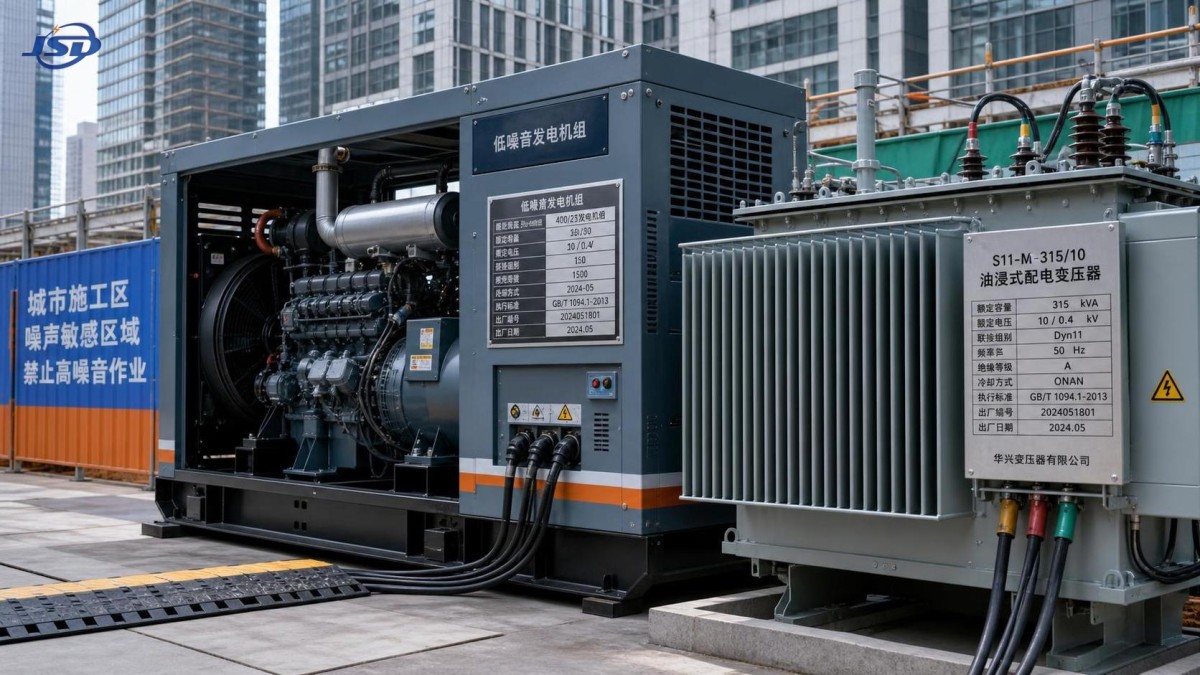
Where open type units usually become difficult
Open type generators are not automatically unsuitable for urban work. But they become harder to justify in several recurring scenarios.
- Projects adjacent to residential buildings, hotels, schools, or medical facilities
- Night works with narrow noise allowances or complaint-sensitive stakeholders
- Sites with limited stand-off distance between equipment and the boundary
- Basement ramps, courtyards, undercrofts, or reflective spaces that intensify noise
- Projects already under environmental scrutiny for dust, traffic, or community disturbance
In these conditions, the issue is not only whether the generator can pass a one-time reading. The broader concern is whether the arrangement is robust enough to remain compliant as load changes, barriers are moved, or neighboring occupancy patterns shift.
What quality and safety managers should verify before approval
The strongest site decisions are made before equipment arrives. Once a generator is mobilized, commercial pressure tends to push teams toward making it work, even when controls are marginal. A more disciplined review should cover the following.
Applicable limits and contract conditions
Check local environmental rules, permit conditions, project specifications, and client-imposed nuisance clauses. In many projects, the strictest requirement may come from the contract rather than from public regulation. If there is any uncertainty about the applicable threshold or measurement method, treat it as 【待核实】 and resolve it before approval.
Supplier acoustic documentation
Request the declared noise data, test basis, distance, loading condition, and any assumptions behind the rating. If the supplier cannot explain the figure clearly, that is already a procurement risk. For temporary power packages connected to broader distribution systems, teams sometimes compare noise-driven equipment choices alongside permanent network components such as 33kV Oil-Immersed Power Distribution Transformer installations, because both require early coordination of safety, siting, and infrastructure interfaces even though their compliance focus differs.
Site layout review
Map the actual location of receptors, boundaries, access routes, fuel handling, cable runs, and ventilation needs. The quietest theoretical position is not always workable if it creates trip hazards, exhaust issues, fire separation concerns, or difficult refueling access.
Control measure feasibility
Noise barriers, enclosures, silencers, anti-vibration mounts, and orientation changes can all help, but only if they are practical on site. Temporary barriers that are frequently removed for access should not be treated as reliable permanent controls.
Monitoring and escalation
Decide in advance who will measure noise, when readings will be taken, what instrument standard is required, and what happens if results are borderline. Without a response plan, the first complaint often becomes the first real test of the system.
Common claims that deserve caution
Several familiar statements around open type generators are true only under limited conditions.
“We can solve it with a barrier.”
Sometimes yes, but barriers are not universal solutions. Their effectiveness depends on height, continuity, placement relative to source and receptor, and whether exhaust or ventilation paths bypass the screen. Poorly positioned barriers may deliver less benefit than expected.
“The site is already noisy, so the generator will not matter.”
This is a risky assumption. Background noise does not automatically permit additional tonal or intermittent source noise, especially at sensitive times. Complaint-driven enforcement often focuses on perceptibility and nuisance, not simply on average site loudness.
“It is temporary equipment, so standards are more relaxed.”
Temporary use may change the administrative path, but it does not remove the need for control. In many urban projects, temporary power equipment receives close attention because it is mobile, visible, and often runs outside standard daytime construction patterns.
“Open type is fine if workers have hearing protection.”
Worker protection addresses occupational exposure near the source. It does not solve community noise, permit compliance, or nuisance risk at the boundary. These are separate control objectives and should not be mixed.
When the economics of open type become less convincing
Open type units are often selected because the initial equipment cost appears favorable. On urban sites, that comparison can break down once indirect controls are included. Additional acoustic screens, labor for repositioning, delayed operating windows, repeat measurements, community relations effort, and lost productivity from restricted hours can materially change the total cost picture.
This is why some teams increasingly assess temporary power in terms of “usable operating envelope” rather than purchase price alone. A cheaper unit that cannot run when needed is not cheaper in project terms. That logic is familiar across power equipment planning more broadly. Whether the discussion concerns a temporary generator package or a fixed asset such as a 33kV Oil-Immersed Power Distribution Transformer, the right question is whether the equipment can perform within the site’s real operating constraints, not simply whether it meets a nominal technical requirement.
A practical approval framework
For QC and safety managers, a useful internal review can be reduced to a short decision sequence:
If several of these answers remain unclear, approval should be conditional rather than automatic. A short delay before mobilization is usually less costly than a late-stage shutdown or neighborhood complaint escalation.
The standards angle is broader than one machine
Because this is ultimately a standards and compliance issue, the site team should resist treating noise as a purely environmental checkbox. It intersects with equipment quality, installation discipline, contractor supervision, and incident prevention. A generator that vibrates excessively, has poor exhaust control, or is installed without adequate separation can create not only noise problems but also fuel, fire, and maintenance risks.
That is why the best-performing teams usually align procurement, HSE, and QA reviews early. The engineering question is straightforward: can the generator supply the load? The standards question is harder: can it do so consistently, measurably, and defensibly under urban constraints? For open type units, that second question is often the one that decides the project outcome.
In short, noise limits do not always prohibit the use of a generator open type unit on urban sites, but they frequently narrow the margin for error. Where site boundaries are tight, operating hours are sensitive, and stakeholders are close, the burden shifts from simple equipment selection to managed compliance. That is the point at which experienced teams stop asking whether open type is possible, and start asking whether it is still the lowest-risk choice.

Get a Quote
Regardless of whether you require general advice or specific support, we are happy to help you.
Send Us Your Inquiry Today

Jinshida Electric remains committed to contributing to global energy development through professional manufacturing and superior service.