





Are high voltage transformers rated above 230 kV increasingly specified with partial discharge limits below 5 pC?
Yes—high voltage transformers rated above 230 kV are increasingly specified with partial discharge (PD) limits below 5 pC. This is no longer an outlier requirement but a growing baseline expectation among grid operators, system integrators, and technical evaluation personnel involved in ultra-high-voltage (UHV) transmission projects, new energy interconnection schemes, and critical infrastructure commissioning. The shift reflects tightening insulation design margins, greater reliance on condition-based acceptance testing, and heightened awareness of PD as both a diagnostic indicator and a precursor to long-term dielectric degradation.
For technical evaluators reviewing transformer specifications—especially for 300 kV, 400 kV, or 500 kV class units—the sub-5 pC threshold now serves as a practical proxy for manufacturing maturity, material purity, and process control rigor. It signals that the manufacturer has implemented strict winding impregnation protocols, precise oil degassing, controlled assembly environments, and calibrated PD measurement systems traceable to international standards such as IEC 60270. Failure to meet this limit during factory or site acceptance tests often triggers rework, extended hold periods, or even contractual non-conformance—not because 5 pC represents an absolute failure threshold, but because it correlates strongly with field performance under transient overvoltage stress and thermal cycling.
Why sub-5 pC matters at >230 kV
At voltages exceeding 230 kV, electric field distribution becomes highly sensitive to microscopic voids, interfacial delamination, and particle contamination within solid insulation systems. Even PD activity at 3–4 pC—undetectable by conventional routine tests—can initiate progressive erosion in pressboard barriers or epoxy-resin interfaces over decades of operation. Unlike lower-voltage units where PD may remain localized and stable, high voltage transformers experience amplified stress gradients across complex insulation structures: conductor-to-pressboard gaps, lead exits, and bushing interfaces. Here, cumulative PD pulses accelerate aging through chemical decomposition of cellulose and localized carbonization, eventually reducing time-to-failure under switching surges or lightning impulses.
This behavior is especially consequential in applications demanding high availability and minimal maintenance windows—such as HVDC converter stations, offshore wind interconnections, and nuclear auxiliary power systems. In those contexts, a transformer replacement involves multi-month lead times, complex logistics, and significant grid stability risks. Hence, technical evaluators now treat PD performance not as a pass/fail checkbox, but as a leading indicator of long-term reliability—and one that must be verified under representative voltage waveforms (e.g., AC + DC superposition for HVDC-linked units) and temperature conditions (typically 20–40 °C oil top layer).
What drives the specification trend
The move toward sub-5 pC limits stems from three converging factors: standard evolution, field experience, and supply chain capability. IEC 60076-3:2019 introduced tighter guidance on PD measurement uncertainty and emphasized reproducibility across test labs—a de facto push toward lower reported values. Meanwhile, post-mortem analyses of failed 400 kV units in Asia and Europe consistently identified PD inception points below 10 pC as early markers in 60% of cases where subsequent failures occurred within 12–18 years of service. Finally, advances in vacuum pressure impregnation (VPI), low-gas-content insulating oils, and real-time PD mapping during factory testing have made consistent sub-5 pC performance technically achievable—not just theoretically possible.
That said, achieving <5 pC is not solely about equipment calibration. It requires synchronized control across design (e.g., optimized electrode shaping to suppress field enhancement), materials (e.g., low-void-content pressboard, degassed resin-impregnated paper), and process (e.g., moisture control below 0.5% by weight in cellulose before impregnation). A single deviation—say, insufficient dwell time during vacuum drying or ambient humidity >45% RH during core insertion—can elevate measured PD by an order of magnitude, regardless of final test setup accuracy.
How to verify compliance meaningfully
Technical evaluators should avoid accepting factory PD reports at face value. Instead, verification hinges on three checkpoints:
- Test configuration fidelity: Confirm that measurements were conducted with the transformer fully assembled—including bushings, tap changers, and cooling radiators—and energized at 1.3 × Um/√3 (per IEC 60076-3), not just at 1.1 × Ur. PD levels at elevated voltage better expose weak spots masked at nominal test voltage.
- Background noise suppression: Require evidence of background subtraction using calibrated pulse injection and spectral gating. Ambient RF interference near substations or industrial plants can easily mimic internal PD; true sub-5 pC validation demands signal-to-noise ratios >20 dB across the 100–500 kHz band.
- Stability over time: Request PD magnitude and phase-resolved patterns recorded over ≥30 minutes at constant voltage. A unit showing drift from 3.2 pC to 4.8 pC within 20 minutes likely has residual moisture or trapped gas—not a stable insulation system.
When discrepancies arise between factory and site test results, prioritize root-cause analysis over retesting. Common contributors include improper grounding of test leads, unshielded cable routing near the unit, or incomplete oil filling causing false cavity discharges. These are process issues—not inherent design flaws—and warrant corrective action before commissioning.
Application-specific considerations
While sub-5 pC is becoming standard for EHV transmission transformers, its relevance varies across application classes. For instance, rectifier duty transformers—such as those used in electrolysis, electroplating, or metallurgical processes—face different stress profiles: harmonic-rich currents, frequent load transients, and DC bias effects. In those cases, PD limits are often set at ≤10 pC during AC testing, with additional focus on thermal stability and harmonic loss management. Jinshida Electric’s Isolation and Rectifier Special Transformer series, for example, is engineered with 100% copper windings, custom-designed magnetic shunts, and enhanced cooling to maintain dielectric integrity under sustained non-sinusoidal excitation—even when PD is not the primary acceptance metric.
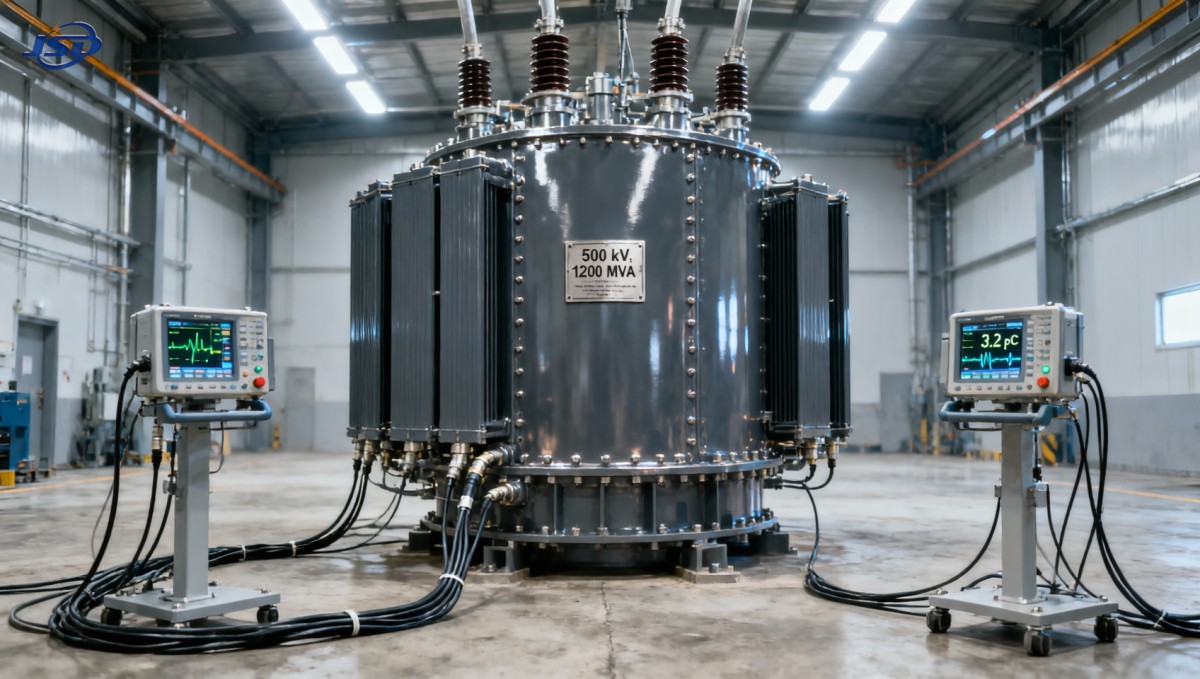
That distinction underscores a key principle for technical evaluators: PD limits must align with actual operating stresses. Specifying <5 pC for a 35 kV rectifier transformer adds cost and complexity without commensurate reliability gains. Conversely, applying a generic 10 pC limit to a 500 kV autotransformer ignores proven correlations between early PD activity and accelerated aging in UHV insulation systems. Contextual alignment—not blanket thresholds—is what separates robust specification from procedural compliance.
Manufacturing capability as a differentiator
Meeting sub-5 pC consistently demands more than calibrated test gear. It requires integrated quality control: real-time moisture monitoring during drying cycles, automated winding tension control to prevent paper damage, and closed-loop oil processing with online gas chromatography. Manufacturers lacking these capabilities may achieve occasional compliance—but fail repeatability audits or batch-to-batch consistency checks. At Jinshida Electric Power Technology Co., Ltd., sub-5 pC compliance for 230 kV+ units is validated across ≥95% of production batches over the past three years, supported by ISO 9001-certified processes and third-party witnessed type tests per IEC 60076-3. This consistency enables technical evaluators to treat PD data as a predictive parameter—not just a contractual obligation.
Ultimately, the rising prevalence of sub-5 pC limits reflects a maturing industry consensus: that partial discharge is not merely a factory test artifact, but a quantifiable expression of insulation health. For technical evaluation personnel, interpreting PD data correctly—within voltage class, application context, and manufacturing capability—remains essential to ensuring decades of safe, stable, and efficient high voltage transformer operation.

Get a Quote
Regardless of whether you require general advice or specific support, we are happy to help you.
Send Us Your Inquiry Today

Jinshida Electric remains committed to contributing to global energy development through professional manufacturing and superior service.