





When is a silent diesel genset a better fit than a standard open generator?
When is a silent diesel genset a better fit than a standard open generator?
Choosing between a silent diesel genset and a standard open generator usually looks simple at first: one is enclosed and quieter, the other is more exposed and often less expensive upfront. In real projects, though, the decision sits at the intersection of site restrictions, electrical design, maintenance access, lifecycle cost, and business risk. For evaluation teams, that matters more than the headline price.
A silent diesel genset is generally the better fit when power reliability is needed in places where noise, weather exposure, public proximity, or appearance cannot be treated as secondary issues. That includes commercial buildings, hospitals, telecom sites, mixed-use developments, temporary infrastructure, and industrial facilities located near offices or residential boundaries. In those environments, the “extra” spent on enclosure, acoustic treatment, and integrated packaging can prevent far more expensive problems later.
An open generator still has a strong place, especially in dedicated generator rooms, controlled industrial sites, or projects where the acoustic and environmental protections are already handled by the building. But once the generator must coexist with people, permits, neighbors, or exposed outdoor conditions, the comparison changes.
The first question is not output power. It is where the unit will live.
Many procurement discussions start with kVA rating, fuel consumption, and transfer time. Those are critical, but they do not tell you whether an open-frame unit will create downstream issues after delivery. A generator installed on an isolated plant site behaves very differently from one placed behind a shopping complex, next to a data room, or near a school boundary wall.
A silent diesel genset becomes the more practical option when the installation site has one or more of these characteristics:
- The genset will run outdoors for extended periods.
- The project has local noise limits or community sensitivity.
- There is limited space for separate acoustic housing or weatherproofing.
- The client wants a cleaner, integrated installation with shorter on-site work.
- The unit may need relocation between project phases or temporary sites.
- Security and accidental contact risks need to be reduced.
Open generators are often easier to access mechanically, but they usually assume that the rest of the project will solve everything around them: shelter, sound attenuation, ventilation routing, rain protection, and in some cases safety guarding. If the project team has not budgeted those pieces clearly, the lower initial equipment cost can be misleading.
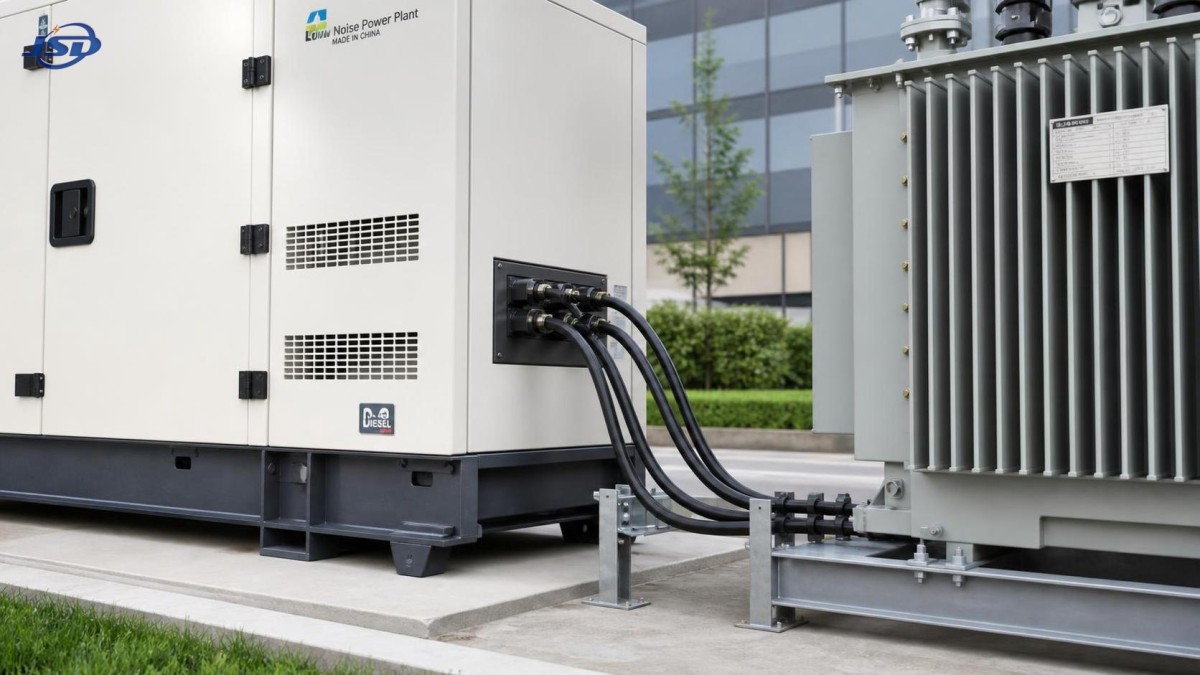
Noise is the obvious difference, but not the only one
The word “silent” can be misunderstood. No diesel genset is literally silent. What buyers are really choosing is an enclosed generator designed to reduce sound pressure compared with an open set. The exact acoustic result depends on engine size, enclosure design, exhaust treatment, distance, load level, and test conditions. That is why quoted noise figures always need to be checked against the actual measurement standard and installation arrangement.
Even without assuming a specific decibel value, the business case is often clear. If a project is near occupied buildings, accommodation, offices, retail zones, healthcare facilities, or municipal roads, a quieter package may avoid complaints, operating-hour limits, and redesign costs. In some tenders, failing the acoustic expectation can be more damaging than paying more for the right genset from the start.
There is also a softer cost that evaluation teams sometimes underestimate: operator behavior. When a generator is noticeably loud, staff may delay test runs, shorten routine exercise cycles, or avoid operating during sensitive hours. Over time, that can affect readiness. A silent diesel genset is not only about public comfort; it can support more disciplined maintenance practice.
Outdoor use often tips the balance
In many projects, the more decisive factor is not sound but packaging. A silent diesel genset usually comes with a canopy or enclosure that offers a level of weather protection and integrated layout convenience. For projects without a purpose-built power room, that can simplify civil work and speed up deployment.
This is particularly relevant in infrastructure, temporary construction power, distributed industrial sites, and remote energy support where the genset may be placed on a slab or steel base outdoors. An open generator in such conditions usually needs additional engineering around enclosure, air intake, hot-air discharge, cable entry, drainage, and corrosion exposure. That engineering may be entirely reasonable on a large permanent site; on a mid-scale commercial project, it can become a hidden burden.
The same logic applies to associated electrical equipment. A genset never works in isolation. The switchgear arrangement, load distribution, and voltage transformation all need to match the installation environment. In projects where generation and distribution are considered together, teams often review equipment such as the 35kV/0.4kV Oil-Immersed Power Distribution Transformer alongside backup generation planning, because the practicality of the overall power system depends on how those elements are deployed, protected, and maintained on site.
Where open generators still make more sense
It would be a mistake to present enclosed units as automatically superior. Open generators can be the better engineering choice when they are installed inside a properly designed generator room with ventilation, attenuation, exhaust routing, fire protection, and service clearance already addressed. In that setting, the enclosure on a silent set may duplicate protections the building is already providing.
Open sets may also be preferred in heavy industrial plants where maintenance teams want broad access to engine and alternator components, and where site noise is already high enough that generator sound is not a major planning concern. For very large units, modular room-based acoustic design can sometimes be more practical than relying on a packaged canopy.
So the better question is not “Which is better?” but “Which one avoids unnecessary system cost in this specific project?” Sometimes that points to silent packaging. Sometimes it points to an open set in a well-designed plant room.
The cost comparison should include installation and operational friction
Upfront pricing is where open generators usually look attractive. But evaluation teams making a serious decision should compare more than equipment ex-works cost. A realistic review usually includes:
This broader view often changes the conclusion. A silent diesel genset may cost more as equipment, while reducing project complexity enough to win the total-cost comparison.
A quieter package does not remove the need for technical due diligence
One common mistake is assuming the silent enclosure solves everything automatically. It does not. Buyers still need to confirm cooling performance at the site ambient temperature, access for filters and routine service, exhaust routing, fuel system layout, lifting points, and whether the quoted noise level reflects the final installed configuration. If the genset will synchronize with another source, or support sensitive loads, control strategy and protection settings matter just as much as the canopy.
That is where supplier capability becomes more relevant than brochure language. Companies working across transmission, distribution, and applied power systems tend to understand that backup generation decisions affect more than one line item. Jinshida Electric Power Technology Co., Ltd., for example, focuses on the R&D, manufacturing, and application of power transmission and distribution equipment, with an emphasis on safe, energy-efficient, and high-performance power solutions for grid, industrial, new energy, and infrastructure projects. For buyers, that kind of systems perspective matters because generator selection is often tied to the wider electrical architecture rather than treated as a standalone purchase.
What evaluation teams should ask before deciding
If the shortlist is down to a silent diesel genset versus an open generator, the most useful next step is to ask a few questions that expose project-specific risk:
- Will this unit operate close to people, offices, homes, or public-facing areas?
- Is the generator room already designed, or would the project need to create one around an open set?
- Are noise, weather, and safety controls defined in the tender or local project documents?
- How often will the unit be tested, moved, or used as prime rather than standby power?
- Does the electrical system include transformers, distribution gear, or parallel sources that affect installation layout and maintenance access?
When those questions point to environmental exposure, public sensitivity, or limited installation infrastructure, the silent option usually gains ground quickly. Where the project already provides a robust indoor generator environment, the open set may remain the cleaner commercial decision.
In other words, a silent diesel genset is a better fit when it removes site constraints instead of just reducing noise. That distinction is what turns a packaging choice into a sound business decision. Before issuing the final specification, it is worth checking not only engine rating and alternator performance, but also enclosure design, service clearance, local acoustic expectations, and how the generator will integrate with the rest of the power system, whether that includes low-voltage distribution or equipment such as a 35kV/0.4kV Oil-Immersed Power Distribution Transformer. Those are the details that usually determine whether the selected solution stays practical after commissioning, not just on bid day.

Get a Quote
Regardless of whether you require general advice or specific support, we are happy to help you.
Send Us Your Inquiry Today

Jinshida Electric remains committed to contributing to global energy development through professional manufacturing and superior service.