





How often should a silent diesel generator be serviced in standby operation?
When a site loses utility power in the middle of the night, nobody on the after-sales team wants to discover that the standby generator has been “available” only on paper. That is why the question comes up so often in maintenance work: how often should a silent diesel generator be serviced in standby operation?
The short answer is this: standby units should be checked regularly, exercised on schedule, and serviced by both calendar time and engine hours. Even if the generator rarely runs under real load, oil ages, batteries weaken, coolant chemistry changes, seals dry out, and fuel can degrade. For maintenance personnel, the real job is not simply reacting to faults but preventing the quiet kind of failure that only appears during an emergency.
In practical terms, most standby generators need routine visual inspections weekly or monthly, functional test runs monthly, and preventive maintenance every 6 to 12 months, depending on manufacturer guidance, environment, and actual operating conditions. The exact interval should never be based on “low usage” alone.
Why standby operation still requires frequent service
A common misunderstanding is that fewer running hours mean less maintenance. For a prime power unit, service intervals are easy to justify because wear is visible. A standby generator is different. It may sit quietly for weeks, yet several risks continue in the background:
- Battery self-discharge and charger faults
- Fuel contamination, water ingress, or microbial growth
- Lubricating oil oxidation and moisture accumulation
- Coolant deterioration
- Loose terminals caused by vibration over time
- Control panel alarms that go unnoticed
- Insulation aging and dust buildup in the enclosure
Silent enclosures also create a false sense of security. Because the machine is enclosed and noise is reduced, some developing issues are easier to miss than on open-frame equipment. Minor leakage, restricted airflow, rodent intrusion, or exhaust deterioration may remain hidden until a test run or actual outage exposes them.
A practical service rhythm for after-sales maintenance teams
Instead of relying on a single service interval, it is more useful to think in layers: routine observation, scheduled testing, and periodic replacement of consumables.
Weekly or biweekly checks for critical standby sites
For hospitals, telecom rooms, data support systems, industrial lines, and infrastructure projects where outage risk is unacceptable, a weekly or biweekly quick inspection is sensible. This does not need to become a major maintenance event. The aim is to confirm readiness.
Typical checkpoints include fuel level, coolant level, oil level, battery voltage, charger status, control panel alarms, breaker position, abnormal odor, fluid leakage, and the general condition of the enclosure and ventilation path.
If the site is less critical and conditions are stable, these checks may move to a monthly cycle. But for high-consequence applications, longer gaps can be risky.
Monthly test runs are often the minimum standard
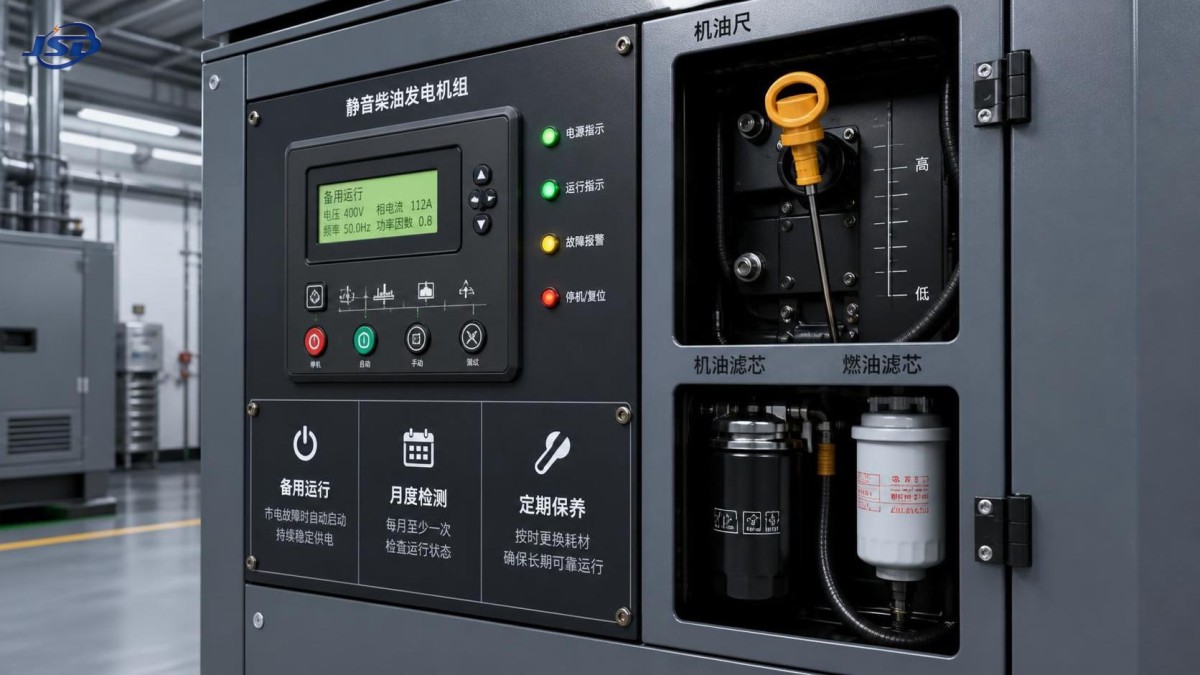
Most standby generator programs include a monthly exercise run. This is often the most important recurring task because it reveals problems that static inspection cannot. Starting performance, battery health, exhaust condition, abnormal vibration, voltage stability, and controller behavior all become easier to judge when the machine actually runs.
Where possible, the test should not be limited to idle operation. A light or moderate load test is more meaningful than an unloaded run because it helps the engine reach proper operating temperature, reduces the chance of wet stacking, and confirms that the alternator and controls respond correctly under working conditions.
For a silent diesel generator used only for standby duty, monthly exercise is usually a better baseline than “run it occasionally when someone remembers.” Random testing often leads to missed intervals and incomplete records.
Quarterly checks for fluid condition and electrical integrity
Every three months, many maintenance teams add a deeper inspection. This may include checking belt tension and wear, cleaning battery terminals, verifying grounding connections, inspecting hoses and clamps, draining water from the fuel-water separator if fitted, and reviewing operating logs and alarm history.
This is also a good time to inspect the ATS interface and remote start logic. In standby systems, the generator may be healthy while the transfer sequence fails elsewhere. After-sales personnel know that emergency power reliability depends on the system, not just the engine.
Every 6 to 12 months: preventive maintenance service
At least once or twice a year, a planned maintenance visit should include the consumables and adjustments that cannot wait for a breakdown. The exact scope depends on the manufacturer manual, but typically includes:
- Engine oil and oil filter change
- Fuel filter replacement as required
- Air filter inspection or replacement based on condition
- Coolant concentration and condition check
- Battery load test or replacement assessment
- Exhaust system inspection
- Fastener and terminal tightening
- Control system parameter review
- Insulation and output verification when appropriate
If the generator has accumulated significant operating hours during power interruptions or commissioning tests, hour-based service may arrive sooner than the annual date. In other words, use whichever comes first: calendar interval or engine-hour interval.
What changes the service interval?
No serious maintenance program treats all units the same. Service frequency should be adjusted when certain site conditions are present.
1. Environment
Generators installed in dusty industrial plants, coastal areas, humid substations, hot climates, or construction-related environments need closer attention. Filters clog faster, corrosion advances quicker, and enclosure ventilation can be compromised. A clean indoor standby room and an exposed outdoor installation do not age at the same rate.
2. Fuel storage conditions
Standby generators often keep fuel for extended periods, which makes fuel management a major factor. If the site has poor tank sealing, inconsistent fuel turnover, or a history of contamination, inspection frequency should increase. Fuel quality issues can make a generator fail to start even when all mechanical systems appear normal.
3. Load profile during testing
Units exercised without meaningful load may require additional attention. Low-load operation can contribute to incomplete combustion and carbon buildup. If load-bank testing is rarely performed, maintenance teams should be more alert to exhaust condition, injector cleanliness, and signs of wet stacking.
4. Duty history
A generator that sat unused for six months is different from one that handled several outage events in one storm season. Always review the running history, not just the schedule. Emergency use accelerates service needs, even on standby-rated equipment.
5. Site criticality
In some facilities, generator failure means inconvenience. In others, it means production loss, safety risk, or interruption to essential services. The more critical the site, the less acceptable it is to stretch maintenance intervals.
Service points that are often missed in silent units
Because maintenance staff often focus on engine essentials, a few silent-generator-specific items may be overlooked.
Enclosure airflow matters. Acoustic design reduces noise, but any blockage in intake or discharge paths can cause overheating. Dust, packaging debris, nests, or damaged louvers should not be ignored.
Door seals and latches deserve attention too. Water ingress into a silent canopy can damage insulation, corrode connectors, and shorten battery life.
Exhaust routing should be checked for looseness, excessive back pressure, or insulation damage. In enclosed designs, heat accumulation can become a hidden problem.
Vibration isolation components also age over time. If mounts harden or shift, the unit may remain “operational” but run with greater stress when finally called into service.
How to decide between monthly, quarterly, and annual tasks
For after-sales maintenance teams managing multiple sites, it helps to split tasks by failure risk:
- Monthly: readiness items that affect starting and immediate operation
- Quarterly: condition items that influence reliability over time
- 6–12 months: consumables, fluid service, and deeper verification
This approach is especially useful when supporting mixed equipment fleets. Some projects may also include different generator configurations, from enclosed low-noise sets to more accessible units such as the Open Type Diesel Generator Set, where inspection visibility is higher but environmental exposure may be greater. Maintenance intervals still need to be matched to duty pattern, site cleanliness, and power continuity requirements.
Warning signs that service should happen sooner
Even if the calendar says the next maintenance visit is weeks away, certain symptoms justify immediate action:
- Slow or failed starting during exercise
- Battery charger alarm or unstable voltage
- Visible oil, fuel, or coolant leakage
- Black smoke, unusual exhaust odor, or wet stacking signs
- Abnormal noise, vibration, or hunting speed
- High coolant temperature during test run
- Frequent controller alarms or communication loss
- Fuel discoloration or water contamination
For standby equipment, these are not minor annoyances. They are early warnings that the machine may not respond correctly in an actual outage.
Recordkeeping is part of maintenance, not paperwork
One of the most effective habits in after-sales support is disciplined recordkeeping. A service log should track inspection dates, run duration, load conditions, fluid replacement, alarm history, battery readings, and any recurring issues. Without this history, teams often repeat the same checks while missing long-term trends.
In power equipment applications tied to grid support, industrial manufacturing, new energy projects, and infrastructure, reliability is built through consistency. Companies focused on transmission and distribution solutions understand this well: stable emergency power is rarely the result of one good repair; it is the result of a maintenance system that catches small issues before they grow.
That same thinking applies whether the standby installation is a silent canopy model or another site configuration such as an Open Type Diesel Generator Set. The equipment format changes the inspection approach, but not the need for disciplined preventive care.
So, how often should a silent diesel generator be serviced?
If you need a practical benchmark, use this: inspect monthly at minimum, exercise monthly, review more deeply every quarter, and complete preventive maintenance every 6 to 12 months or according to engine hours—whichever comes first. For critical sites or harsh environments, shorten the interval.
For after-sales maintenance personnel, the best service schedule is not the one that looks efficient on paper. It is the one that keeps the generator ready for the one moment when failure is not an option. A silent diesel generator in standby operation may spend most of its life waiting, but maintenance teams should never do the same.

Get a Quote
Regardless of whether you require general advice or specific support, we are happy to help you.
Send Us Your Inquiry Today

Jinshida Electric remains committed to contributing to global energy development through professional manufacturing and superior service.