





When does an ESS energy storage system make sense for a factory
When does an ESS energy storage system make sense for a factory?
For many factories, the question is no longer whether energy costs are rising. They are. The more practical question is whether an ess energy storage system can solve a real operating problem, rather than just add another line item to the capital budget.
In manufacturing, power decisions are rarely isolated. They sit between production planning, transformer loading, utility tariffs, backup requirements, and increasingly, renewable integration. A storage system makes sense when it addresses one or more of those issues in a measurable way. If it does not, even a technically sound project can end up underused.
That is why the right starting point is not battery capacity. It is the factory load profile.
The best ESS projects begin with a problem, not a product
Factories often look at storage after hearing about peak shaving or solar self-consumption, but the real trigger is usually more specific. A plant may face sharp demand spikes from motors, furnaces, compressors, or production lines starting together. Another may be dealing with frequent short-duration voltage events that do not justify a full-scale standby generation system but still disrupt sensitive processes. In some sites, the utility tariff itself creates the business case, especially where demand charges or time-of-use pricing are aggressive.
An ess energy storage system tends to make sense when at least one of these conditions exists:
- Peak demand charges are high enough that shaving short intervals has value.
- The factory has recurring load volatility that strains upstream electrical equipment.
- Brief outages or grid instability create production losses larger than the cost of storage.
- There is onsite solar or planned renewable generation that would otherwise be curtailed or underused.
- Capacity expansion from the utility is slow, expensive, or uncertain.
If none of those are true, the financial logic becomes weaker. Storage is not automatically the cheapest path to lower electricity bills. In some factories, power factor correction, process scheduling, motor soft-start strategies, or transformer reconfiguration will produce faster returns with less complexity.
Peak shaving is often the clearest use case
In practice, peak shaving is where many industrial ESS projects prove their value first. Not because it sounds advanced, but because it matches how factories actually consume power: mostly stable base load, interrupted by expensive peaks.
A stamping workshop, injection molding plant, or metal processing facility may only hit its highest demand for a limited number of intervals each month. Yet those intervals can shape a large part of the utility bill. Storage can discharge during those windows and reduce the billed peak. The key detail is duration. Some peaks last 10 to 20 minutes. Others persist for hours during full production. A battery sized for the first pattern may be cost-effective; a battery sized for the second may become too large to justify.
This is where many early evaluations go wrong. Decision-makers focus on total monthly consumption, but the ESS design depends more on the shape and timing of load than on the total kilowatt-hours purchased.
Looking at 15-minute or 30-minute interval data usually tells the truth quickly. If the plant has narrow, predictable peaks, storage deserves serious analysis. If the load is already flat and high all day, the savings opportunity may be limited.
Backup power matters, but it is not all the same
Some factories consider an ess energy storage system because they want backup power. That can be the right reason, but only if everyone is precise about what “backup” means.
If the objective is to keep the entire factory running through a long outage, battery storage may be expensive unless the outage duration is short or critical loads are limited. If the objective is ride-through power for control systems, automation equipment, critical pumps, data infrastructure, or clean shutdown procedures, storage becomes much more practical.
In other words, ESS is often strongest when it protects process continuity rather than replacing every function of a diesel generator. In some industrial settings, the best architecture is hybrid: storage handles fast response and short interruptions, while generators cover longer events. That approach can also reduce generator oversizing.
Facilities with sensitive equipment should also look beyond outage frequency. Voltage sag, flicker, and short transients may create more hidden cost than blackouts, especially where rejected batches, line resets, or equipment trips are involved. Whether storage can address that depends on the power electronics design, site protection coordination, and the actual disturbance profile.
The transformer side of the decision is often overlooked
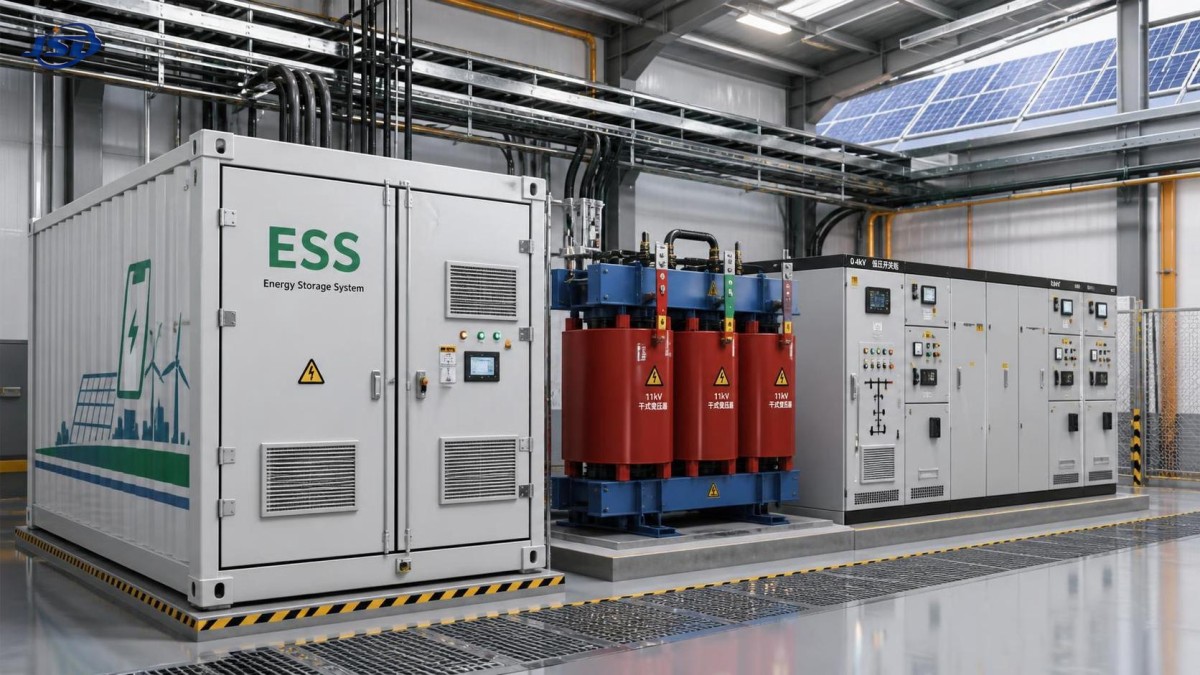
Since factory power systems are built around transformation and distribution, ESS should never be evaluated as a battery-only decision. It affects feeder loading, protection settings, short-circuit behavior, harmonics, and transformer thermal performance.
That matters especially in plants where the existing distribution transformer is already operating near practical limits during production peaks. In some cases, storage can reduce temporary overload stress and delay a transformer upgrade. In others, adding storage actually requires a more careful review of switching arrangements, cable sizing, and coordination on the medium- and low-voltage side.
For indoor industrial applications, dry-type equipment is often considered where fire behavior, maintenance convenience, or installation environment is a concern. In projects tied to medium-voltage distribution upgrades, components such as the 11kV Three-Phase Cast Resin Dry-Type Distribution Transformer may fit into the wider electrical design, not because the ESS demands a particular product by default, but because storage projects frequently expose weaknesses or constraints in the existing distribution architecture.
This is one area where experienced power equipment suppliers add value. Companies working across transmission, distribution, and industrial power applications tend to see the whole path from grid connection to end-use load. That broader view matters. Jinshida Electric Power Technology, for example, works in the R&D and manufacturing of transmission and distribution equipment for industrial manufacturing, grid construction, new energy, and infrastructure projects. In ESS discussions, that kind of background is useful because the battery system has to live inside a real electrical network, not a presentation slide.
ESS becomes more attractive when solar is already on the table
Factories installing rooftop or ground-mounted solar often discover that generation and consumption do not line up as neatly as expected. Weekend production may be low. Midday output may exceed onsite demand for periods. Or export rules may be restrictive. Under those conditions, storage can improve self-consumption and reduce wasted generation.
Still, it is a mistake to assume every solar factory needs batteries. If the plant already consumes most of its solar output in real time, the incremental value of storage may be modest. The stronger case appears when solar production regularly overshoots load, when evening tariffs are high, or when the plant wants more resilience from its distributed energy setup.
Here again, tariff structure decides a lot. Without understanding import prices, export compensation, and demand charges, it is impossible to judge whether storing solar energy is smarter than using it directly, exporting it, or rescheduling production.
What to check before approving a project
A factory should be cautious if an ESS proposal is built around broad promises without operational detail. Before moving ahead, a few questions usually separate serious projects from optimistic ones:
- What exact load problem is being solved: peak demand, backup, power quality, solar shifting, or deferred capacity expansion?
- How many charge-discharge cycles are expected each day or each week?
- What is the required discharge duration at target power?
- Will the system serve the whole facility or only critical buses?
- How will it interact with existing transformers, switchgear, protection, and controls?
- What operational constraints come from the utility interconnection agreement or local code?
If those answers are vague, the project is probably not ready. A well-grounded ESS decision typically comes from measured interval data, a realistic operating profile, and a single-line review of the electrical system.
It is also worth being honest about maintenance and control. Storage is not a passive box. It brings battery management, thermal management, PCS controls, communications, and system integration questions. None of those are reasons to reject ESS, but they are reasons to treat it like industrial infrastructure rather than a quick utility-saving add-on.
When the answer is probably no
There are factories where an ess energy storage system is technically possible and commercially weak. If the tariff has minimal time-of-use spread, if demand charges are low, if outages are rare and non-critical, and if load is already stable, storage may not earn its keep. The same goes for plants whose main issue is poor internal distribution design rather than energy timing. In those cases, upgrading transformers, feeders, or process controls may be more sensible than adding batteries.
Another caution: some facilities expect storage to fix every power issue at once. It will not. ESS can be very effective, but it works best when the application is narrow enough to model and broad enough to matter financially.
A practical way to decide
For a factory, the right moment to invest in storage usually comes when three things line up: the electrical pain point is clear, the utility pricing rewards action, and the site infrastructure can support integration without hidden upgrade costs.
That is why the decision should involve both operations and power system engineering. A production manager may see lost output from disturbances. A finance team may see demand charges. An electrical engineer may notice that the real bottleneck sits at the transformer or feeder level. Good ESS projects connect all three views.
If the factory is already reviewing distribution upgrades, adding new loads, or expanding solar, that is often the ideal time to evaluate storage in parallel. The economics and the electrical design are easier to optimize together than retrofit separately. And if medium-voltage equipment renewal is part of that conversation, elements such as the 11kV Three-Phase Cast Resin Dry-Type Distribution Transformer may become part of a broader reliability and efficiency plan rather than a standalone purchase.
In the end, an ESS makes sense for a factory when it solves a specific power problem better than the alternatives. Not because storage is fashionable, and not because every modern plant is expected to have one. The facilities that benefit most are usually the ones that do the unglamorous work first: gather interval load data, review the distribution system, test the tariff assumptions, and define exactly what success looks like before the equipment arrives.

Get a Quote
Regardless of whether you require general advice or specific support, we are happy to help you.
Send Us Your Inquiry Today

Jinshida Electric remains committed to contributing to global energy development through professional manufacturing and superior service.