





How to compare a transformer supplier when lead time matters
When lead time becomes the constraint, procurement is no longer comparing suppliers on price alone. The real question is simpler and harder at the same time: which transformer supplier can deliver the required unit on schedule without creating new risk in quality, compliance, installation, or lifecycle cost?
That is usually what buyers are trying to clarify when they search for this topic. They may already have a specification, a project milestone, and pressure from engineering or operations. What they need is not a generic checklist, but a way to separate suppliers that merely promise fast delivery from those that can actually support a time-sensitive project end to end.
In the transformer business, lead time is rarely an isolated issue. It is tied to design freeze, raw material availability, production slotting, test planning, logistics, and documentation readiness. A supplier that quotes a short lead time but depends on unstable material sourcing, incomplete engineering review, or outsourced bottlenecks can easily turn an apparently competitive offer into an expensive delay.
For that reason, the most useful comparison framework is not “Who is cheapest?” or even “Who is fastest?” It is “Who is most likely to deliver the correct transformer, with the correct documentation and test quality, within the time window the project can actually tolerate?”
Start by defining what “lead time matters” really means in your project
Buyers often use the phrase broadly, but urgency can mean different things, and each one changes how a supplier should be evaluated.
- Project-critical delivery: the transformer is on the construction critical path, and a delay affects commissioning.
- Operational replacement: an installed unit has failed or is near failure, and downtime cost is the main concern.
- Capacity expansion: the date matters, but some schedule flexibility exists if technical and commercial terms improve.
- Framework or recurring procurement: the buyer is less focused on one shipment and more focused on whether the supplier can repeatedly meet agreed windows.
This distinction matters because not every short lead-time request should be solved the same way. For example, in an emergency replacement, standardization and stock availability may matter more than optimization. In a new industrial or infrastructure project, technical fit, drawings, interface dimensions, and approval cycles may matter just as much as factory output.
Before comparing suppliers, procurement should align internally on three time thresholds: the latest acceptable ship date, the latest acceptable on-site arrival date, and the point at which a delayed delivery starts creating measurable commercial loss. Without that clarity, every supplier conversation stays too vague to be useful.
A short quoted lead time is not the same as a short achievable lead time
One of the most common mistakes in transformer sourcing is to compare only the headline delivery promise in the quotation. In practice, quoted lead time may or may not include the same scope across suppliers.
When reviewing offers, ask what the quoted period actually starts from and what it includes. Some suppliers count from purchase order receipt. Others count from technical approval, advance payment, or drawing confirmation. A few may quote manufacturing time only, leaving packaging, routine testing, export documentation, or transport booking outside the stated window.
This is where many procurement teams discover that two offers with similar schedules are not comparable at all. One supplier may be offering an integrated timeline through factory testing and shipment release, while another is effectively offering only workshop completion.
A practical comparison should break lead time into stages:
- technical clarification and drawing approval
- core materials and winding materials availability
- production queue and fabrication time
- routine test scheduling
- third-party witness testing, if required
- packing and dispatch readiness
- export and shipping coordination
If a supplier cannot explain these stages clearly, that is already useful information. In urgent procurement, opacity is a risk signal.
Capacity matters, but visible capacity matters more
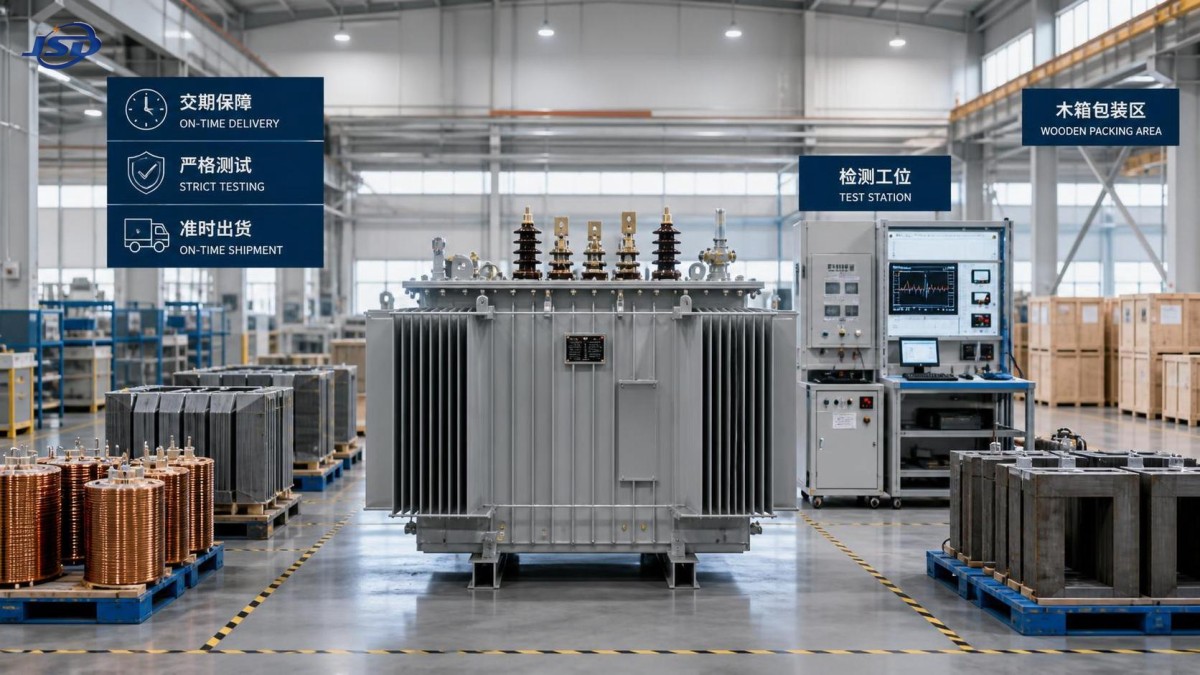
Many suppliers describe themselves as having strong production capacity. That statement is too broad to help a buyer under schedule pressure. What procurement needs to understand is not theoretical annual output, but whether the supplier has visible, controllable capacity for the exact product range being requested.
A manufacturer may be capable in distribution transformers but constrained in medium-voltage or project-specific units. Another may have enough winding and assembly capacity, but limited drying, testing, or painting throughput. These constraints often become visible only after order placement unless buyers ask the right questions early.
Useful questions include:
- What percentage of current capacity is already committed for the relevant production line?
- Are critical processes performed in-house or outsourced?
- Which components have the longest procurement cycle at present?
- How many similar transformers have been delivered in the last 6 to 12 months? 【待核实 by buyer with supplier records】
- Can the supplier show a realistic production schedule for this order size?
For recurring buyers, it is worth distinguishing between suppliers that are simply willing to accept urgent orders and those that have a reliable operating model for them. The latter usually have stronger planning discipline, better supplier coordination, and more predictable internal release processes.
Technical standardization can shorten lead time, but it also limits flexibility
Procurement teams under pressure are often advised to “choose a standard unit” to get faster delivery. In many cases that is sound advice. Standard ratings, common cooling methods, and familiar enclosure or insulation configurations can reduce engineering review time and lower production complexity.
But the phrase can be misleading if it encourages oversimplification. A transformer that is standard for the manufacturer may still be non-standard for the application site. Voltage class, tap range, impedance, altitude, ambient temperature, harmonics, installation footprint, cable entry direction, and local grid conditions can all affect suitability.
The wrong compromise here can create a different delay later: redesign, rejection at site, extra installation work, or performance problems after energization.
In time-sensitive procurement, the better question is not “Can we standardize?” but “Which requirements are essential, and which can be normalized without creating downstream cost?” Engineering, procurement, and project management should answer that together.
Quality control should be evaluated as a schedule issue, not just a reliability issue
Buyers usually treat quality and lead time as separate categories. In reality, poor quality control is one of the most common reasons promised delivery dates slip.
If process discipline is weak, defects appear late in production, routine tests fail, documents need correction, or shipment is held while deviations are resolved. A supplier may still insist the schedule is intact until very close to the promised date, which leaves procurement with little room to react.
This is why a time-critical supplier comparison should include quality questions such as:
- What are the routine test procedures for this transformer type?
- How are non-conformities recorded and closed?
- What is the document control process for drawings, nameplates, and test reports?
- Are insulation materials, copper or aluminum conductors, and magnetic core materials sourced from stable suppliers?
- What certifications or management systems are in place? Specific claims should be checked directly and treated as 【待核实】 until confirmed.
A disciplined manufacturer will usually answer these questions with process detail rather than slogans. That does not guarantee perfect execution, but it is a better predictor than sales language about “strict quality” alone.
In this context, companies with established technical teams and structured manufacturing controls may deserve closer attention, especially when the buyer needs confidence in both delivery and performance. That is one reason some procurement teams look beyond pure trading capability and prefer suppliers with clear engineering and manufacturing ownership, whether evaluating regional specialists or firms such as Jinshida Electric Power Technology in broader power equipment sourcing discussions.
The best urgent supplier is often the one that responds clearly, not just quickly
Fast reply times can create a good first impression, but response speed alone is not the same as execution strength. For urgent projects, buyers should pay close attention to the quality of supplier communication during the quotation stage. It usually predicts how issues will be handled after the order is placed.
Strong indicators include:
- clear identification of missing technical inputs
- transparent assumptions in the quotation
- exceptions listed upfront instead of hidden in later correspondence
- named commercial and technical contacts
- willingness to discuss risk points before the order is awarded
Weak indicators are just as important: generic brochures instead of project-specific clarification, very short commercial validity with little detail, reluctance to confirm standards, and repeated schedule assurances without a manufacturing basis.
In practical procurement work, the supplier that challenges vague specifications early is often more dependable than the one that says “no problem” to everything.
Compare logistics readiness, not only ex-works completion
A transformer is not “on time” because it is finished in the factory. It is on time when it reaches the project in a usable condition, with the right packing, markings, reports, and supporting documents.
This becomes more important in cross-border procurement, where delays can occur after manufacturing is complete. Export packing, transport dimensions, lifting arrangements, customs documentation, insurance coordination, and port congestion can all affect the real delivery outcome.
Procurement should therefore ask suppliers to specify:
- shipment terms and Incoterms basis
- packing method and moisture protection approach
- gross dimensions and transport weight
- document package timing
- whether logistics coordination is handled internally or by a third party
For larger or more specialized units, buyers should also confirm whether any site constraints could affect transport or unloading. A supplier that is fast in production but weak in shipment execution can still miss the project window.
Price comparison is only useful after schedule risk is normalized
When lead time matters, the lowest quoted price can be misleading in two ways. First, it may exclude cost items that become urgent later: faster freight, additional witness testing, accelerated engineering work, special packing, or field support. Second, it may come from a supplier whose schedule risk is materially higher than the competition.
A better commercial comparison is to normalize quotations against the same delivery definition and the same risk assumptions. Buyers can do this with a simple matrix.
Once this is done, procurement can compare total decision value rather than nominal unit price.
Do not ignore after-sales support in urgent purchases
It is easy to deprioritize service questions when the immediate problem is delivery. That can be a mistake, especially for industrial users, utility-related projects, or installations in remote locations.
If energization support, installation guidance, troubleshooting, or spare parts access is likely to matter, the buyer should test the supplier’s support model before placing the order. Some suppliers are responsive during quotation but less structured after shipment. Others have stronger technical follow-through, which can reduce commissioning risk even if their initial quote is not the absolute lowest.
This is particularly relevant where site conditions are demanding or where operating continuity is critical. A transformer delivered on time but poorly supported can still create avoidable delays during installation or startup.
What experienced buyers usually watch for
Over time, procurement teams learn that delivery risk usually appears in patterns. A few recurring warning signs deserve attention:
- a lead time far shorter than peer quotations without a clear explanation
- major technical deviations treated as minor commercial notes
- incomplete test scope definition
- limited visibility into raw material sourcing for critical components
- unclear ownership between manufacturer, trader, and subcontractor
- slow revision turnaround once technical comments are issued
None of these points automatically disqualifies a supplier. But together they change the risk profile, and in urgent procurement the cost of a wrong decision is usually higher than the savings from an aggressive quote.
The most useful outcome of supplier comparison is a defendable decision
In many organizations, procurement is not only buying equipment. It is also creating a decision trail that engineering, finance, project management, and operations can accept. When lead time matters, that internal defensibility becomes even more important.
The strongest supplier comparison is one that documents why a selected offer is credible on schedule, acceptable on technical scope, manageable on quality risk, and reasonable on total cost. That is what protects the project if conditions tighten further or if management later asks why one supplier was chosen over another.
For transformer purchases, especially under schedule pressure, the best supplier is rarely the one with the most attractive headline. It is the one whose manufacturing reality, quality controls, technical clarity, and delivery process still hold up after detailed questioning. That is the comparison that usually saves time in the part of the project where time is most expensive.

Get a Quote
Regardless of whether you require general advice or specific support, we are happy to help you.
Send Us Your Inquiry Today

Jinshida Electric remains committed to contributing to global energy development through professional manufacturing and superior service.