





When Is a Mobile Compact Substation the Right Choice for Temporary Power?
A construction site can look ready for work and still be held back by one missing element: a usable power supply. The utility connection may be available at medium voltage, while cranes, pumps, workshops, and temporary buildings need low-voltage distribution. During a plant shutdown, the problem may be different—the normal transformer is offline, but essential operations cannot stop.
A mobile compact substation transformer can bridge that gap by providing relocatable voltage conversion and distribution equipment. It is a practical choice when a suitable upstream supply exists, the load is substantial enough to justify a packaged installation, and the project needs flexibility without sacrificing electrical protection. Mobility alone, however, is not a reason to choose one. The real question is whether the complete system fits your power source, operating schedule, and site constraints.
The first decision: do you need transformation, generation, or both?
A mobile compact substation does not generate electricity. It typically combines a transformer with medium-voltage switching, low-voltage distribution, protection, and an enclosure or transportable mounting arrangement. The exact equipment included varies by supplier and project specification.
That distinction matters when comparing it with a generator. If a site has no usable electrical source, a substation by itself will not solve the problem. If a utility medium-voltage feeder is available but the site needs 400 V or 415 V power, a mobile substation may be the missing link.
Generator-supported installations are also possible, but voltage, frequency, grounding, fault levels, and protection must be engineered as a complete system. A package designed for a utility feeder should not be assumed to work unchanged with a generator.
Where a mobile installation earns its place
Construction with changing load centers
Large construction projects rarely draw power from one location throughout the schedule. Excavation equipment may dominate early work; later, demand shifts toward mechanical installation, commissioning, and temporary facilities. A relocatable substation can move closer to the active work area, potentially reducing long low-voltage cable runs and associated voltage drop.
But relocation is not an everyday plug-and-play activity. It requires shutdown, isolation, disconnection, transport, reconnection, and appropriate testing. The benefit is greatest when moves are planned around project phases rather than frequent, unpredictable changes.
Planned shutdowns and transformer replacement
During an industrial outage, temporary power may keep drainage, ventilation, workshops, or selected production services operating while permanent equipment is replaced. A mobile package can be positioned and prepared before the shutdown, leaving the outage window focused on controlled switching and connection work.
For project managers, this can simplify scheduling—but only when the bypass route is designed early. Available cable paths, connection points, interlocks, and the return-to-normal sequence deserve as much attention as the transformer rating.
Emergency recovery and interim capacity
After transformer damage or a distribution equipment failure, a mobile unit may restore selected loads while repairs proceed. It can also support an industrial expansion when the permanent substation is not yet ready.
Neither application guarantees immediate energization. Emergency access, utility authorization, earthing arrangements, and commissioning still apply. At hospitals or data centers, temporary transformation must also fit the existing redundancy, UPS, and transfer strategy; it is not a substitute for continuity engineering.
Size the mobile compact substation transformer for the actual load
The sum of equipment nameplate ratings is useful, but it is not a complete sizing method. Some loads never operate together. Others impose a starting demand far above their normal running current. A transformer selected only from average consumption can leave a project with nuisance trips or unacceptable voltage dips.
Ask the electrical team to separate the load schedule into continuous demand, intermittent demand, large motor starts, and sensitive or nonlinear loads. Include the expected project phases: a unit adequate for civil works may become undersized when commissioning begins.
For illustration, a simultaneous demand of 600 kW at a power factor of 0.85 represents approximately 706 kVA before adjustments for starting conditions, environmental derating, harmonics, or future loads. That calculation is a starting point—not a recommendation to select the next standard rating without further study.
- Motor starting: Pumps, compressors, and cranes may require a starting study. Soft starters or variable-frequency drives change the assessment but do not eliminate it.
- Ambient conditions: High temperature, altitude, solar exposure, and restricted airflow can affect usable capacity.
- Nonlinear loads: Drives, welders, and electronic equipment may introduce harmonics requiring additional evaluation.
- Low-voltage current: Large capacity at 400 V means substantial current. Busbars, breakers, terminals, and cables must all support the duty.
- Expansion margin: Allow for credible additional demand, not an arbitrary oversized transformer that complicates transport and increases cost.
Do not use short-term overload capability as routine design capacity. Any overload allowance must be confirmed for the specific transformer, loading history, cooling arrangement, ambient conditions, and monitoring provisions.
The transformer is only one part of the package
A useful way to review the proposed system is to trace power from the source to the final load: medium-voltage connection, switching and protection, transformer, low-voltage main breaker, outgoing circuits, and site distribution. Every interface needs a defined owner and rating.
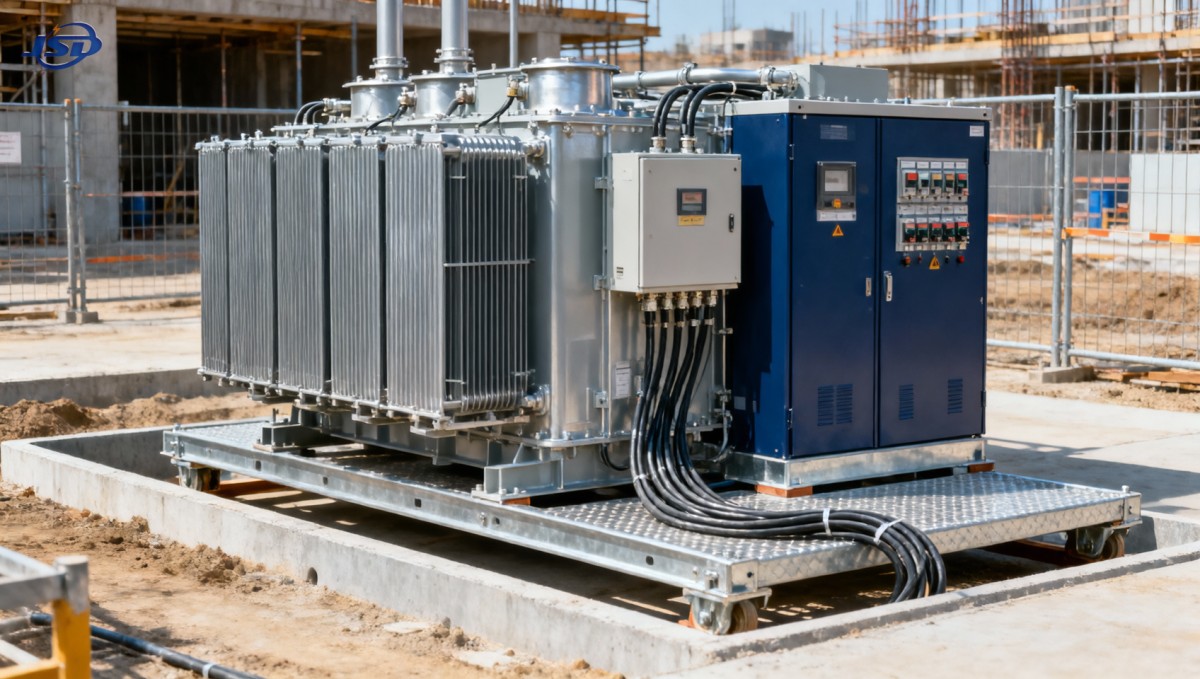
Confirm the incoming voltage and frequency, transformer vector group, impedance, tap arrangement, and neutral configuration. Protection must account for transformer energization inrush while still detecting relevant faults. The available fault current also determines switchgear interrupting ratings and the coordination of downstream protective devices.
For a site with a confirmed 20 kV feeder and 400 V or 415 V loads, Jinshida Electric’s 20kV/0.4kV Oil-Immersed Power Distribution Transformer is a relevant transformer option to evaluate within an engineered package. The listed range covers 50–5,000 kVA, with 50/60 Hz configurations and an optional FR3 vegetable-oil insulating fluid. The selected unit’s frequency, voltage ratio, capacity, and fluid specification should be confirmed in the project datasheet.
A distribution transformer is not automatically a complete mobile substation. Switchgear, structural mounting, transport suitability, enclosure ventilation, cable interfaces, and protection need separate confirmation. Likewise, any listed enclosure protection rating should be checked for its precise scope rather than assumed to cover the entire assembled package.
Oil-filled equipment also requires a site-specific review of fire separation, spill containment, and environmental rules. Choosing an alternative insulating fluid does not remove those responsibilities or eliminate inspection requirements.
“Compact” does not mean the site needs no preparation
The transportable footprint may be small compared with a permanent substation, yet the working installation needs considerably more space. Operators require safe access, cables need suitable bend radii, ventilation must remain unobstructed, and maintenance or emergency response routes must stay clear.
Before approving a location, walk the delivery and installation route with the civil, electrical, and logistics teams. A narrow gate, weak access road, or unavailable crane position can undermine an otherwise workable electrical solution.
- Verify delivered dimensions, total weight, lifting points, and whether transport requires disassembly.
- Provide a level, load-bearing foundation or support arrangement suitable for the selected mounting system.
- Assess flooding, drainage, dust, corrosive atmospheres, and exposure to moving vehicles.
- Protect cable routes from excavation, traffic, sharp edges, and unauthorized access.
- Maintain electrical clearances, security barriers, and safe operating access.
- Confirm whether a skid, trailer, or container arrangement is suitable for the expected relocation frequency.
Earthing needs particular care on temporary sites. A qualified designer should assess the earth grid or electrode arrangement, bonding, neutral treatment, and touch and step voltages under fault conditions. Simply connecting the enclosure to a nearby earth rod is not evidence of an adequate earthing system.
When a mobile solution is the wrong shortcut
A mobile substation is less attractive when the existing low-voltage supply can already meet the load safely. In that situation, better distribution planning may solve the problem with less equipment and fewer interfaces.
It may also be unsuitable where no compatible medium-voltage connection exists, the feeder has insufficient capacity, or connection approval cannot be obtained within the project schedule. Mobility cannot overcome an unavailable power source.
For a long-term installation with a stable load location, compare the mobile option against a permanent substation. Repeated rental extensions, temporary cabling, security arrangements, and maintenance logistics can erode the initial scheduling advantage. Conversely, a reusable unit may make sense for an organization managing several projects—but transport, storage, and recommissioning costs belong in that calculation.
Where interruption is unacceptable, a single mobile transformer remains a single point of failure. Consider redundancy or backup arrangements based on the consequences of losing supply, rather than assuming a temporary installation can accept a lower reliability standard.
Make readiness—not delivery—the schedule milestone
The date equipment arrives is not the date power becomes available. A realistic deployment schedule includes approvals, site preparation, cable installation, protection configuration, testing, and permission to energize.
Before handover, the responsible electrical team should verify the installation against an approved commissioning plan. Depending on the equipment and jurisdiction, this includes relevant insulation checks, earthing and bonding verification, protection testing, interlock checks, phase sequence confirmation, and transformer-specific tests. Energization and load pickup should follow an authorized switching procedure.
The operating plan matters after commissioning as well. Define who can switch the equipment, who monitors loading and temperature, how alarms are handled, and what happens if the unit trips. Keep inspection records, emergency contacts, and isolation instructions accessible to authorized personnel.
What to include in the supplier brief
A clear brief helps suppliers such as Jinshida Electric Power Technology Co., Ltd., whose work covers power transmission and distribution equipment, evaluate the application rather than quote a transformer in isolation. Send the source voltage, frequency, available feeder capacity and fault level, load schedule, largest motor starts, required duration, and expected relocation plan.
Add site temperatures and altitude, access restrictions, layout drawings, cable lengths, utility requirements, and the intended earthing arrangement. Request a documented scope covering switchgear, protection, low-voltage distribution, installation responsibilities, testing, and applicable compliance evidence. Define what is excluded as clearly as what is supplied.
A mobile compact substation is the right choice when it connects an available source to a well-defined temporary load, with manageable installation and operating risks. Its value lies in a coordinated power system that can support the project’s changing needs—not simply in equipment that can be moved. Resolve the source, load, safety, and commissioning questions early, and temporary power becomes a planned part of delivery rather than a last-minute obstacle.

Get a Quote
Regardless of whether you require general advice or specific support, we are happy to help you.
Send Us Your Inquiry Today

Jinshida Electric remains committed to contributing to global energy development through professional manufacturing and superior service.