





Can single phase transformer be used for emergency backup in three-phase UPS systems without phase imbalance risk?
Can a single-phase transformer safely back up a three-phase UPS system?
The question isn’t theoretical — it’s urgent. A data center in Kuala Lumpur lost 47 minutes of runtime during a grid outage because its emergency diesel generator was tied to a single-phase transformer feeding only one leg of a three-phase UPS input. The imbalance tripped the UPS bypass, cascading into a partial shutdown. That incident wasn’t caused by poor maintenance or faulty firmware. It came down to an under-scrutinized assumption: “If it delivers voltage and kVA, it should work.”
When evaluating emergency backup options for three-phase UPS systems, technical assessors often question whether a single phase transformer can be safely integrated without introducing phase imbalance — a critical reliability concern. While cost and availability may favor single phase transformer adoption, its application in inherently balanced three-phase environments demands rigorous analysis of load distribution, harmonic impact, and system coordination. At Jinshida Electric Power Technology Co., Ltd., we combine deep transformer engineering expertise with real-world grid and industrial deployment experience to help assessors make informed, risk-aware decisions — ensuring backup resilience without compromising power quality or system stability.
Why “just voltage” isn’t enough
A three-phase UPS expects symmetrical line-to-line voltages (e.g., 400 V ±1%), near-identical phase currents, and minimal zero-sequence current under normal operation. Introducing a single-phase transformer — say, 400 V → 400 V isolation — on just one phase creates immediate asymmetry:
- Phase A sees full-rated voltage from the transformer; Phases B and C rely on the main utility or static switch — unless they’re also backed up, which defeats the purpose of using a single-phase unit.
- Even if the transformer feeds a local 400 V bus shared across all three phases, its impedance, regulation, and thermal behavior differ from the other two legs — especially under dynamic load steps or harmonic-rich IT loads.
- Zero-sequence harmonics (3rd, 9th, 15th) don’t cancel — they add in the neutral. A single-phase transformer doesn’t manage that path the same way a three-phase unit does. Overheated neutrals, relay misoperations, and unexpected ground-fault alarms follow.
None of this appears in nameplate ratings. You won’t find “phase balance tolerance” listed in kVA or %Z specs. It lives in the interaction — between transformer design, UPS control logic, and site-specific grounding practices.
Where it *can* work — with constraints
There are narrow, validated cases where a single phase transformer functions as part of a three-phase UPS backup strategy — but only when deliberately engineered as a subsystem, not dropped in as a drop-in replacement.
One is auxiliary feed: powering non-critical 230 V single-phase loads (lighting, HVAC controls, fire panels) during extended outages — completely decoupled from the UPS input stage. Another is temporary commissioning support: using a portable 50 kVA single-phase unit to verify UPS bypass functionality before final three-phase integration.
But for direct UPS input backup — especially in mission-critical infrastructure like hospitals, data centers, or industrial process lines — the engineering consensus remains clear: a three-phase transformer matches the system’s native symmetry. Its magnetic coupling, shared core losses, and coordinated tap-changing behavior inherently suppress imbalance far more effectively than three separate single-phase units — let alone one.
What about three single-phase transformers instead?
That’s a common pivot — and technically sounder than one. But it introduces new variables: manufacturing tolerances between units (±5% impedance variation is typical), differential aging, and independent thermal derating. A mismatched set can still produce >5% phase current imbalance at full load — enough to trigger UPS alarms or reduce battery runtime unpredictably.
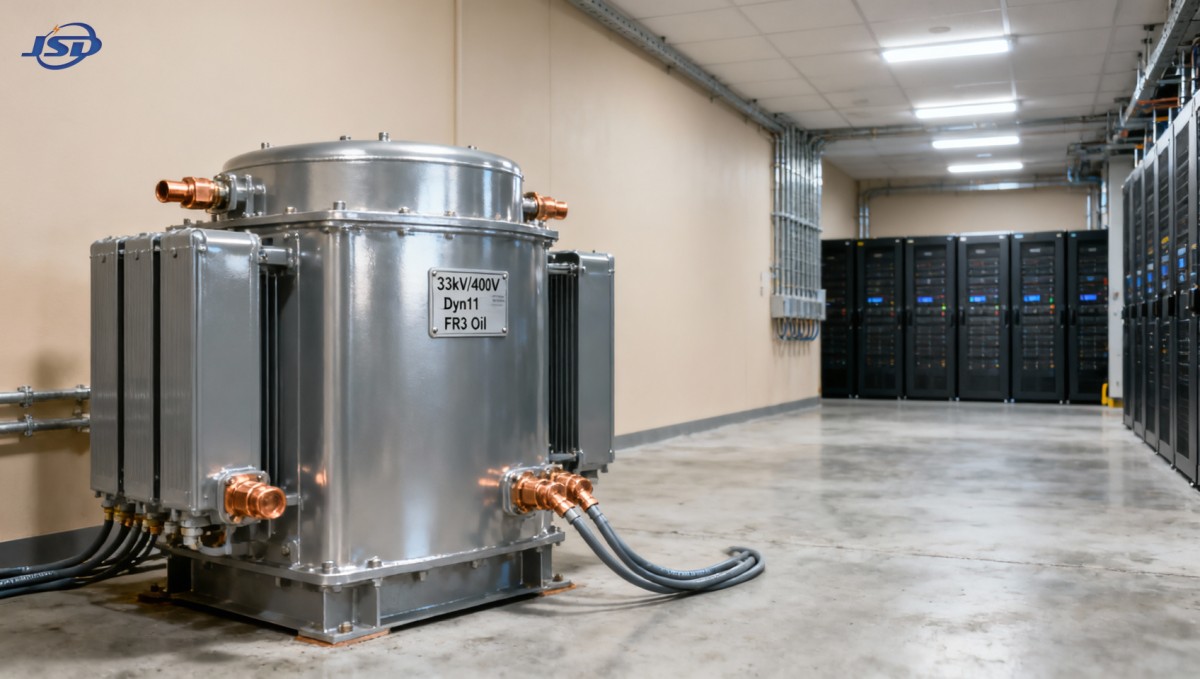
Which brings us to robust alternatives. For sites requiring high-reliability 33 kV to 400 V conversion — especially where space, oil containment, or environmental sensitivity matters — our 33kV Oil-Immersed Power Distribution Transformer offers field-proven performance across rural grids, petrochemical plants, and hospital substations. Built with copper windings, FR3 vegetable oil insulation, and IP65-rated enclosures, it supports short-term overloads up to 150% for two hours — provided oil temperature stays ≤95 °C. Its NLTC design allows precise voltage stabilization across fluctuating upstream conditions, and its 6.5% short-circuit impedance helps dampen harmonic resonance with modern rectifier-based UPS systems.
The decision checklist — no shortcuts
Before approving any transformer for UPS backup duty, ask these five questions — not just of the vendor, but of your own protection relay settings and UPS manuals:
- Does the UPS manufacturer explicitly approve single-phase transformer integration on its input? (Most don’t — check Section 4.2 of your specific model’s installation guide.)
- What’s the maximum allowable phase current imbalance per IEC 62040-3 or IEEE 1668? (Typically 2–3% for continuous operation — not peak.)
- Is neutral current monitored downstream? If not, how will you detect 3rd-harmonic buildup before insulation stress occurs?
- Has the transformer been tested — not just rated — for harmonic loss at 150% THD? Nameplate load loss assumes sinusoidal current.
- What’s the documented field failure mode for similar configurations in your region’s ambient temperature and dust profile?
Jinshida Electric Power Technology Co., Ltd. doesn’t sell transformers — we solve continuity problems. That means reviewing your UPS topology, validating fault-current contributions, and confirming coordination between transformer protection relays and UPS static switch timing. Our team routinely cross-checks vector group compatibility (Dyn11 vs. Yy0), neutral grounding resistance, and even cable length-induced impedance skew — because imbalance rarely starts at the transformer terminals. It accumulates.
Bottom line
A single phase transformer has its place — in lighting circuits, small HVAC units, or legacy control panels. But as primary backup for a three-phase UPS? It introduces asymmetry that’s difficult to quantify, harder to monitor, and impossible to fully compensate for in software alone. The risk isn’t hypothetical. It’s measurable in milliseconds of transfer time, degrees of winding temperature rise, and cycles of neutral conductor fatigue.
If your project requires reliable 33 kV to 400 V conversion with resilience built in — not bolted on — start with a transformer designed for the job, not adapted to it. And if your scenario falls outside standard guidance, bring us the full single-line diagram. We’ll help map where the real imbalances live — before they show up in your event logs.

Get a Quote
Regardless of whether you require general advice or specific support, we are happy to help you.
Send Us Your Inquiry Today

Jinshida Electric remains committed to contributing to global energy development through professional manufacturing and superior service.