





What should you compare before buying a 10 kva generator silent model?
What should you compare before buying a 10 kva generator silent model?
A 10 kva generator silent unit often looks simple on paper: same rating, similar enclosure, similar engine type, and a price gap that may seem easy to explain away. In real procurement, that is where mistakes start. Two generators with the same nominal capacity can behave very differently once they are installed on a construction site, beside a commercial building, or as temporary backup for industrial equipment.
For buying teams, the better question is not just “How much does it cost?” but “What will this machine cost us to run, maintain, and rely on?” Noise level, fuel use, voltage performance, alternator quality, cooling design, service access, spare parts support, and supplier discipline all matter. If the generator will feed transformers, control panels, motors, or sensitive low-voltage loads, poor output quality can create problems that do not show up in a quotation sheet.
That is why comparison should go beyond brochure claims. A silent generator is not simply a smaller diesel set with a canopy. It is part of a power system, and its real value depends on how well it fits the site, the load profile, and the expected service conditions.
Start with the load, not the nameplate
A 10 kva rating is only a starting point. Before comparing brands or suppliers, confirm what the generator is actually expected to power. Continuous lighting and small office loads are very different from motor-driven pumps, air compressors, or mixed loads with high starting current. A unit that appears correctly sized for total connected load may still struggle during startup if the load includes inductive equipment.
Procurement teams should ask at least three practical questions:
- Is the generator for standby, prime, or intermittent mobile use?
- What is the highest starting load, not just the running load?
- Will it supply equipment that is sensitive to voltage fluctuation or frequency drift?
If the generator will interface with distribution equipment or step-up/step-down transformers in a wider temporary power setup, stability becomes more important than headline capacity. In these cases, the alternator and control system deserve as much attention as the engine.
Compare noise data carefully, because “silent” is not a fixed standard
One of the most misleading parts of the market is the word “silent.” In practice, it usually means sound-attenuated rather than truly silent. Suppliers may quote different sound pressure values at different test distances, and sometimes without clearly stating the operating condition. A figure measured at 7 meters cannot be directly compared with one measured at 1 meter or under partial load.
Ask for the test distance, load condition, and whether the enclosure includes standard acoustic treatment or optional upgrades. This matters if the generator will operate near residential zones, hospitals, telecom sites, events, or urban infrastructure projects where local noise restrictions may apply.
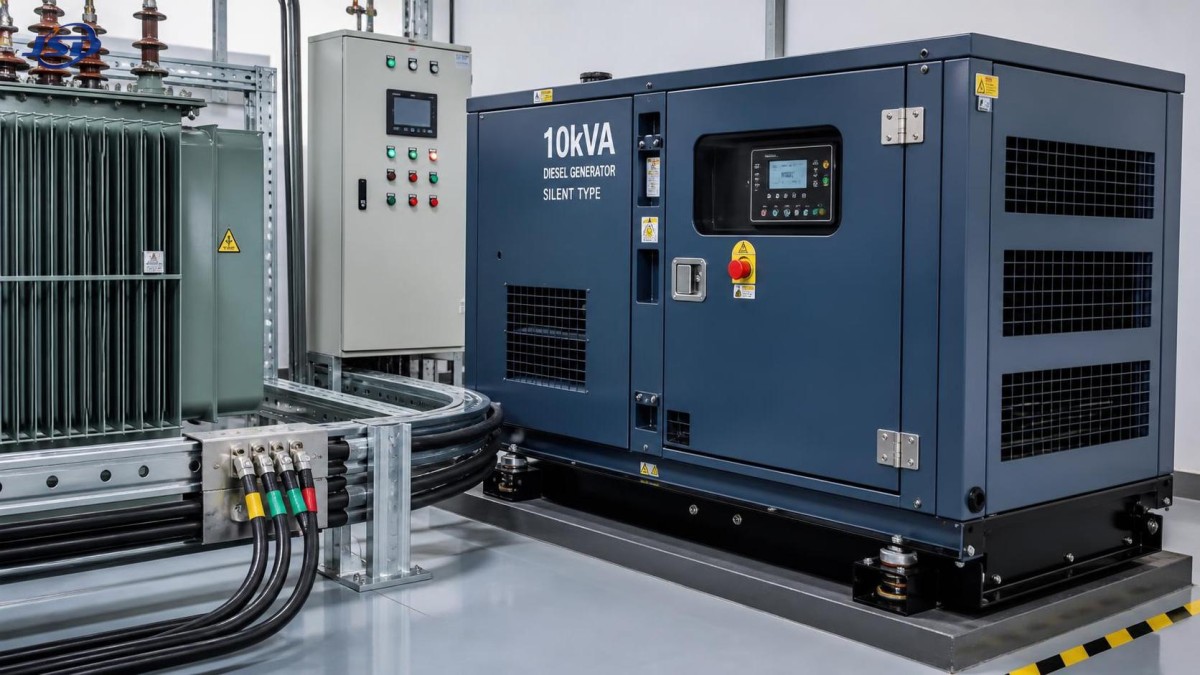
Also compare the enclosure itself. A better canopy design affects more than sound. It can improve airflow path, reduce panel vibration, and make maintenance less awkward. Poor acoustic enclosure design sometimes leads to heat buildup, which creates a different reliability problem.
Fuel efficiency is really a question of operating profile
It is easy to ask which 10 kva generator silent model uses less fuel, but the more useful comparison is fuel consumption at the load levels your site will actually see. Many small generators spend long periods at partial load. If a unit is oversized for the job, it may not run in its best operating range. If it is undersized, it may be stressed, noisier, and less stable.
Fuel tank size should be reviewed together with consumption, not separately. A larger tank may reduce refueling frequency, but it also adds weight and affects trailer or base-frame considerations for mobile use. For remote projects, runtime between refills can be a decisive factor. For urban backup use, compactness and easier handling may matter more.
If the project includes a broader temporary power or hybrid setup, it may be worth comparing whether a generator should run continuously or work alongside storage. In some applications, a battery-based supplement such as the 100kW/215kWh Mobile Trailer Energy Storage System may reduce generator runtime, especially where loads fluctuate and noise or fuel logistics are concerns. That is not a universal replacement for a 10 kva diesel unit, but it is a useful planning reference when mobile power strategies are being compared.
Output quality matters more than many buyers expect
For basic resistive loads, almost any correctly sized generator may appear acceptable. The situation changes when the set is feeding control cabinets, communication devices, protection equipment, variable-speed drives, or transformer-linked distribution systems. Voltage regulation, frequency stability, waveform quality, and response to load changes become much more important.
Some comparisons that deserve attention:
- Alternator brand and winding quality
- Type and responsiveness of the AVR
- Performance under sudden load application or load rejection
- Single-phase or three-phase output configuration
- Compatibility with downstream distribution and protection devices
This is especially relevant in projects where generator power is only one part of the electrical chain. Companies with experience in transmission and distribution equipment tend to understand these interactions better, because generator behavior does not stop at the terminal. Jinshida Electric Power Technology Co., Ltd., for example, focuses on the R&D, manufacturing, and application of power transmission and distribution equipment, which is useful context when a buyer needs to evaluate how source equipment, transformers, and site distribution must work together rather than as isolated items.
Build quality is visible in the small details
Many procurement decisions are made from datasheets, but reliability often shows up in details that are not highlighted in marketing materials. Check the base frame, canopy sheet thickness, coating quality, anti-corrosion treatment, cable routing, vibration isolation, radiator protection, and door hinge strength. These details matter much more in dusty sites, coastal climates, high humidity areas, or projects where the generator will be transported frequently.
Open the access panels if possible. Is routine service straightforward, or will technicians struggle to reach filters, drain points, and battery terminals? A silent generator with poor maintenance access may look compact and tidy on delivery day but become expensive to keep running over time.
Cooling design deserves separate attention. Enclosure-based generators must balance noise reduction and heat dissipation. In hot climates or enclosed operating areas, weak airflow management can shorten service intervals or cause nuisance shutdowns. That is not always obvious in a factory acceptance discussion, so it is worth asking how the unit is intended to perform under local ambient conditions.
Maintenance intervals and spare parts support change the real cost
A lower purchase price can be erased quickly if filters, belts, sensors, controllers, or alternator parts are hard to source. For a 10 kva generator silent model, buyers should confirm routine service requirements, recommended operating intervals, parts availability, and who will support troubleshooting after delivery.
It is also wise to ask whether the engine platform is widely supported in the target market. A good machine with weak local parts support can become a bad procurement decision. This is particularly true for overseas projects or decentralized infrastructure work, where downtime may cost more than the generator itself.
The supplier’s manufacturing discipline matters here. A company with a professional technical team, defined quality management processes, and real experience in industrial and infrastructure power applications is usually better positioned to support documentation consistency, component traceability, and configuration control. Those things are not flashy, but they reduce risk.
Do not ignore compliance, protection, and integration details
Depending on the destination market, you may need to verify emission requirements, electrical safety provisions, panel configuration, earthing method, breaker specification, socket or terminal arrangement, and weather protection. These are not universal; they often depend on local practice and project specification.
If the generator will connect to a building system, ATS panel, temporary site distribution board, or transformer-fed network, the interface details should be reviewed before placing the order. A mismatch in output arrangement or protection settings can create installation delays even when the generator itself is functional.
In mixed power projects, some buyers now compare diesel-only solutions with more flexible combinations of generator, transformer, and mobile storage. In that context, equipment such as the 100kW/215kWh Mobile Trailer Energy Storage System enters the conversation not as a like-for-like substitute for a 10 kva unit, but as part of a broader power continuity strategy for temporary or mobile applications.
A simple comparison framework that actually helps
This kind of framework keeps procurement focused on risk and suitability rather than on headline price alone.
The best buying decision is usually the clearest specification
When comparing a 10 kva generator silent model, the biggest cost often comes from unclear assumptions. If the supplier does not know the load type, ambient conditions, runtime expectation, installation method, and downstream electrical arrangement, the quotation may still look complete while hiding practical gaps.
A strong procurement process usually ends with a short checklist: actual load characteristics, acceptable noise level, required output configuration, site environment, maintenance expectation, and any local compliance points that need to be verified. Once those are clear, price becomes meaningful because it is tied to a defined technical scope.
For projects involving generators, transformers, and temporary or mobile distribution, it also helps to work with suppliers that understand the full power chain rather than only one piece of equipment. That does not guarantee the right choice by itself, but it makes technical discussions more grounded and reduces the chance of buying a generator that looks right in the catalog and wrong on the jobsite.

Get a Quote
Regardless of whether you require general advice or specific support, we are happy to help you.
Send Us Your Inquiry Today

Jinshida Electric remains committed to contributing to global energy development through professional manufacturing and superior service.