





Can a 10kva silent generator run air conditioners and shop equipment together?
Many buyers searching for a 10kva silent generator want a practical answer to one question: can it run air conditioners and shop equipment together without tripping or damaging the unit? In most cases, the answer is yes, but only if the combined running load stays within the generator's real output and the startup surge is managed properly.
For homeowners, workshop users, and small shop operators, the real concern is not the generator label alone. What matters is how many watts your air conditioner needs at startup, how much power your tools or equipment draw, and whether everything starts at the same time.
This is why a 10kva silent generator is often suitable for mixed-use backup or temporary power, yet still requires careful load planning. In this guide, we will look at realistic power capacity, common appliance combinations, overload risks, and how to decide whether this generator size matches your needs.
Can a 10kva silent generator realistically power both air conditioners and shop equipment?
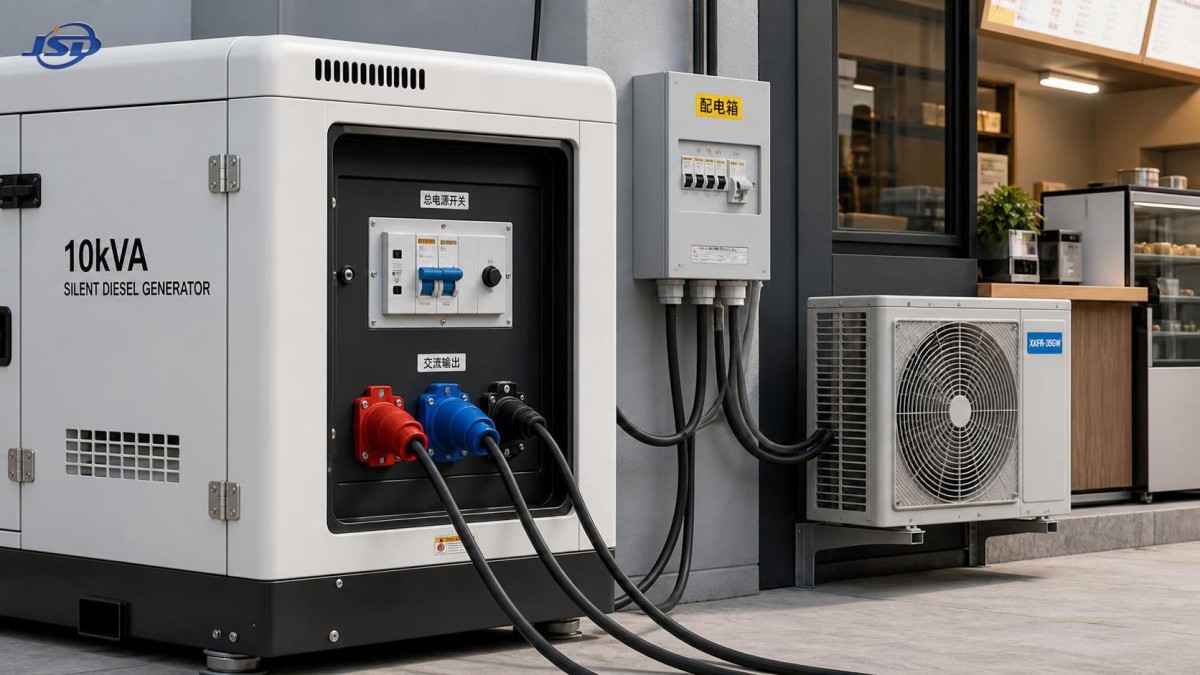
A 10kva silent generator can often run both categories of equipment together, but not always at full scale. The outcome depends on the generator's power factor, the type of air conditioner, and whether the shop equipment has motors or compressors.
In practical terms, a 10kva unit usually provides around 8kW of usable real power when operating at a 0.8 power factor. That means you should evaluate actual watt demand, not just assume the full 10kva figure is continuously available for every load.
If you have one moderate-sized air conditioner and a few light-to-medium shop devices, the setup may work smoothly. If you are trying to run several air conditioners, heavy cutting tools, welders, or large compressors, the generator may be undersized.
The keyword here is balance. A generator can support mixed loads well when the total running demand remains controlled and the largest startup surges are staggered instead of happening together.
What does 10kva mean in real usable power?
Many end users confuse kVA with kW, but they are not always the same. Generator capacity is often listed in kVA, while most appliances and tools are discussed in watts or kilowatts.
For a typical generator rated at 10kva with a 0.8 power factor, the real output is about 8kW. This number is much more useful when deciding what can run at the same time.
For example, if your air conditioner consumes 2kW while running and your shop lighting, fan, and small tools consume another 3kW combined, the generator may handle them comfortably. But if startup demand spikes to 9kW or 10kW, performance becomes much less predictable.
You should also remember that continuous operation should stay below the absolute maximum. Many users target around 70% to 80% of rated output for better reliability, fuel efficiency, and voltage stability.
How much power do air conditioners usually need?
Air conditioners are often the biggest uncertainty because their startup current can be much higher than their normal running current. This is especially true for older units and non-inverter models.
A small residential split air conditioner may run at roughly 700 to 1500 watts, while a larger unit may run between 1800 and 3000 watts or more. Window units can also vary significantly depending on cooling capacity and efficiency.
The starting load can be two to three times the running load, and sometimes even higher. That means a unit with a 2000-watt running demand might briefly require 4000 to 6000 watts when the compressor starts.
This surge is often what determines whether a 10kva silent generator succeeds or struggles. If the air conditioner starts while other motor-driven equipment is already under load, the generator can overload even when the total running watts seem acceptable on paper.
What kinds of shop equipment are easy or difficult for a 10kva silent generator?
Not all shop equipment behaves the same way. Some tools draw stable power, while others create sharp startup surges or fluctuating loads that are harder for a generator to support.
Generally easier loads include LED lighting, cash registers, chargers, fans, small drills, desktop equipment, and modest refrigeration units. These are usually manageable when combined with one air conditioner.
Moderately demanding loads include bench grinders, medium air compressors, display refrigeration, pumps, and larger saws. These require closer calculation because their motors can briefly pull much more than their nameplate running wattage.
More difficult loads include welders, large compressors, commercial freezers with heavy cycling, high-powered woodworking machines, and multiple motor loads starting together. These can quickly push a 10kva silent generator beyond a comfortable operating range.
So the question is not simply whether it can run shop equipment. The better question is which equipment, how many devices, and in what startup sequence.
A simple load planning example for everyday users
Suppose you want to run one 1.5-ton air conditioner, lighting for a small shop, a refrigerator, a computer system, and one small power tool. On paper, this may look well within the generator's range.
For example, the air conditioner may use 1800 watts running, the refrigerator 300 watts, lights 200 watts, computer and router 250 watts, and a small tool 800 watts. The running total is about 3350 watts.
That appears comfortable for a generator with roughly 8000 watts of real output. However, if the air conditioner compressor starts while the refrigerator compressor cycles on and the power tool is activated, the short-term surge could jump much higher.
In this case, the system may still work if devices are started in sequence and the generator has good surge handling. But if another air conditioner or a larger compressor is added, overload risk rises fast.
This is why experienced buyers plan for both running load and starting load. A generator that looks sufficient in theory can still become unstable in daily use if surge demand is ignored.
What happens if the generator is overloaded?
Overloading a generator does more than just shut it down. Repeated overload can shorten equipment life, create unstable voltage, and affect the connected appliances and tools.
You may notice warning alarms, circuit breaker trips, engine strain, dimming lights, or poor air conditioner performance. In some cases, sensitive electronics can also suffer from unstable output if the generator is pushed too hard.
Air conditioners are especially vulnerable because compressors dislike low voltage and repeated hard starts. Shop tools with motors can also overheat or perform poorly if the power supply is inconsistent.
For this reason, choosing a 10kva silent generator should involve a margin of safety rather than trying to use every available watt continuously. Stable operation is usually more valuable than chasing the maximum possible load.
How to tell if a 10kva silent generator is the right size for your needs
The easiest method is to list every device you want to run, note its running wattage, and identify whether it has a motor, compressor, or heating element. Then estimate which items may start at the same time.
If your combined running load stays around 5kW to 6kW and startup surges are controlled, a 10kva silent generator is often a sensible choice. It gives useful flexibility without becoming unnecessarily large for many households and small shops.
If your expected running load is already close to 7kW or 8kW, the margin becomes thin. In that case, the generator may still run the load, but reliability, fuel use, and future expansion become concerns.
Users who need multiple air conditioners, heavy workshop machinery, or frequent compressor cycling should often look at a larger capacity. A bigger generator can reduce stress and provide more stable power under changing conditions.
Why noise level and generator design also matter
People searching for a 10kva silent generator are usually not focused on power alone. Noise control matters for homes, stores, temporary job sites, and neighborhoods where constant engine sound can be disruptive.
A silent generator enclosure helps reduce noise while also offering better protection for internal components. This makes the unit more suitable for retail areas, residential backup, and projects that need a cleaner operating environment.
Buyers should still check ventilation design, fuel tank size, access for maintenance, and runtime under partial load. A quiet generator that overheats or needs constant refueling is not a practical long-term solution.
In broader power systems, stable distribution remains just as important as generation capacity. For larger facilities or infrastructure projects, equipment such as the 35kV/0.4kV Oil-Immersed Power Distribution Transformer plays a key role in delivering safe and efficient power where operating conditions demand stronger distribution support.
Practical tips to make a 10kva silent generator work better
First, start the heaviest motor loads one at a time. Avoid turning on the air conditioner, compressor, and major tools simultaneously, especially during the first minutes after startup.
Second, keep some reserve capacity. Operating continuously at around three-quarters of rated output usually gives better voltage stability and reduces mechanical strain on the generator.
Third, check the air conditioner's startup profile. Inverter air conditioners often behave more smoothly than older fixed-speed models, which can make a major difference when using a medium-size generator.
Fourth, maintain the generator properly. Dirty filters, poor fuel quality, neglected oil changes, and weak electrical connections can reduce actual performance and make overload issues appear sooner.
Finally, think about future load growth. If your shop may add more refrigeration, tools, or cooling equipment, choosing only for today's minimum demand may become a costly limitation later.
How this choice fits different end-user scenarios
For home backup users, a 10kva silent generator is often enough for one or two air conditioners plus lighting, refrigeration, internet equipment, and a few household essentials. It can be a practical middle ground between portability and useful capacity.
For small retail shops, it may support an air conditioner, POS system, lighting, fans, and selected equipment without major issues. It works best where loads are relatively predictable and not heavily motor-based.
For workshops or mixed commercial sites, suitability depends much more on the specific machines involved. If tools include compressors, saws, pumps, or refrigeration systems, proper load assessment becomes essential before buying.
That is why professional power planning matters beyond the generator itself. Companies focused on dependable power infrastructure, including manufacturers involved in generation and distribution equipment such as Jinshida Electric, understand that stable operation comes from matching equipment size to real application conditions.
Final answer: can a 10kva silent generator run air conditioners and shop equipment together?
Yes, a 10kva silent generator can often run air conditioners and shop equipment together, but only within a realistic load range. One moderate air conditioner plus light or medium shop equipment is usually achievable when startup surges are managed properly.
It becomes less reliable when you add multiple air conditioners, large compressors, welders, or heavy motor-driven tools. In those situations, the challenge is usually startup current rather than normal running wattage.
The best buying decision comes from checking real kW demand, planning for surge loads, and leaving operating headroom. If your expected load sits comfortably below the limit, a 10kva silent generator can be an efficient and practical solution for home or small business use.
In short, the generator can do the job, but only when the load plan is honest. That is the difference between smooth backup power and repeated overload trouble.

Get a Quote
Regardless of whether you require general advice or specific support, we are happy to help you.
Send Us Your Inquiry Today

Jinshida Electric remains committed to contributing to global energy development through professional manufacturing and superior service.