





What makes a single phase transformer suitable for residential lighting loads?
When selecting power equipment for residential lighting loads, reliability, efficiency, and safety are paramount—making the single phase transformer a top choice for homes and small-scale applications. Unlike three-phase systems designed for industrial motors or heavy machinery, single phase transformers operate with one alternating current waveform, simplifying integration into standard household wiring where lighting circuits typically draw between 100 W and 2,000 W per branch. Their suitability stems not from generic electrical conversion capability, but from precise alignment with the physical and operational constraints of residential infrastructure: low kVA demand, intermittent load patterns, tight voltage tolerance windows, and space-limited installation environments.
Core Design Simplicity Enables Predictable Performance
A single phase transformer consists of two windings—primary and secondary—wound on a shared laminated silicon steel core. This configuration eliminates phase-balancing complexity inherent in three-phase units. For lighting loads, which rarely exceed 5 kVA in most dwellings, the absence of inter-winding phase relationships reduces magnetic flux leakage and core saturation risk during momentary surges—such as those caused by incandescent filament inrush or LED driver startup transients. The reduced number of winding terminations also lowers the probability of insulation breakdown at connection points, a common failure mode in humid or poorly ventilated residential utility rooms. Moreover, the symmetrical magnetic path allows for tighter regulation of no-load to full-load voltage drop—typically maintained within ±2.5% across standard 120/240 V residential configurations—ensuring consistent lumen output without flicker or premature lamp degradation.
Voltage Regulation Stability Under Variable Load Profiles
Residential lighting exhibits highly non-linear load behavior: occupancy sensors switch circuits on/off abruptly; dimmers introduce harmonic distortion; and mixed technologies (incandescent, CFL, LED) present vastly different power factor characteristics. A well-designed single phase transformer responds to these variations through inherent impedance matching. Its leakage reactance is intentionally calibrated—not minimized—to dampen rapid current spikes while maintaining sufficient short-circuit withstand capability. This contrasts with utility-grade distribution transformers optimized for continuous high-load operation, where lower impedance improves efficiency but increases fault current magnitude beyond what residential circuit breakers can safely interrupt. In practice, this means a properly rated single phase unit delivers stable secondary voltage even when a single 60 W LED fixture is energized alongside a 1,500 W halogen track system on the same secondary, without requiring external tap changers or electronic regulators.
Thermal Management Without Forced Cooling
Residential installations rarely accommodate oil circulation pumps or radiator fins. Single phase transformers for lighting duty therefore rely on natural convection cooling, enabled by conservative thermal design margins. Core losses are minimized via high-grade grain-oriented steel with low hysteresis coefficients, while copper loss is controlled by oversized conductors—often using Class H insulation (180°C rating) even for units rated at 75°C rise. This derating strategy ensures surface temperatures remain below 65°C under sustained 80% load—a critical factor when mounted inside enclosed meter cabinets or attic spaces with ambient temperatures exceeding 40°C. Crucially, this thermal headroom accommodates real-world derating factors often overlooked in datasheets: dust accumulation on cooling surfaces, proximity to other heat sources (e.g., water heaters), and reduced airflow in retrofit installations where ventilation grilles were sealed during energy audits.
Material and Construction Considerations for Long-Term Reliability
The insulating medium plays a decisive role in longevity. While dry-type units dominate indoor residential use due to fire safety codes, oil-immersed variants—especially those using FR3 environmentally friendly insulation oil—offer superior dielectric strength and thermal stability for outdoor pole-mounted or pad-mounted applications serving multiple dwellings. FR3’s higher flash point (360°C vs. 160°C for mineral oil) and biodegradability reduce environmental liability without compromising performance. This material choice directly supports extended service life: units built to IEC 60076 standards with FR3 and recyclable structural components routinely achieve over 30 years of field operation when protected from direct UV exposure and moisture ingress—far exceeding typical residential infrastructure replacement cycles. Such durability is not incidental; it results from deliberate trade-offs in winding tension control during coil winding, precision core clamping to prevent magnetostriction-induced noise, and hermetic sealing against seasonal humidity cycling.
For larger-scale residential deployments—such as multi-family complexes or rural microgrids integrating solar generation—the scalability of transformer technology becomes relevant. While individual dwelling lighting remains firmly in the single phase domain, upstream voltage transformation often involves higher-capacity units like the 110kV Oil-Immersed Transformer, which steps down transmission-level voltage for local distribution. These systems rely on the same foundational principles of magnetic coupling and thermal resilience, scaled for 200 MVA capacity and certified to EN, IEC, and ANSI/IEEE standards—but their design philosophy originates in the same physics that govern the compact unit powering a single porch light.
Installation-Specific Advantages Often Overlooked
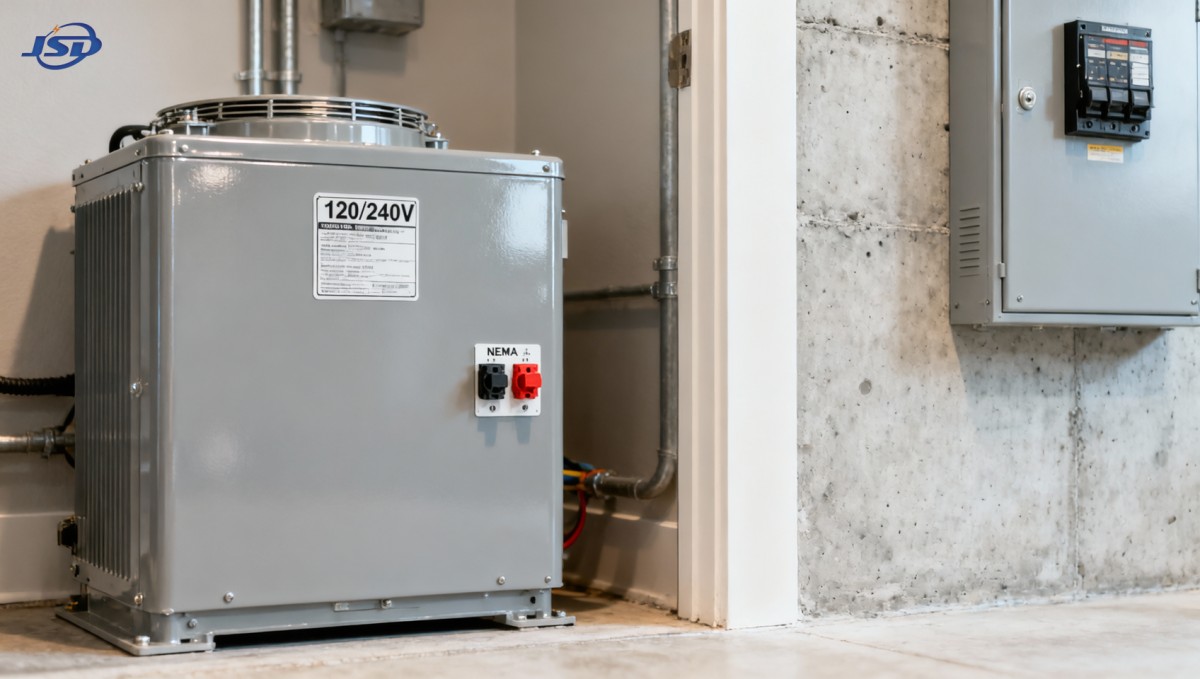
Physical footprint and mounting flexibility significantly influence suitability. Standard single phase transformers for residential lighting weigh between 15 kg and 90 kg—light enough for wall-mounting without structural reinforcement—and feature standardized bolt patterns compatible with NEC-compliant enclosures. Their rectangular or square cross-sections maximize usable space in cramped utility closets, unlike cylindrical three-phase units that waste corner clearance. Additionally, terminal arrangements follow NEMA and IEC color-coding conventions (e.g., black/red for primary, white for neutral), reducing miswiring errors during field commissioning—a leading cause of premature failure in DIY or contractor-led installations. Grounding continuity is simplified too: a single low-impedance grounding conductor suffices, avoiding the multi-point grounding complications that arise in three-phase delta-wye configurations.
Why Efficiency Metrics Alone Are Misleading
Energy efficiency labels—such as Tier 2 compliance per EU Regulation 548/2014—are valuable, but they represent only part of the picture for lighting applications. A transformer rated at 99.2% efficiency at 50% load may still induce unacceptable voltage distortion if its harmonic suppression capability is inadequate for modern LED drivers. Conversely, a unit with slightly lower nameplate efficiency (e.g., 98.7%) but optimized winding geometry for third-harmonic cancellation will deliver more stable light output over time. Real-world suitability depends on how the transformer interacts with the *entire* lighting circuit—including ballasts, drivers, and dimming controls—not just its standalone loss profile. This interaction is why field-tested performance data, rather than theoretical calculations alone, informs reliable selection.
Ultimately, the single phase transformer’s fitness for residential lighting lies in its focused engineering: eliminating unnecessary complexity while reinforcing the specific failure modes most likely to occur in domestic environments—thermal stress, voltage fluctuation, mechanical vibration, and insulation aging under variable humidity. It does not attempt to be universally adaptable. Instead, it excels precisely where it is needed: delivering quiet, stable, and safe power to the lights that define everyday living spaces.

Get a Quote
Regardless of whether you require general advice or specific support, we are happy to help you.
Send Us Your Inquiry Today

Jinshida Electric remains committed to contributing to global energy development through professional manufacturing and superior service.