





What Is a Compact Substation Transformer, and Where Is It Used?
A compact substation transformer converts distribution-level voltage into the lower voltage used by buildings, machinery, and other electrical loads. The term usually refers to the transformer inside a packaged substation, where medium-voltage switchgear, the transformer, and low-voltage distribution equipment are arranged in one coordinated assembly. These units are commonly used in factories, residential developments, commercial buildings, infrastructure facilities, and renewable energy projects.
The practical problem is often space: a site needs substantial electrical power but cannot easily accommodate a large electrical room or widely separated equipment. A packaged arrangement can reduce the equipment footprint and simplify installation. However, whether it suits a particular site depends on more than physical size. Load demand, access, ventilation, protection, and the utility connection all affect whether the installation will deliver reliable power.
The transformer is one part of the substation
A transformer and a compact substation are not the same thing. The transformer changes voltage through electromagnetic induction. A compact substation combines that transformer with equipment needed to connect, protect, control, and distribute the supply.
This distinction matters when reviewing a specification. A quotation for a transformer alone may not include incoming switchgear, outgoing circuit breakers, metering, or the enclosure. A packaged substation may include these items, but its exact scope still needs confirmation.
A typical arrangement contains three main functional sections:
- Medium-voltage section: Connects the installation to the distribution supply and provides switching and protection. Depending on the network design, it may use a load-break switch with fuses or a circuit breaker with protective relays.
- Transformer section: Changes the supply voltage to the level required by the connected loads. The transformer may be liquid-filled or dry-type, depending on the design and installation conditions.
- Low-voltage section: Distributes power through outgoing circuits. It can include a main breaker, feeder breakers, metering, and, where specified, reactive power compensation equipment.
The enclosure provides physical protection and separates equipment areas. Doors, ventilation openings, cable entries, and internal barriers are part of the design, not merely accessories. They influence weather resistance, cooling, safe access, and maintenance.
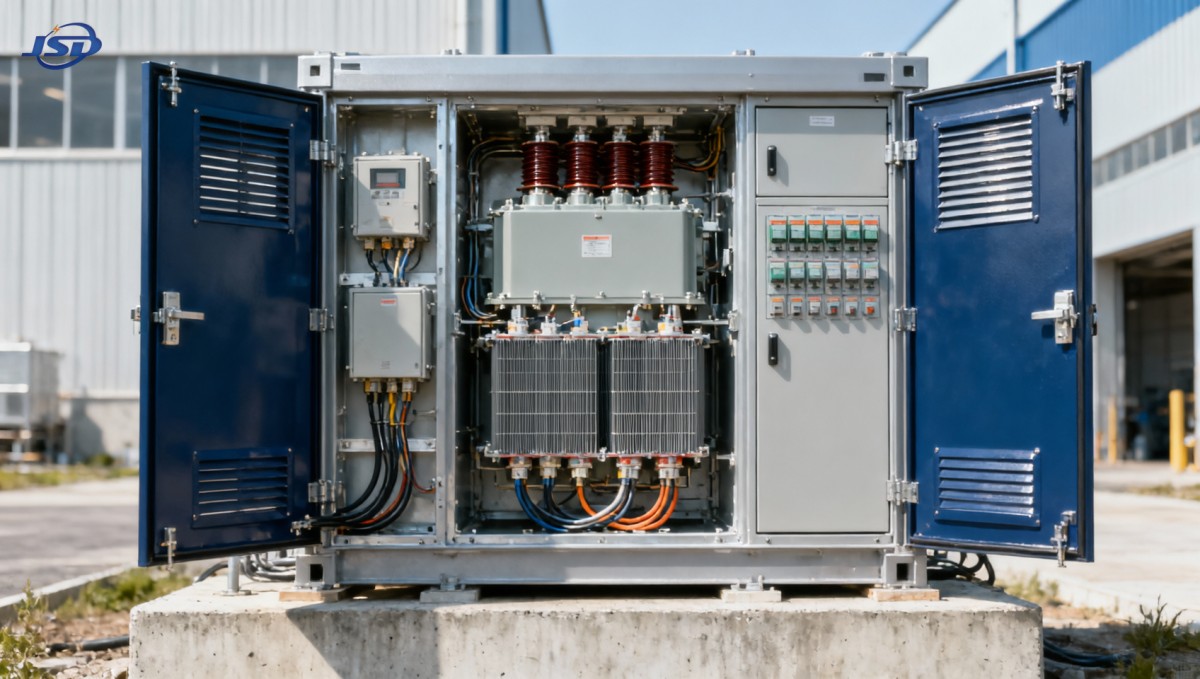
The electrical path is straightforward: the distribution supply enters the medium-voltage section, feeds the transformer, and leaves through the low-voltage distribution section. In a renewable energy installation, power may flow in the opposite direction during generation, so the transformer and protection arrangement must be designed for that duty.
Where compact substations solve practical site problems
Factories, industrial parks, and mining facilities
Industrial loads often sit far from an existing electrical room. Supplying them through long low-voltage cables can increase voltage drop and require larger conductors. Locating a substation near a production area allows power to travel farther at medium voltage, with the final low-voltage connection kept shorter.
Space savings are useful, but industrial suitability also depends on load behavior. Large motors, welding equipment, variable-speed drives, and intermittent production cycles can influence transformer loading and power quality. Dust, corrosive substances, and hazardous areas may require additional design measures. A standard outdoor enclosure should not be assumed suitable for an explosive atmosphere.
Residential complexes and commercial buildings
A residential development may need local power conversion without dedicating a large part of the building to electrical equipment. An outdoor compact substation can serve apartments, shared lighting, pumps, lifts, and other communal loads, provided the location meets utility and site requirements.
In commercial buildings, the challenge may be balancing electrical capacity with valuable floor space. Placement still requires careful planning: residents and occupants can be affected by transformer noise, while maintenance personnel need clear access. Screening or landscaping must not block ventilation, doors, or equipment-removal routes.
Ports, public areas, and infrastructure sites
Ports and infrastructure facilities often have distributed loads such as lighting, pumps, handling equipment, and service buildings. A packaged substation can establish a local distribution point without constructing a separate electrical building for every load cluster.
These locations expose equipment to conditions that ordinary indoor installations may not face. Coastal environments can accelerate corrosion; vehicle routes create impact risks; public spaces require controlled access. Enclosure material, foundation height, protective barriers, and cable routing therefore become important selection criteria.
Solar and wind installations
Renewable energy sites use transformers to connect generating equipment to a collection network or grid interface. Although a compact substation transformer often steps voltage down in a building application, an appropriately designed unit may step voltage up from inverter output to the collection-system voltage.
The familiar enclosure does not make the electrical duties identical. Generation output, inverter characteristics, harmonics, grounding arrangements, and utility protection requirements must be considered. A transformer specified for ordinary building distribution should not automatically be treated as suitable for solar or wind service.
Construction sites and temporary supplies
Packaged equipment can support temporary power where a permanent electrical room is unavailable. Construction machinery, site facilities, and temporary lighting may all require a local distribution point.
Temporary use does not remove the need for engineering. The unit still needs a stable foundation or approved support, grounding, safe cable connections, and protection against weather and accidental contact. Relocation also requires suitable lifting provisions and transport planning; “compact” does not mean easily portable.
Compact does not mean clearance-free
The main advantage of a packaged substation is integration. Compared with separately installed equipment, it can reduce the number of site interfaces and consolidate much of the assembly work. This can simplify installation, although civil works, cable termination, grounding, and commissioning remain necessary.
Its footprint must be assessed as an installed system rather than a cabinet outline. Space is needed for opening doors, operating equipment, inspecting components, and eventually replacing the transformer. Ventilation and any required safety separation can further increase the occupied area.
No arrangement is automatically better. A compact package is less attractive when it restricts future feeders, cannot reject heat adequately, or cannot be accessed for maintenance. Those constraints should be identified before equipment dimensions are finalized.
Reading the ratings without confusing them
Transformer capacity is normally expressed in kilovolt-amperes, or kVA. This is apparent power, not the same as the useful power expressed in kilowatts. A basic relationship is kVA = kW ÷ power factor, but selecting capacity also requires an understanding of which loads operate together.
Adding every connected load at full rating may overstate normal demand. Looking only at average consumption can underestimate peaks. Motor starting, seasonal cooling demand, future expansion, and nonlinear loads can all change the required capacity or operating conditions.
Voltage ratings need equally careful interpretation. Confirm the incoming supply voltage, required output voltage, frequency, and transformer connection arrangement. Insulation ratings and system grounding must match the network. A product family’s maximum voltage is not necessarily the rating of every available configuration.
Current ratings belong to specific components. The transformer, low-voltage busbars, main breaker, and outgoing feeders each have their own limits. A high busbar current rating does not increase the transformer’s kVA capacity, and continuous current capacity does not establish short-circuit withstand capability.
Enclosure protection ratings describe resistance to access, dust, and water under defined conditions. They do not establish corrosion resistance, flood tolerance, internal-arc performance, or explosion protection. The rating should be checked for the complete assembly and its compartments, including ventilation openings and cable entries.
Matching a packaged design to the project
The European-Type Compact Substation provides one example of this integrated approach. Its listed transformer capacity range is 100 kVA to 2500 kVA, with 50 Hz or 60 Hz configurations. Enclosure material options include steel plate, composite panel, stainless steel, and cement board. These options allow the specification to address different installation environments rather than treating every site as identical.
The listed functions include power distribution, metering, and reactive power compensation. Their inclusion should be defined in the project scope: not every application needs the same metering arrangement, and compensation equipment should be selected against actual load characteristics. Enclosure protection, switchgear ratings, and special-environment provisions likewise require confirmation for the selected configuration.
For an initial technical discussion, the most useful project information is:
- The supply connection: Utility voltage, frequency, connection arrangement, available fault level, and applicable utility requirements.
- The loads: Expected peak demand, significant motors, sensitive equipment, harmonic-producing loads, and planned additions.
- The location: Indoor or outdoor placement, ambient temperature, altitude, contamination, flood exposure, and access restrictions.
- The distribution layout: Number of outgoing circuits, cable routes, metering requirements, and any backup-supply interfaces.
- The operating needs: Acceptable outages, isolation requirements, maintenance access, and responsibility for operation.
These details are more useful than selecting a cabinet by appearance or choosing capacity solely from available space.
What remains to be done on site
Factory assembly can reduce site work, but it does not make the substation a plug-in appliance. The foundation must support the equipment, cable ducts must align with the entries, and the grounding system must be designed for the installation. Water drainage deserves particular attention where cables enter below the enclosure.
Before energization, qualified personnel need to verify connections, grounding, protective settings, interlocks, and other commissioning requirements specified for the equipment. Protection coordination matters because a fault on an outgoing circuit should be cleared by the appropriate device rather than unnecessarily disconnecting the entire site.
Routine care remains necessary even where individual components have low-maintenance designs. Ventilation paths can become obstructed, enclosure seals can deteriorate, and electrical connections or protective devices may need inspection. “Maintenance-free” should never be interpreted as permission to omit the manufacturer’s inspection requirements.
For a space-constrained project, the decisive question is whether the proposed location can accommodate both normal operation and future intervention. If the equipment fits but its doors cannot open fully, cooling air cannot circulate, or the transformer cannot be removed safely, the site layout needs revision before the compact substation is selected.

Get a Quote
Regardless of whether you require general advice or specific support, we are happy to help you.
Send Us Your Inquiry Today

Jinshida Electric remains committed to contributing to global energy development through professional manufacturing and superior service.