





Procurement Checklist for Substation Transformers in Solar Farm Projects
Procurement Checklist for Substation Transformers in Solar Farm Projects
Selecting a substation transformer for a solar farm is not a simple exercise in matching MVA capacity to an inverter schedule. The transformer sits between a variable generation source and a grid operator that expects stable voltage, compliant protection behavior, and predictable availability. A low purchase price can quickly lose its appeal if the unit arrives with the wrong tap range, requires late redesign of the substation layout, or cannot satisfy the utility’s test and documentation requirements.
For procurement teams, the practical question is not “Which transformer is cheapest?” It is “Which transformer configuration reduces technical, schedule, operating, and financial risk for this specific project?” The answer depends on grid connection voltage, solar plant export profile, ambient conditions, site access, loss evaluation rules, and the owner’s plans for the asset over the next few decades.
This checklist focuses on the decisions that should be resolved before a purchase order is released. It is intended for buyers who need to compare suppliers without treating every quotation as directly equivalent.
Start with the Grid Connection, Not the Transformer Nameplate
A solar farm step-up transformer must be designed around the point of interconnection. Confirm the incoming collector voltage, outgoing transmission or distribution voltage, system frequency, grounding arrangement, insulation level, and required vector group before requesting final quotations. These are not details to leave for later engineering clarification; each can affect winding design, bushings, protection interfaces, and price.
Procurement should ask for the latest utility interconnection requirements rather than relying on an early-stage grid study. In many projects, the utility’s final requirements define acceptable voltage regulation, fault contribution assumptions, metering arrangements, and protection coordination. If the plant connects through a shared substation or an existing network, upstream equipment constraints may also dictate transformer impedance or tap-changer performance.
One recurring problem is purchasing a unit based on nominal voltage only. For example, two transformers may both be described as “33/110 kV,” yet differ materially in tapping range, impedance, insulation coordination, cooling duty, and winding connection. The labels look similar, but they are not interchangeable for grid compliance.
Define Capacity Around Real Operating Conditions
Transformer capacity should reflect more than the DC nameplate of the photovoltaic array. The buyer needs the AC export limit, inverter loading assumptions, power factor requirements, reactive power duty, auxiliary consumption, expected curtailment, and any future battery energy storage connection. A transformer that appears adequately sized at unity power factor may have less useful margin when the grid operator requires reactive support.
It is also worth separating normal operating capacity from emergency or contingency expectations. A project with two main transformers may require each unit to carry a defined share of plant output during maintenance or after the loss of one transformer. That requirement can change the preferred MVA rating and cooling arrangement.
Do not automatically buy the largest rating proposed. Oversizing can increase capital cost, no-load losses, footprint, transport weight, and civil works requirements. Conversely, an aggressively minimized rating may constrain plant expansion or result in higher thermal stress during high-irradiance periods. The right choice should be supported by the electrical design and the project’s energy model, not just by a supplier’s standard production range.
Treat Losses as a Lifecycle Cost Item
For a solar project, transformer losses affect delivered energy throughout the operating life of the plant. No-load loss is present whenever the transformer is energized, including low-generation periods. Load loss rises with current and becomes especially relevant during higher output. The commercial importance of each depends on the plant’s operating profile, local energy value, curtailment pattern, and the loss capitalization method used by the owner or utility.
A quotation comparison should therefore list guaranteed no-load loss and load loss separately, together with the reference temperature and applicable test standard. Avoid accepting a broad claim such as “high efficiency” without guaranteed figures in the technical schedule. If tender documents include a loss evaluation formula, use it consistently across bids; otherwise, a lower initial price can mask a materially higher operating cost.
Efficiency requirements may also be contractually important in some markets. When a supplier states that a design meets a specific ecodesign requirement, procurement should verify the relevance of that requirement to the destination project and obtain the supporting technical documentation rather than treating a general compliance statement as universal approval.
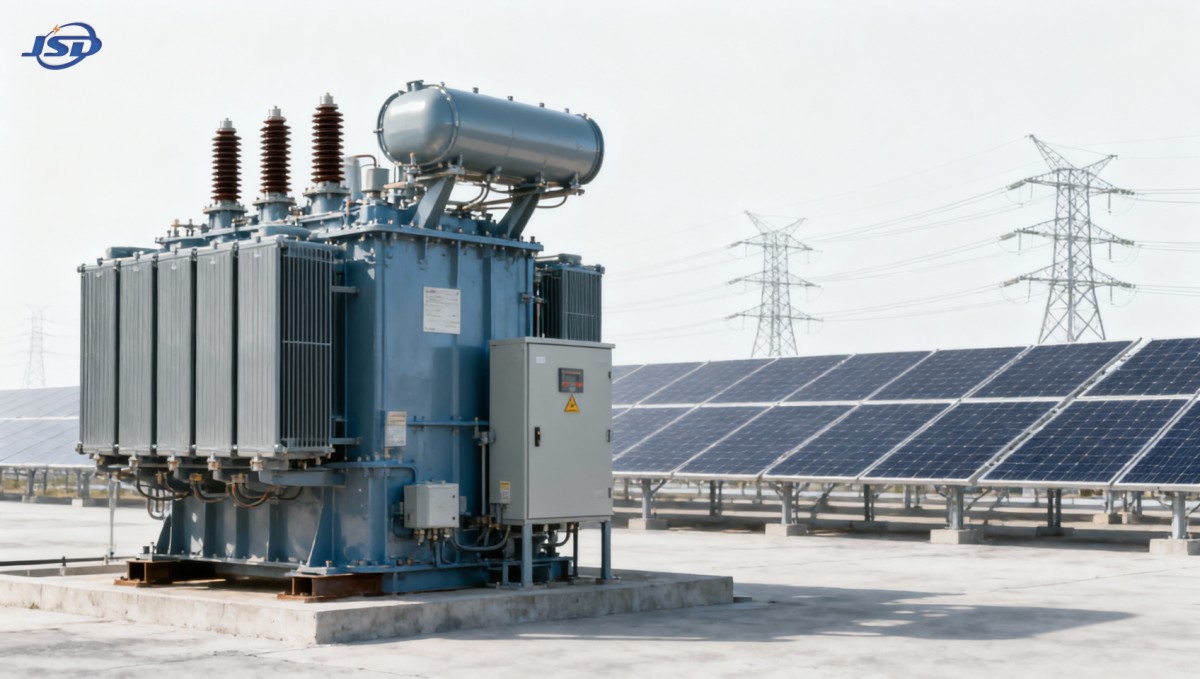
Check the Design Features That Affect Solar Farm Availability
Solar farm transformers usually experience a different load profile from equipment serving a continuously loaded industrial plant. Daily loading ramps, inverter-driven harmonics, reactive power dispatch, and repeated voltage adjustments can all influence specification choices. The engineering team should determine whether harmonic assessment is required and whether the transformer needs any special consideration for harmonic currents, thermal performance, or audible noise.
Tap-changing is another area where buyers should be precise. An off-circuit tap changer may be adequate where voltage conditions are stable and adjustments are infrequent. An on-load tap changer can be justified when voltage regulation requirements and operating conditions demand active adjustment, but it introduces additional equipment, maintenance needs, and control interfaces. Neither choice is automatically better. The procurement document should explain the intended operating philosophy and identify which party supplies the associated control and protection equipment.
Ask suppliers to state clearly what is included: neutral grounding equipment, surge arresters, bushings, marshalling kiosks, oil monitoring devices, temperature indicators, cooling controls, fire protection interfaces, and spare parts. Scope gaps often surface only during substation commissioning, when changes are expensive and schedule pressure is highest.
Environmental Conditions Are Procurement Conditions
The site environment should be translated into a formal transformer duty specification. High ambient temperature, altitude, windblown dust, humidity, salt contamination, flood exposure, seismic requirements, and limited water availability may all influence cooling selection, creepage distance, enclosure details, coating systems, and maintenance access.
For remote solar sites, access deserves particular attention. Confirm the heaviest transport weight, shipping dimensions, lifting points, oil shipment arrangement, and site assembly requirements early. A transformer can be electrically correct yet become a logistics problem if local road restrictions, bridge limits, crane capacity, or substation access were not considered. This is one of the most avoidable late-stage costs in utility-scale projects.
Oil type also needs a project-specific review. Mineral oil remains common, but some owners evaluate alternative insulating fluids where fire safety, environmental considerations, or local permitting conditions matter. Any decision involving FR3 or another fluid should cover dielectric design, fire protection strategy, maintenance practices, fluid availability, and compatibility with the project’s operating procedures. It should not be treated merely as a sustainability line item.
Use a Bid Comparison Matrix That Exposes Differences
A good technical-commercial comparison matrix prevents procurement from comparing incomplete offers on price alone. Require each bidder to respond to the same specification clauses and identify every deviation. “Comply” should not be accepted where the supplier has not provided the requested data.
Verify Standards, Testing, and Documentation Before Manufacturing Begins
The applicable standard framework must be stated in the purchase specification. Depending on the project location and owner requirements, this may involve IEC, IEEE/ANSI, national standards, utility standards, or a combination of them. Listing multiple standards without identifying which clauses govern in the event of conflict is risky. The project engineer should define the order of precedence.
Factory acceptance testing should be planned as part of the procurement schedule, not as a final administrative event. Confirm which routine tests are included, whether the buyer or an appointed inspector will witness them, how nonconformities are handled, and when certified reports will be issued. If special tests are requested, define them early because they can affect both lead time and price.
Documentation is equally important. Typical deliverables include approved drawings, guaranteed loss data, terminal and nameplate details, protection and control diagrams, test reports, installation instructions, oil handling procedures, recommended spares, and maintenance guidance. A late or incomplete document package can delay civil, cable, relay, and SCADA work even when the transformer itself is ready.
Assess the Supplier Beyond the Factory Tour
Manufacturing capability matters, but solar farm buyers should also assess engineering communication and project discipline. Useful questions include: Who approves drawings? How are design changes controlled? What is the planned inspection and test plan? Can the supplier provide clear interface information for protection, civil works, and transport teams? Is there a defined escalation path if commissioning support is needed?
Jinshida Electric Power Technology Co., Ltd. positions its work around the research, manufacturing, and application of transmission and distribution equipment, with quality management and technical support forming part of its project approach. For buyers considering a high-voltage step-up solution, the relevant discussion should remain specific: whether the proposed design matches the solar farm duty, destination standards, transport conditions, and required service scope.
For projects requiring a 110 kV connection, the 110kV Oil-Immersed Transformer is positioned for applications including photovoltaic booster stations and other grid-connection step-up projects. Its stated configuration options include double-winding, three-winding, and autotransformer arrangements, with capacities up to 200 MVA. Those capabilities are useful starting points, but the purchase decision should still be based on the approved project specification, particularly impedance, tap arrangement, losses, insulation level, and included auxiliary equipment.
Price the Whole Delivery Scope, Not Only the Transformer
The lowest equipment price may exclude items that another bidder has included. Compare freight terms, export packing, insurance, oil filling or separate oil supply, site supervision, commissioning assistance, special tools, spares, training, testing, and warranty conditions. If the transformer is shipped partially dismantled, clarify who is responsible for assembly, vacuum treatment, oil processing, and final testing on site.
Lead time should be broken into engineering approval, manufacturing, factory testing, shipment, and site support. A supplier may quote an attractive production period while leaving approval cycles or transport arrangements outside the stated commitment. In practice, drawing approval delays are often more damaging than a few extra factory days. Set response times for technical submittals and make responsibility for late information visible in the contract.
Warranty language needs the same care. Define the warranty start point, remedy process, exclusions, site labor responsibility, and availability of critical spare parts. A broad warranty statement is less useful than a clear process for responding to an oil leak, cooling alarm, bushing issue, or protection-related concern after energization.
The Final Procurement Gate
Before issuing the order, confirm that the selected substation transformer for solar farms has an approved technical deviation list, an agreed document schedule, guaranteed losses, a defined test plan, confirmed shipping scope, and a realistic commissioning support arrangement. If any of these remain ambiguous, the apparent saving from moving quickly may be outweighed by downstream change orders and delay risk.
A transformer is expected to serve long after the EPC team has left the site. The sensible procurement decision is the one that gives the owner a unit that fits the grid, can be transported and maintained in the real site environment, and comes with documentation and support that remain useful when the project is no longer new.

Get a Quote
Regardless of whether you require general advice or specific support, we are happy to help you.
Send Us Your Inquiry Today

Jinshida Electric remains committed to contributing to global energy development through professional manufacturing and superior service.