





How american type pad mounted transformer fire resistance rating affects urban underground feeder planning?
When planning urban underground feeder systems, the fire resistance rating of an American type pad mounted transformer is not a secondary specification—it directly governs spatial layout, vault construction, cable separation distances, and regulatory compliance with IEEE C57.12.26 and NEC Article 450. Unlike overhead or indoor substations, underground feeders operate in confined, thermally restricted environments where heat dissipation is limited and fire propagation pathways are highly constrained. In such settings, a transformer’s ability to resist ignition, limit flame spread, and maintain structural integrity under sustained thermal stress determines whether adjacent cables, duct banks, or access chambers require additional fire-stopping layers, increased clearances, or even complete re-routing.
Why Fire Resistance Class Directly Shapes Feeder Geometry
Class 20/40/60 ratings—defined by UL 1561 and IEEE C57.12.26—measure how long a transformer can withstand exposure to a standardized hydrocarbon pool fire (1100°C) without external flame penetration or internal failure. A Class 20 unit may survive 20 minutes; Class 60, up to 60. But this time metric alone misleads planners: what matters operationally is not just duration, but *how* failure occurs. Oil-immersed units may vent flammable vapors before reaching full-rated time, triggering cascading ignition in adjacent polymeric cable jackets. Dry-type alternatives avoid this risk entirely—but only if their insulation system maintains dielectric strength and mechanical cohesion at elevated temperatures.
For example, epoxy resin casting systems behave differently than traditional varnish-impregnated windings under thermal stress. When subjected to prolonged 800°C surface exposure, standard epoxy begins charring at ~350°C, losing tensile strength and allowing copper conductors to deform under electromagnetic forces during fault conditions. However, formulations incorporating mineral-based flame retardant fillers—such as aluminum trihydrate or magnesium hydroxide—delay decomposition onset by 120–180°C and generate non-combustible surface char that insulates underlying layers. This delay directly extends functional integrity beyond nominal Class thresholds, especially when combined with vacuum-pressure impregnation and thermosetting prepreg cloth reinforcement on low-voltage windings.
Material-Level Constraints That Alter Vault Design
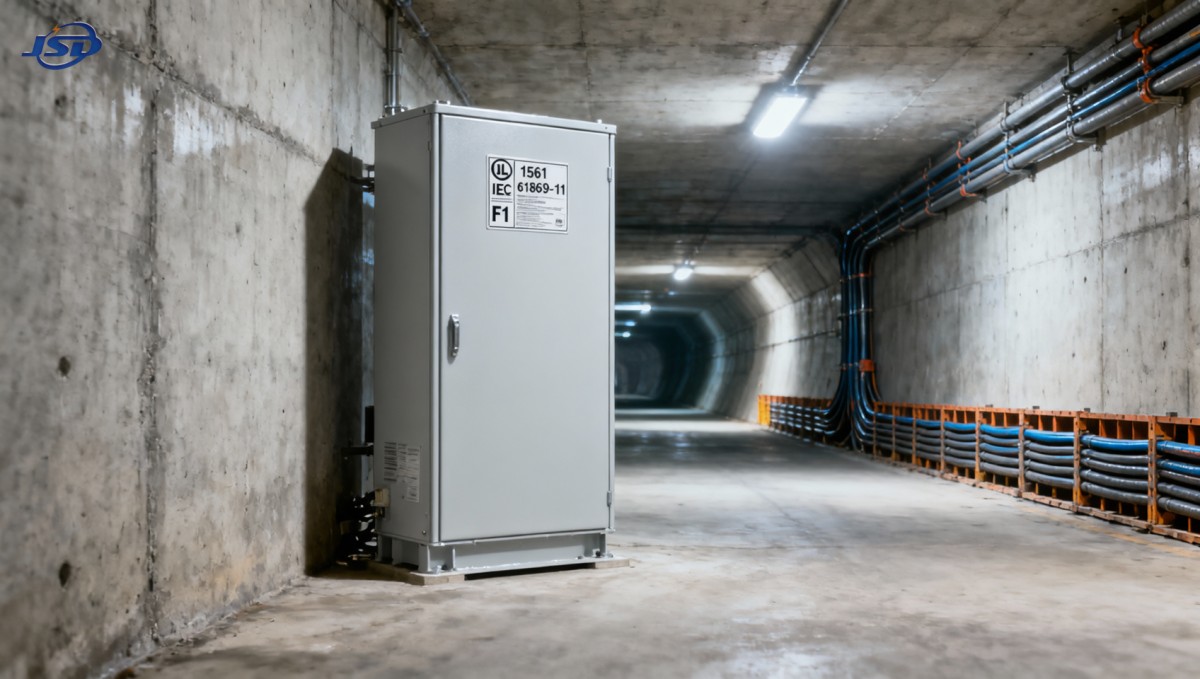
Urban underground vaults rarely exceed 2.5 m in height and often share walls with building foundations or subway tunnels. Within those limits, transformer selection affects more than just footprint—it dictates ventilation strategy, fire barrier placement, and maintenance access. A unit rated for Class 40 using conventional oil-filled design may require 1.2 m of separation from any combustible conduit, whereas a dry-type unit with F1-class fire performance (IEC 61869-11) permits 0.6 m spacing under equivalent load conditions—provided its core uses cold-rolled grain-oriented silicon steel with mineral oxide insulation and its high-voltage coil is cast under high vacuum with flame-retardant filler.
This material-level differentiation becomes critical when evaluating real-world installation trade-offs. For instance, copper strip winding technology enables tighter turn-to-turn control and reduced eddy current losses—but only if the epoxy matrix remains dimensionally stable above 200°C. If thermal expansion mismatch between copper and resin exceeds 0.3% per 100°C, microcracks form at the interface, accelerating moisture ingress and partial discharge. Jinshida’s 33kV Cast Resin Dry-Type Distribution Transformer addresses this through matched coefficient-of-expansion formulation and dual-layer insulation: high-voltage coils use flame-retardant vacuum-poured epoxy, while low-voltage windings employ thermosetting epoxy prepreg cloth bonded under controlled pressure and temperature. The result is verified operational stability at 120% rated load under forced air cooling—without compromising fire integrity.
How Voltage Class Interacts With Fire Performance in Underground Contexts
While fire rating applies across voltage classes, 33kV applications introduce unique interaction effects. At higher primary voltages, partial discharge inception voltage drops significantly when insulation degrades due to thermal cycling or moisture absorption. In underground vaults, ambient humidity often exceeds 75% RH, and condensation forms on cooler surfaces—including transformer tank interiors during night-time load cycles. Standard cast resin may absorb 0.15–0.22% moisture by weight over 12 months in such conditions, reducing surface resistivity by up to 40%. This accelerates tracking across creepage paths, especially near bushing bases where electric field gradients peak.
That’s why fire resistance cannot be evaluated in isolation from dielectric robustness. A transformer meeting Class 60 requirements but failing IEC 60076-11 impulse tests after 500 hours of damp-heat cycling offers false security. Real resilience requires simultaneous validation: flame test per UL 1561, impulse withstand per IEC 60076-4, and humidity endurance per IEC 60076-11. The 33kV Cast Resin Dry-Type Distribution Transformer satisfies all three—not because it uses thicker insulation, but because its casting process integrates vacuum degassing, controlled post-cure ramp rates, and filler dispersion that inhibits both thermal decomposition and moisture migration pathways.
Operational Consequences of Underestimating Fire-Rating Dependencies
Planners who treat fire rating as a checkbox item—rather than a system-level constraint—often encounter late-stage redesigns. One common oversight is assuming that vault fire suppression (e.g., CO₂ or Novec 1230) eliminates the need for transformer-level fire resistance. In practice, suppression systems respond to detected flames—not to pre-ignition thermal runaway. By the time detectors activate, temperatures may exceed 600°C at the transformer surface, causing irreversible degradation of cable jacketing within 1.5 m radius. Without inherent transformer fire resistance, suppression merely mitigates consequences rather than preventing escalation.
Another subtle but costly error involves interpreting “F1 class” as equivalent to “oil-free.” While dry-type transformers eliminate oil leakage risk, F1 classification (per IEC 61869-11) specifically requires zero flaming droplets, maximum 10 cm flame height, and no hole formation after 30 minutes of 850°C exposure. Not all dry-types meet this—only those with optimized filler loading, uniform cross-linking density, and validated thermal barrier geometry. Units certified to F1 class also demonstrate lower smoke toxicity (CO yield < 0.2 g/g consumed mass), which is essential for personnel egress in enclosed vaults during emergency response.
Ultimately, fire resistance rating isn’t about passing a lab test. It’s about ensuring that, under actual urban underground operating conditions—high humidity, limited airflow, adjacent polymeric infrastructure, and extended service life—the transformer remains a passive safety element, not a latent ignition source. Selecting based on verified, integrated performance—rather than isolated metrics—avoids spatial penalties, reduces vault excavation volume, and preserves flexibility for future feeder upgrades without structural retrofitting.

Get a Quote
Regardless of whether you require general advice or specific support, we are happy to help you.
Send Us Your Inquiry Today

Jinshida Electric remains committed to contributing to global energy development through professional manufacturing and superior service.