





What total cost of ownership factors matter most when comparing oil-immersed vs dry-type substation transformers?
What Total Cost of Ownership Factors Matter Most When Comparing Oil-Immersed vs Dry-Type Substation Transformers?
For procurement personnel evaluating substation transformers, the upfront price tag is rarely the deciding factor—especially when choosing between oil-immersed and dry-type units. What matters more is how each design performs across its full service life: installation constraints, energy losses under real load profiles, maintenance frequency and complexity, fire safety compliance costs, environmental liabilities, and end-of-life disposal or refurbishment. These are the true TCO levers—and they don’t move in lockstep. A dry-type unit may cost 20–35% more at purchase but avoid oil containment systems, spill reporting, and biannual dielectric testing. An oil-immersed transformer might offer 0.3–0.5% higher efficiency at full load—but only if operated consistently near rated capacity. In practice, many substations run at 40–60% load for extended periods, narrowing that gap significantly.
Installation & Site Readiness: Where Hidden Costs Accumulate Fast
Oil-immersed transformers require secondary containment (e.g., bund walls or catchment sumps), oil spill response plans, and often dedicated ventilation or fire suppression infrastructure—especially indoors or in urban settings. Permitting alone can add 6–10 weeks to project timelines. Dry-type units eliminate those requirements, but introduce their own constraints: stricter clearances for cooling airflow, higher floor loading per kVA (due to heavier core/coil assemblies), and sensitivity to ambient dust and humidity. In retrofit projects—particularly industrial facilities upgrading aging switchgear—dry-types often win on speed: no oil handling permits, no tank fill-and-test cycles, and simpler civil works. But in greenfield substations with ample space and existing oil-handling protocols, the oil-immersed option may integrate more seamlessly with legacy protection schemes and grounding practices.
Maintenance Realities: Not Just Frequency—But Who Does It, and How Often It’s Done Wrong
Oil-immersed units demand routine oil sampling (DGA, moisture, acidity), periodic filtration or reclamation, and internal inspections every 8–12 years—typically requiring outage windows and specialized contractors. Missed or misinterpreted DGA results are a leading cause of unexpected failures. Dry-types avoid oil-related maintenance entirely, but shift attention to insulation integrity monitoring (e.g., partial discharge testing), coil thermography, and cleaning of cooling ducts—tasks often deferred until thermal hotspots trigger alarms. Crucially, both types suffer from one shared vulnerability: poor ventilation design. A dry-type transformer installed in an enclosed kiosk without adequate intake/exhaust airflow can degrade insulation life by 50% within five years. Likewise, oil-immersed units placed in poorly ventilated vaults run hotter, accelerating oil oxidation and sludge formation. Procurement teams should insist on site-specific thermal modeling—not just nameplate ratings—before finalizing either choice.
Energy Losses: Efficiency Isn’t Static—It’s Load-Dependent and Time-Weighted
IEC 60076-20 defines loss measurement at 50%, 75%, 100%, and 110% load—but real-world load profiles rarely match those test points. Industrial plants with cyclical production, commercial campuses with HVAC-driven peaks, and renewable-integrated feeders all impose highly variable loading. Oil-immersed units typically show lower no-load (core) losses but higher load (copper) losses than equivalently rated dry-types. The net effect? At light loads (<30%), oil-immersed units often consume less total energy annually; at sustained heavy loads (>80%), dry-types may edge ahead—depending on cooling class and winding design. For procurement teams building long-term ROI models, it’s not enough to compare “efficiency class” labels. You need hourly load data spanning at least one full year—and a loss calculation weighted by local electricity tariff structure (e.g., time-of-use rates, demand charges). A 0.2% difference in average annual losses translates to tens of thousands in avoided energy costs over 25 years—but only if modeled against actual usage, not catalog assumptions.
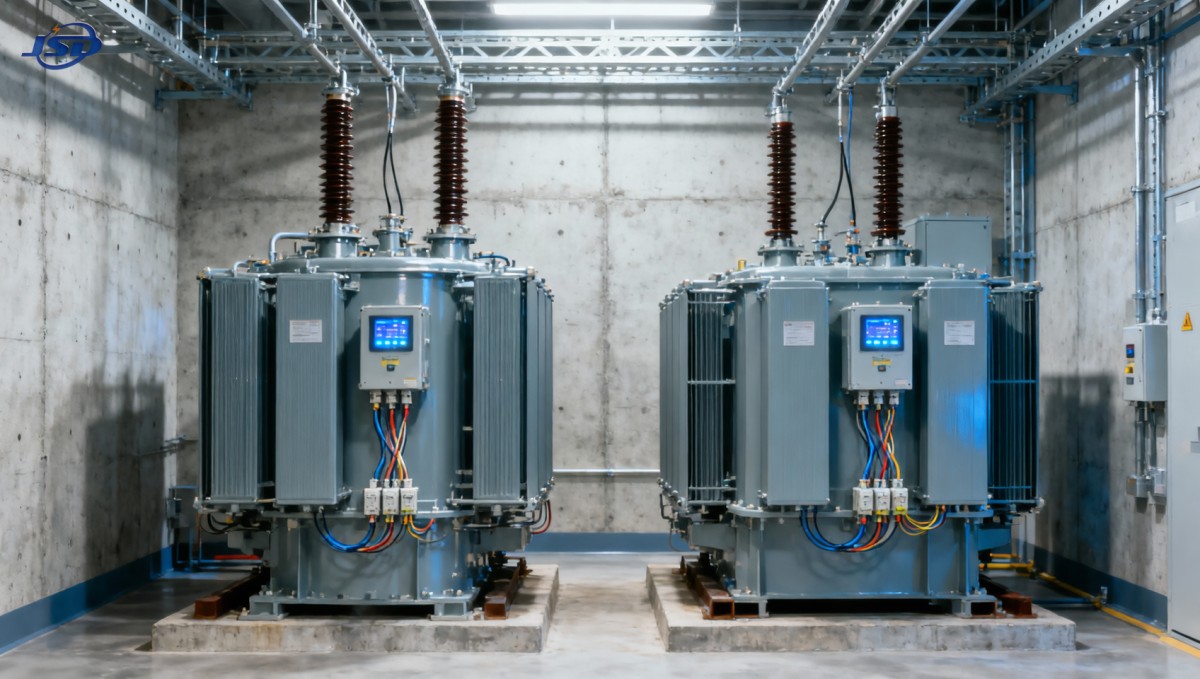
Fire Safety & Environmental Liability: Compliance Isn’t Optional—It’s Non-Negotiable
Dry-type transformers carry inherent fire-safety advantages—no flammable oil, no risk of vapor ignition, no regulatory reporting for minor leaks. That makes them standard in high-occupancy buildings (hospitals, data centers, airports) and indoor substations where NFPA 70E or IEC 61936-1 apply. But “fire-safe” doesn’t mean “maintenance-free.” Dust accumulation on windings, degraded varnish, or moisture ingress can still lead to tracking faults and arc flash events. Oil-immersed units, meanwhile, face tightening global restrictions: EU’s REACH Annex XVII bans PCB-containing oils outright; China’s GB 2536-2017 mandates strict biodegradability thresholds for new installations; and U.S. EPA SPCC rules impose $10,000+ fines for unreported spills >42 gallons. Even with modern silicone or natural ester fluids, insurance premiums and third-party audit costs remain higher for oil-filled assets—especially near waterways or sensitive ecosystems. Procurement must align selection not just with local code minimums, but with corporate ESG commitments and long-term asset stewardship policies.
Integration with Modern Grid Needs: Where Transformer Choice Affects System Flexibility
As grids incorporate more distributed generation, battery storage, and bidirectional power flow, transformer selection influences more than just voltage transformation. Dry-types respond faster to transient overloads—a key advantage when paired with rapid-cycling assets like the 500kW/1MWh Air Cooling Container Energy Storage System, which delivers peak-shaving and microgrid support in commercial and industrial applications. Their solid insulation also handles higher harmonic distortion from inverters more robustly than some mineral-oil systems. Conversely, oil-immersed units offer superior overload tolerance for short-duration fault ride-through and better damping of ferroresonance in lightly loaded rural feeders. Neither type is universally “better”—but mismatching transformer thermal response with storage dispatch patterns or solar ramp rates introduces avoidable stress and premature aging.
A Practical Decision Framework for Procurement Teams
Start by mapping your application against three non-negotiable filters:
- Location & Enclosure: Indoor, underground, or densely populated area? Dry-type is likely mandatory. Outdoor, rural, or oil-handling-capable site? Oil-immersed remains viable—and often more economical at >10 MVA.
- Load Profile Certainty: Do you have 12+ months of validated hourly load data? If not, default to oil-immersed for its broader efficiency sweet spot—and budget for future retrofits as load patterns stabilize.
- Maintenance Capability: Do you have in-house staff trained in DGA interpretation and oil reclamation—or will every oil test go to a third-party lab? If the latter, dry-type reduces dependency and scheduling friction.
Then layer in TCO weighting: assign realistic values to outage cost per hour (including production loss), energy cost escalation (3–5% annually), and insurance premium differences. Avoid generic “20-year TCO calculators”—they obscure the real drivers. Instead, build a simple spreadsheet with four columns: (1) capital cost, (2) 5-year maintenance spend, (3) 20-year energy loss cost (using your actual load profile), and (4) contingency for compliance upgrades (e.g., future ester-fluid transition or fire suppression retrofit). Run scenarios. Revisit assumptions annually. And remember: the lowest TCO choice today may not be the most adaptable choice tomorrow—especially as grid-edge assets like energy storage redefine what “substation transformer” means in practice.

Get a Quote
Regardless of whether you require general advice or specific support, we are happy to help you.
Send Us Your Inquiry Today

Jinshida Electric remains committed to contributing to global energy development through professional manufacturing and superior service.