





What noise level is realistic for a silent power generator on site?
On many sites, the noise question comes up later than it should. A generator is booked because the power rating looks right, the delivery window is tight, and the job cannot stop. Then someone stands near the temporary power area, hears the unit running, and asks the uncomfortable question: is this really “silent”? That moment matters more than the brochure language, because what sounds acceptable in a yard or depot can feel very different beside offices, residential edges, hospitals, schools, night work zones, or enclosed service areas.
When people search for a silent power generator, they often expect a simple number. The reality on site is less neat. A realistic noise level depends on where the meter is placed, how hard the generator is working, whether reflections from walls or containers are increasing perceived sound, and whether the main complaint is overall loudness, low-frequency rumble, or tonal noise from cooling airflow. If you are trying to make a practical decision, the better question is not “Is it silent?” but “What noise level is believable under my actual working conditions?”
Why advertised noise figures often feel misleading on site
A common source of confusion is that a generator can be honestly described with one noise figure in one test condition and still seem much louder during real use. Sound pressure level is usually reported at a stated distance, often in an open-field style condition with limited reflection. Site conditions are rarely that clean. Put the same unit near a boundary wall, under a slab edge, between stacked materials, or close to a metal fence, and the sound can bounce back toward people who are working nearby.
Load also changes the picture. A lightly loaded generator may sound noticeably different from one carrying a fluctuating construction load, especially where pumps, hoists, welding equipment, compressors, or temporary HVAC systems start and stop. Even if the engine itself is well enclosed, fan noise, intake noise, vibration transfer into the base, and exhaust treatment all shape the result.
That is why a realistic expectation for a silent power generator should always be framed as a range rather than a single magic figure. On site, “quiet enough” is usually a combination of distance management, equipment selection, placement, and operating discipline.
The first practical judgment: where will people actually hear it?
Before comparing models, it helps to map the listening points that matter. Many teams focus only on the generator location, but complaints usually come from somewhere else: a security gate, a nearby office cabin, a night-shift rest area, a hospital wing across the service road, or a site boundary next to occupied buildings. If the generator is tucked into a corner that creates a sound pocket, the measured level at the machine may matter less than the level at that sensitive point.
This is where many noise decisions go wrong. The unit may be technically acceptable in specification terms, yet poorly positioned in acoustic terms. A small change in orientation can reduce direct exhaust or fan noise toward occupied areas. Moving the generator away from rigid surfaces can also help. So can keeping cable runs planned early enough that the quietest location remains usable, instead of forcing the unit into the nearest open space.
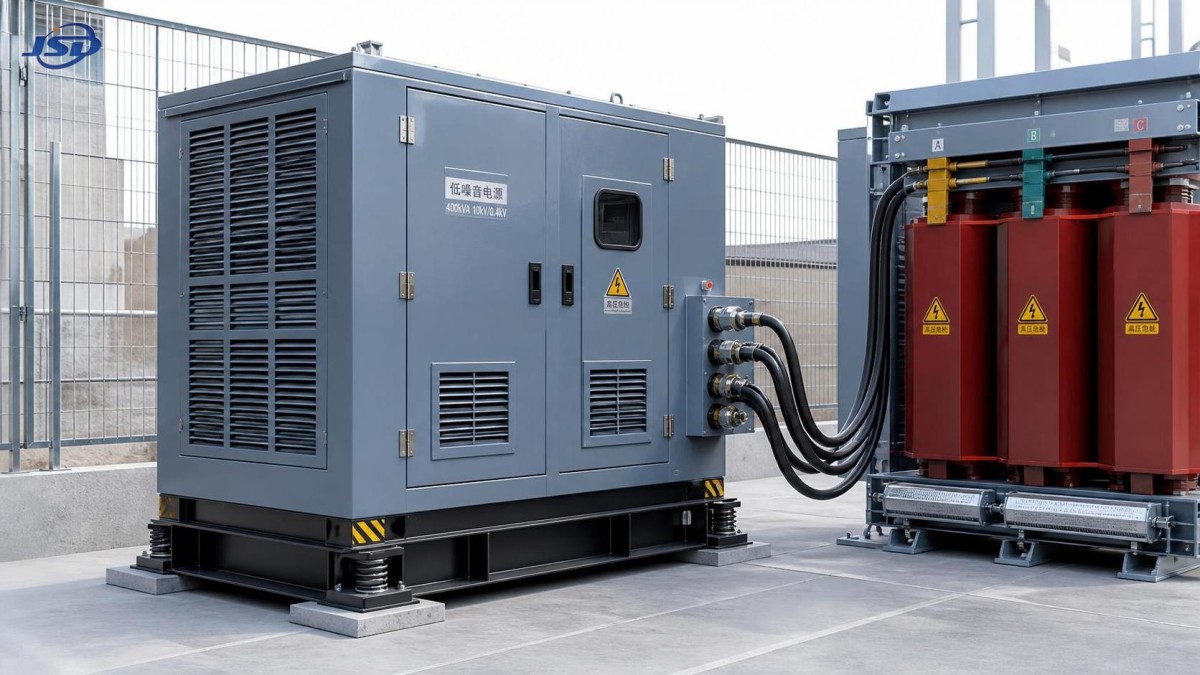
When a site includes both temporary generation and distribution equipment, layout becomes even more important. For example, if power is being routed to indoor or semi-enclosed loads, engineers may pay attention not only to the generator enclosure but also to how downstream equipment is integrated. In some projects, a dry-type distribution arrangement is preferred inside occupied or controlled spaces for practical installation reasons, such as an 11kV Three-Phase Cast Resin Dry-Type Distribution Transformer, while the generator itself remains in a better outdoor acoustic position. That does not reduce generator noise directly, but it can make the overall power setup easier to organize without pushing the noisy source into the worst possible location.
What noise range is usually realistic, not just optimistic
Without attaching a site-specific promise, it is fair to say that the term “silent” in the generator market usually means “sound-attenuated” rather than literally quiet in the everyday sense. A well-enclosed unit may be suitable for many commercial and infrastructure settings, but nobody should assume it will disappear acoustically once installed under load.
The realistic range depends on measurement distance and operating condition. If you review vendor documents, check whether the number is given at a defined distance, whether it refers to rated load or another condition, and whether it is A-weighted. If none of that is clear, the figure is not very useful for comparison. On a live site, perceived noise can rise because of partial enclosure effects, hard ground reflection, wind direction, maintenance condition, and surrounding machinery.
In other words, a believable expectation for a so-called silent set is not “barely audible,” but “noticeably quieter than an open generator, with noise still requiring planning.” That sounds less attractive than a marketing label, but it is closer to the decisions people actually have to make.
Three mistakes that lead to disappointment
Trusting one number without asking where it was measured
If two suppliers provide different noise figures, that does not automatically mean one unit is quieter. One may be measured at a different distance or in a different condition. Unless the basis is comparable, the numbers do not settle the question.
Ignoring the character of the noise
A generator can have a moderate average sound level and still trigger complaints because of tonal peaks, low-frequency rumble, or start-up transients. People often react more strongly to character than to a single average figure. This is especially true at night or in mixed-use areas.
Assuming enclosure alone solves everything
A good canopy helps, but installation details matter. Loose panels, poor maintenance, inadequate anti-vibration mounting, or an exhaust path aimed toward a reflective surface can undo much of the acoustic benefit.
A better way to judge suitability before the unit arrives
If you are trying to avoid trial-and-error, build the decision around use conditions rather than labels. Start with four questions.
First, how close will people be during normal operation? Not emergency access distance, but routine occupancy distance. Second, what times will the unit run? Daytime tolerance and nighttime tolerance are often very different. Third, is the site open or reflective? Fourth, will the electrical load be steady, stepped, or highly variable?
Once those are clear, ask the supplier for noise information with the measurement basis stated plainly. It is reasonable to ask about distance, load condition, enclosure type, exhaust arrangement, and whether any optional attenuation package changes cooling performance or maintenance access. A vague answer usually means more uncertainty on site.
It also helps to think beyond the generator itself. If the temporary power arrangement includes transformers, switchgear, cable routing, and indoor distribution zones, the quietest overall setup may come from separating functions intelligently rather than clustering every power asset together. In some layouts, a component like the 11kV Three-Phase Cast Resin Dry-Type Distribution Transformer supports a cleaner distribution path in spaces where oil-filled equipment or different placement would complicate the installation, while the generator stays where sound control is more manageable.
Simple on-site checks that tell you more than a brochure
When the generator is commissioned, do not rely only on a pass-or-fail impression standing beside the enclosure. Walk the site. Listen at the boundary, at workstations, near cabins, and at any façade that can reflect sound back. If there is a concern about compliance or neighbor disturbance, capture readings using a consistent method and document the operating condition at the time. A reading taken during low load and one taken during heavy cycling are not equivalent.
Pay attention to changes in tone as well. A rattling door, a loose fastener, or a degraded seal may be more noticeable than a modest increase in overall level. Likewise, vibration transmitted into a platform or steel deck can create a problem that is felt and heard away from the machine.
Another practical check is line of sight. If the main fan discharge or exhaust path has a clear direct path toward occupied space, the generator may sound worse than expected even if its specified attenuation is reasonable. Small barriers, reorientation, or relocation can sometimes help more than a last-minute argument about spec sheets.
If the unit is already louder than expected
Once the generator is on site, the response should be orderly rather than reactive. Start with maintenance condition: panel fit, latch security, exhaust integrity, air filter condition, and anti-vibration mounts. Then review load behavior. A unit that is oversized or cycling awkwardly with the demand profile may produce operating noise that feels less stable and more intrusive.
Placement comes next. If the generator sits in a reverberant corner, moving it may be the cleanest fix. If relocation is limited, consider whether temporary acoustic screening can break direct sound paths without obstructing ventilation or safe access. Any screening approach has to respect cooling airflow; a quieter generator that overheats is not a solution.
After that, review operating windows. Sometimes the issue is not the absolute sound level but when the sound occurs. Sequencing certain activities differently, reducing idle operation, or avoiding unnecessary night running can make the setup workable without major equipment changes.
What “realistic” means for decision-makers
The most useful mindset is to treat “silent” as a category of mitigation, not a guarantee of near-silence. On a real site, a silent power generator is realistic when its documented noise basis is clear, its installed location is acoustically sensible, its load profile is understood, and its operating impact is acceptable at the places where people will actually hear it.
That may sound less satisfying than chasing the lowest advertised number, but it leads to better outcomes. Many noise problems are not caused by choosing the wrong machine in principle. They happen because the team compares figures without context, leaves placement too late, or forgets that reflected sound and operating behavior can matter as much as enclosure design.
If you are reviewing options now, ask for comparable data, plan the layout around sensitive listening points, and expect the final answer to be a realistic range instead of a perfect headline figure. That approach makes it much easier to decide whether a silent power generator will be genuinely suitable for your site rather than merely sounding good on paper.

Get a Quote
Regardless of whether you require general advice or specific support, we are happy to help you.
Send Us Your Inquiry Today

Jinshida Electric remains committed to contributing to global energy development through professional manufacturing and superior service.