





When should industrial furnace transformer be specified with forced-air instead of oil natural cooling?
Selecting forced-air cooling for an industrial furnace transformer is not a matter of preference—it’s a response to measurable thermal, spatial, and operational demands. When load profiles spike unpredictably, ambient temperatures exceed 40°C, or physical installation space restricts oil reservoir size or radiator surface area, oil-natural (ONAN) cooling reaches its functional limit. In such cases, specifying forced-air (ONAF or OFAF) becomes technically necessary—not optional—to maintain winding temperature rise within IEC 60076-2 limits, avoid insulation degradation, and ensure continuous operation during peak smelting cycles. This decision directly impacts transformer lifespan, grid stability, and furnace uptime. For technical evaluators assessing high-temperature industrial environments—especially in steel, aluminum, or silicon carbide production—the question isn’t “Should we consider forced air?” but rather “What specific conditions confirm it’s required?”
Thermal Load Thresholds That Trigger Forced-Air Specification
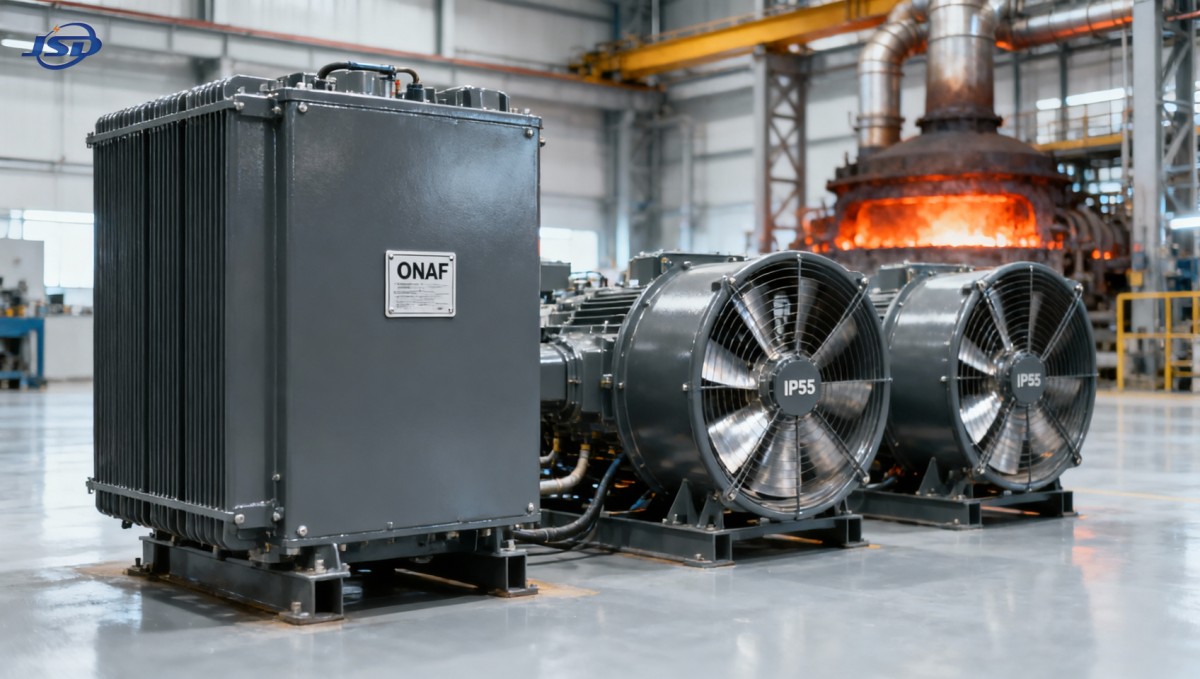
Industrial furnace transformers operate under highly dynamic loads. Unlike distribution units with stable demand, furnace transformers experience repeated 150–200% overloads lasting 10–30 minutes during melt phases, followed by low-load holding periods. ONAN cooling relies solely on natural convection: heat transfers from windings to oil, then from oil to tank walls, and finally to ambient air. Its capacity is fixed—and sharply de-rated above 30°C ambient. At 45°C ambient, ONAN-rated capacity drops by ~18%. If your furnace cycle requires sustained operation above 110% of nameplate rating for more than 5 minutes, or if measured hotspot temperatures exceed 120°C under load (per IEC 60076-7), ONAN is insufficient. Forced-air cooling adds controllable airflow across radiators, increasing heat transfer coefficient by 2.5–4×. This enables the same unit to deliver up to 120% rated load continuously—provided the fan system meets IP55 ingress protection and is integrated with temperature-based staging logic.
Space and Layout Constraints That Eliminate ONAN Feasibility
Furnace halls are dense environments. Transformer bays often have ceiling heights under 4.5 m and lateral clearances less than 1.2 m on two sides. ONAN units require substantial radiator surface area—typically 30–40% more than equivalent ONAF designs—to compensate for low convective efficiency. A 2500 kVA ONAN unit may need 8–10 m² of exposed radiator surface, whereas an ONAF version achieves the same thermal performance with 3–4 m² plus two axial fans. When footprint or height is constrained—as in retrofits inside existing furnace buildings or modular skid-mounted installations—forced-air isn’t just convenient; it’s the only viable path to meet thermal targets without relocating ductwork, raising ceilings, or rebuilding foundations. Jinshida’s 35kV Three-Phase Cast Resin Dry-Type Distribution Transformer exemplifies this trade-off: its compact ONAF-configurable design allows 120% overload capability within standard footprint envelopes, eliminating the need for oversized oil tanks or external cooling towers.
Ambient and Environmental Conditions Beyond Standard Ratings
Standard ONAN ratings assume clean, dry, still air at ≤40°C. Furnace environments rarely comply. Dust-laden air clogs radiator fins within weeks, reducing heat dissipation by up to 35%. High humidity accelerates corrosion on fin surfaces and promotes oil oxidation. Near-furnace locations regularly see ambient spikes to 55–65°C—well beyond ONAN derating curves. If site measurements show >45°C average summer ambient, >60% RH for >4 months/year, or visible dust accumulation on adjacent equipment surfaces, forced-air systems with washable filters and corrosion-resistant fin coatings become mandatory. Crucially, ONAF doesn’t just add fans—it enables active airflow management: fans can be staged (low/high speed), interlocked with furnace PLCs, and paired with oil temperature sensors to modulate cooling precisely to real-time load. This prevents thermal cycling stress that accelerates paper-oil insulation aging.
Reliability and Redundancy Requirements in Critical Processes
Furnace shutdowns cost thousands per minute. A single ONAN transformer failure halts production entirely. Forced-air systems introduce redundancy: dual independent fan circuits, separate power feeds, and fan-failure alarms tied to SCADA. When one fan train fails, the unit remains operational at ~85% rating—enough to sustain holding temperature while maintenance is scheduled. ONAN offers no such grace period. Moreover, forced-air cooling reduces the rate of insulation thermal aging (per IEEE C57.91 Arrhenius model). At constant 110°C hotspot, ONAN units age ~2.3× faster than ONAF units operating at 95°C under identical load profiles. For facilities targeting ≥30-year transformer service life, this difference is decisive—not theoretical.
When Oil-Natural Cooling Still Applies
ONAN remains appropriate where all the following hold true: ambient stays ≤35°C year-round; furnace duty cycle includes ≥4 hours of no-load or light-load recovery time between melts; radiator access allows quarterly manual cleaning; and footprint permits ≥15% larger tank dimensions. It also suits backup or auxiliary furnace transformers with infrequent use. However, if any one condition fails—e.g., summer ambient exceeds 40°C even for 3 weeks annually—ONAN’s thermal margin collapses. In those cases, forced-air isn’t an upgrade. It’s the baseline specification.
Integration Considerations for Evaluation Teams
Specifying forced-air requires verifying three interface points: electrical (fan motor voltage, phase count, starting current, and control signal type—e.g., 24 VDC enable vs. 4–20 mA proportional); mechanical (fan mounting orientation, ducting clearance, and vibration isolation requirements); and thermal (oil temperature sensor location, alarm setpoints, and whether fans activate on winding hot-spot or top-oil temperature). Jinshida’s engineering team provides pre-commissioning checklists covering all three, ensuring compatibility with existing plant MCCs and DCS architectures. No retrofit requires rewiring control panels when specifications align at the bid stage.
For technical evaluators, the decision threshold is quantitative, not qualitative. Measure ambient temperature at the intended location for 72 consecutive hours. Log furnace load profile for three representative melt cycles. Calculate required kVA output at 110°C hotspot using IEC 60076-2 Annex B. If the ONAN solution falls below that output—or requires >15% larger footprint than available—forced-air is not merely advisable. It is the only compliant, reliable, and lifecycle-cost-effective choice.

Get a Quote
Regardless of whether you require general advice or specific support, we are happy to help you.
Send Us Your Inquiry Today

Jinshida Electric remains committed to contributing to global energy development through professional manufacturing and superior service.