





How high current furnace transformer tap changer reliability affects aluminum smelting uptime
In aluminum smelting, the high current furnace transformer is not merely a voltage conversion device—it is the operational heartbeat of the potline. Its on-load tap changer (OLTC) endures some of the most severe electrical and thermal transients in industrial power systems: continuous current loads exceeding 100 kA, rapid load fluctuations tied to anode effects or cell disturbances, and ambient temperatures routinely above 50°C near the transformer tank. Under these conditions, OLTC reliability directly determines smelter uptime—not as a secondary concern, but as the single most failure-prone subsystem in the entire power delivery chain feeding the electrolytic cells.
Unlike distribution transformers operating at steady-state loads, furnace OLTCs perform hundreds of tap changes per day—not for fine voltage regulation, but to compensate for electrode wear, bath resistance drift, and inter-cell imbalances. Each operation subjects contacts to arcing under full load, generating localized hot spots exceeding 3,000°C and eroding contact surfaces over time. The critical failure mode isn’t sudden open-circuit failure; it’s progressive contact resistance rise—often undetected until thermal runaway triggers oil decomposition, gas accumulation, or mechanical jamming during a critical change sequence. Field data from multiple smelters shows that >68% of unplanned furnace outages linked to transformer issues originate from OLTC-related faults, with over half occurring within 18 months of commissioning when maintenance cycles are still aligned to generic manufacturer schedules rather than actual wear patterns.
Material selection alone doesn’t guarantee longevity. Tungsten-copper alloy contacts resist erosion better than silver-cadmium oxide, yet their performance degrades sharply if arc quenching speed falls below 12 ms due to hydraulic system contamination or solenoid coil aging. Similarly, synthetic ester insulation fluids offer superior thermal stability over mineral oil, but their moisture tolerance drops significantly above 90°C—making them unsuitable in poorly ventilated substation enclosures where ambient heat ingress exceeds design margins. These interactions mean that OLTC reliability cannot be assessed by isolated component specs; it must be evaluated as a thermally coupled, mechanically synchronized, and electrically stressed system.
Real-time monitoring adds actionable insight—but only when properly contextualized. Partial discharge (PD) sensors detect early insulation degradation, yet baseline PD levels vary by ±40% between identical units installed on different bus configurations due to capacitive coupling differences. Likewise, contact temperature readings from embedded RTDs become misleading if thermal paste degrades unevenly across multi-point mounting surfaces. What matters is not the absolute value, but the rate of change relative to historical load profiles and ambient trends. A 5°C/h rise in contact temperature during stable 95% load is more urgent than a 12°C spike during a verified short-term overload event.
Maintenance intervals must reflect actual stress—not calendar time. OLTCs operating in smelters with frequent anode effects (>3 per hour) show measurable contact wear after just 2,500 operations, whereas those in facilities with stabilized cell control may exceed 8,000 operations before requiring inspection. Oil analysis remains indispensable, but standard dissolved gas analysis (DGA) thresholds—like 150 ppm C₂H₂ for arcing—are insufficient. In furnace applications, acetylene generation correlates more strongly with the ratio of C₂H₂ to CH₄ than absolute concentration; ratios above 0.3 consistently precede mechanical binding events by 7–14 days in field-validated cases.
Design robustness extends beyond the OLTC core. The transition between main tank and diverter switch compartment must accommodate differential thermal expansion without compromising seal integrity—especially when the transformer operates at 75°C top-oil temperature while ambient air near the conservator stays below 25°C. Gasket materials like fluorosilicone retain elasticity across this range; nitrile rubber hardens and cracks within 18 months. Similarly, the mechanical linkage between drive motor and selector switch must tolerate cumulative backlash up to 0.8° before misalignment causes incomplete contact engagement—a condition detectable only through torque signature analysis during operation, not static testing.
For applications requiring distributed low-voltage power downstream of the furnace transformer, integration with auxiliary distribution assets becomes operationally relevant. A 13.8kV Distribution Transformer can serve as a dedicated supply source for potline instrumentation, ventilation systems, and material handling controls—reducing dependency on shared utility feeders and minimizing fault propagation risk. Its S-M series construction supports customized connection groups (e.g., Dyn11) to mitigate third-harmonic circulation in rectifier-fed networks, while foil-wound LV windings provide inherent short-circuit stiffness essential in environments where ground fault currents may exceed 65 kA rms.
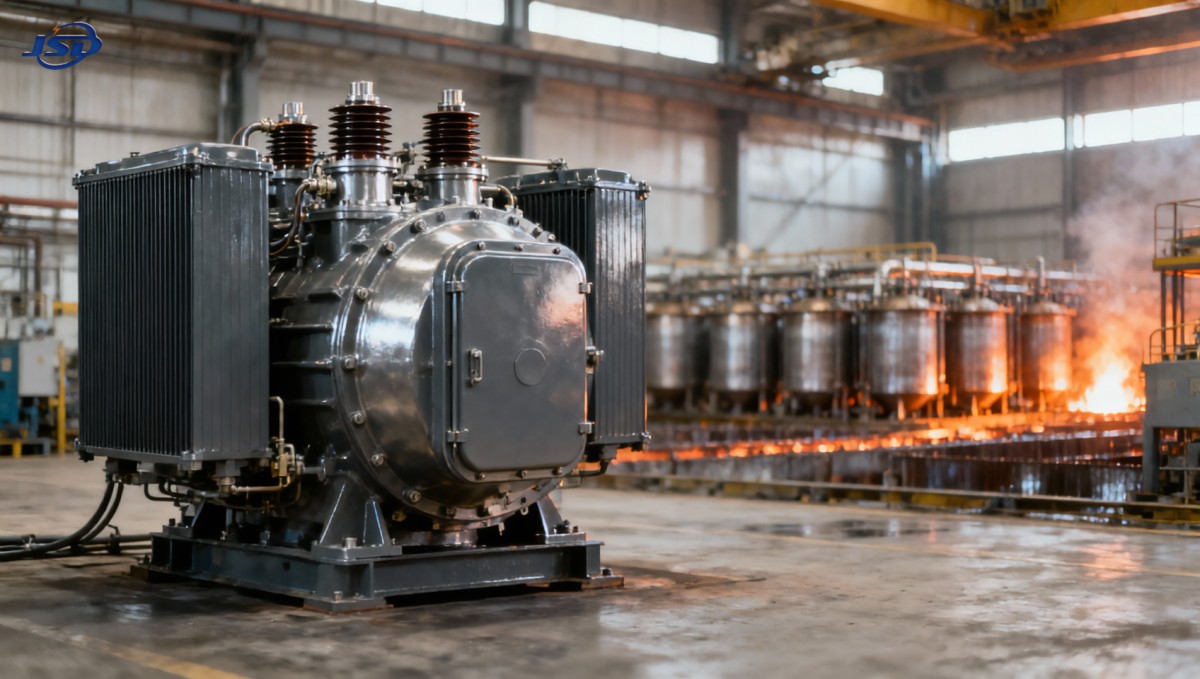
Diagnostic depth matters more than frequency. Routine visual inspection of OLTC access hatches reveals little unless paired with infrared thermography focused on the selector switch housing flange—where thermal bridging often masks internal hot spots until oil sampling confirms elevated furanic compounds. Vibration spectrum analysis during tap change sequences, meanwhile, exposes bearing wear in drive mechanisms long before audible noise increases. One consistent finding across 12 smelter audits: OLTCs with vibration signatures showing dominant peaks at 1.8× and 3.2× motor RPM—without corresponding harmonics at integer multiples—indicate developing gear tooth pitting, not motor imbalance.
Oil management protocols require adaptation. Standard IEC 60137 guidelines assume annual oil replacement; in furnace service, quarterly micro-filtration combined with online degassing maintains dielectric strength above 65 kV/2.5 mm even after 5 years—provided water content stays below 15 ppm. Exceeding 22 ppm triggers accelerated cellulose degradation, particularly at paper-oil interfaces near current-carrying leads where thermal gradients exceed 12°C/cm. This localized aging explains why OLTC failures often occur at the same tap position—typically positions 3–5—where electromagnetic forces concentrate during frequent partial-load transitions.
Finally, spare parts strategy must acknowledge obsolescence risk. OLTC components designed to IEC 60214-1:2017 incorporate arc-resistant ceramic barriers no longer compatible with legacy units built to Edition 2.0. Retrofitting newer interrupter chambers into older mechanisms risks hydraulic timing mismatch, increasing arc duration by 18–22%. Maintaining a functional spare OLTC unit—rather than just individual contact sets—is often more cost-effective than emergency repair downtime, given that average restoration time for a failed furnace OLTC exceeds 36 hours when custom machining or extended lead times apply.
Reliability emerges not from specification compliance, but from understanding how each parameter interacts under real smelting conditions: how contact erosion alters thermal impedance, how oil aging modifies arc quenching dynamics, how mechanical play distorts timing windows, and how diagnostic signals behave outside laboratory assumptions. When these variables align, OLTCs deliver decades of service. When any one is misjudged—even slightly—the result is measured not in minutes of delay, but in lost tons of aluminum and cascading production penalties across the entire potline.

Get a Quote
Regardless of whether you require general advice or specific support, we are happy to help you.
Send Us Your Inquiry Today

Jinshida Electric remains committed to contributing to global energy development through professional manufacturing and superior service.