





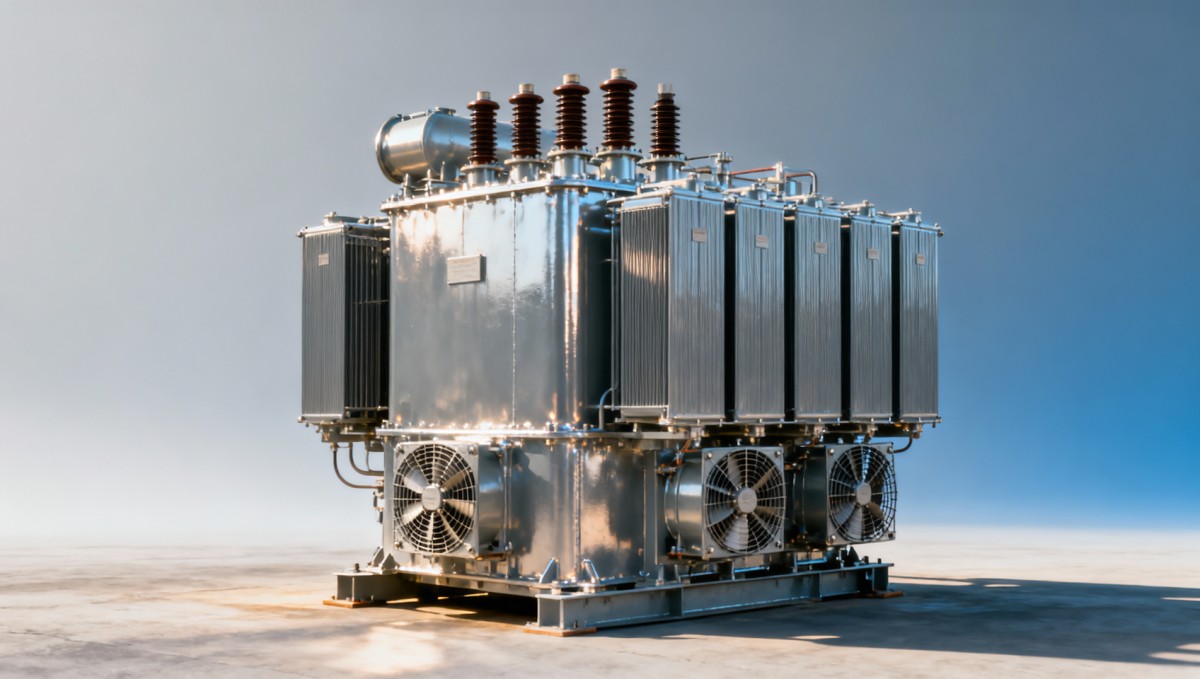
When does a three-phase power transformer need forced-air cooling?
A three phase power transformer needs forced-air cooling when natural cooling cannot keep winding and insulating-liquid temperatures within the manufacturer’s permitted limits under the intended operating conditions, or when operation depends on an approved fan-assisted rating. There is no universal kVA threshold at which fans become mandatory.
Consider an industrial transformer whose temperature rises during afternoon production peaks, particularly after additional equipment is installed nearby. The immediate concern is insulation aging or a thermal trip, but the correct response is not automatically to add fans. The decision depends on the load profile, air temperature at the cooling surfaces, installation airflow, and the transformer’s verified cooling ratings.
Start with the cooling designation and rated capacity
The nameplate and technical schedule establish whether forced-air operation is part of the design. A transformer with two documented ratings can operate at its natural-cooling rating without fans under specified service conditions, then use its fan-assisted rating when the required cooling equipment is available. A single-rated natural-cooling unit does not acquire a higher approved capacity simply because fans are fitted.
Liquid-filled transformers using higher-fire-point insulating fluids may carry different cooling designations. Use the supplied documentation rather than assuming every liquid-filled unit is designated ONAN or ONAF. Also distinguish cooling fans from room ventilation fans: one improves heat transfer at the transformer, while the other removes heat from the installation space.
Operating conditions that can justify forced air
Sustained loading exceeds the natural-cooling rating
Fans are a valid selection when the required continuous load exceeds the documented natural-cooling capacity but remains within an approved forced-air rating. This often matters where production demand grows or a distribution transformer must carry transferred load during an outage elsewhere.
Evaluate the daily load curve, not just its maximum value. A brief peak after a lightly loaded period has a different thermal effect from the same peak following hours of heavy operation. Winding hot-spot temperature can change faster than bulk oil temperature, so a modest top-oil reading does not prove that an overload is harmless.
Load-related winding losses rise approximately with the square of current at a given resistance, with additional effects from temperature and stray losses. Consequently, a relatively small current increase can create a disproportionate cooling requirement. Forced air is useful only within the thermal and electrical limits established for that design.
High ambient temperature reduces thermal margin
A transformer selected for one ambient-temperature range may require derating or a different cooling arrangement at a hotter site. The relevant air temperature is the temperature entering the cooling surfaces or enclosure, not a distant weather-station reading.
Outdoor equipment may experience solar heating and recirculated radiator exhaust. Indoors, adjacent equipment and inadequate exhaust ventilation can raise the local ambient above the building’s nominal temperature. Fans may improve heat transfer, but they cannot cool a transformer below the temperature of the incoming air.
Installation constraints restrict natural convection
Radiators close to walls, obstructed enclosure openings, and hot air trapped beneath a ceiling can undermine an otherwise adequate natural-cooling design. A transformer operating acceptably outdoors may therefore run hotter when placed in a poorly ventilated room.
Correct clearances, remove obstructions, and verify the room’s heat-removal capacity before changing the transformer cooling system. Blowing more air over radiators inside a sealed room can simply return warmer air to the same surfaces.
Separate inadequate cooling from abnormal heat generation
An unexpected temperature increase at a previously acceptable load requires diagnosis. Adding airflow may suppress a temperature indication while leaving the underlying fault unresolved.
- Check each phase current: total kVA can conceal a heavily loaded phase. Unbalance may produce localized heating that an average load figure misses.
- Review harmonic loading: converters, drives, and other nonlinear loads can increase additional losses. Use the actual current spectrum where the application warrants it.
- Inspect the heat-transfer path: dirty radiator surfaces, obstructed air passages, damaged fans, or incorrectly positioned radiator valves can reduce cooling performance.
- Investigate abnormal electrical heating: poor connections, inappropriate operating voltage, and internal defects are not corrected by stronger fans.
- Validate the measurements: confirm sensor condition, location, calibration, and controller scaling before relying on a single high or low reading.
Inspection around energized equipment requires appropriate electrical safety procedures. Internal work, connection checks, and cooling-system modifications should follow the manufacturer’s instructions and the site’s isolation requirements.
Use temperature evidence, not a universal fan-start setting
There is no single correct fan-start temperature for every transformer. Insulation systems, permissible temperature rises, sensor arrangements, and controller functions differ. Dry-type winding sensors and liquid-filled top-oil thermometers do not measure the same thermal condition.
For liquid-filled equipment, distinguish top-oil temperature, winding hot-spot temperature, and temperature rise above ambient. Top-oil temperature helps characterize operating conditions, but the winding hot spot is especially important when assessing insulation aging. Depending on the design, winding temperature may be measured directly or estimated through a thermal model.
Compare recorded temperatures with the manufacturer’s limits and the applicable loading guidance, such as the relevant IEC or IEEE guide for the transformer type. Include ambient temperature, prior loading, cooling state, and the duration of any excursion. A temperature value without that context is a weak basis for approving additional capacity.
A fan-control scheme should define:
- Fan-start and fan-stop thresholds, including hysteresis to prevent rapid cycling.
- Staged operation where more than one cooling group is provided.
- High-temperature alarms and protective actions coordinated with permitted operating limits.
- Fan supply failure, motor failure, and loss-of-cooling indications where required.
- The permitted loading response when one or all fan groups are unavailable.
Current-based anticipation or thermal-model control may be appropriate where waiting for a temperature threshold would provide insufficient response. These functions must be coordinated with the supplied thermal design rather than copied from an unrelated installation.
Choose between fans, ventilation improvements, and a larger transformer
Forced air is often attractive for intermittent higher demand, but it introduces auxiliary power, moving parts, noise, and maintenance. A larger naturally cooled transformer may be preferable where heavy loading is continuous or dependence on fans is operationally undesirable.
For room ventilation calculations, use transformer losses at the intended load and cooling state, together with other room heat sources. Transformer kVA is not the heat load released into the room. The ventilation design must also account for airflow resistance, inlet and outlet placement, and prevention of hot-air recirculation.
Applying the decision to a 10 kV distribution installation
For a 10 kV-to-0.4 kV project, the 10kV/0.4kV Oil-Immersed Power Distribution Transformer offers a stated capacity range of 30–2,500 kVA, with copper windings and an optional FR3 vegetable-oil configuration. These details help establish the electrical and material options, but they do not establish an approved forced-air rating.
Request the cooling designation, guaranteed temperature-rise data, and site-specific loading capability for the exact configuration being quoted. Do not infer fan-assisted capacity from the product’s capacity range, enclosure protection, or choice of insulating liquid.
The supplied product information also describes short-term loading up to 150% of rated capacity for no more than two hours, with oil temperature monitored at no more than 95 °C. Treat this as a conditional claim requiring written confirmation for the selected unit and operating conditions—not as a routine operating entitlement or evidence that adding fans makes that duty acceptable. Prior loading, ambient temperature, winding hot-spot limits, and limits of bushings, leads, and other components still matter.
Changing the liquid or cooling arrangement can affect thermal behavior and verification requirements. Confirm that the final offered configuration, rather than a general product description, supports the proposed duty.
Define the required performance before ordering
A useful enquiry specifies the load profile, maximum and typical ambient temperatures, altitude, installation layout, harmonic content where relevant, and the load that must remain supplied after cooling failure. Include future demand only where it forms part of the actual design requirement.
Ask the manufacturer to return separate natural- and forced-air ratings where available, associated temperature-rise guarantees, fan auxiliary demand, acoustic data, control logic, and applicable test evidence. Any stated capacity increase should be tied to defined service conditions and a specific cooling configuration.
For an existing transformer, approve a fan retrofit only after the original manufacturer or a qualified transformer engineering assessment confirms compatibility. External airflow cannot establish the adequacy of internal oil circulation, winding ducts, leads, bushings, or protection settings.
The acceptance criterion is specific: the proposed cooling arrangement must carry the required load within documented thermal limits at the site’s actual conditions, with a defined response to fan failure. If that evidence is unavailable, retain the verified rating, reduce the load, or select equipment whose rating explicitly covers the duty.

Get a Quote
Regardless of whether you require general advice or specific support, we are happy to help you.
Send Us Your Inquiry Today

Jinshida Electric remains committed to contributing to global energy development through professional manufacturing and superior service.