





What to Include in an RFQ for Distribution Transformers for Mining Sites
When sourcing distribution transformers for mining sites, an RFQ is more than a request for a kVA rating and a price. It is the document that determines whether suppliers are quoting comparable equipment—or making different assumptions about duty, environment, protection, and delivery scope. In mining, those assumptions can become expensive after the transformer reaches site.
A transformer serving a processing plant, dewatering station, crusher circuit, underground substation, or remote camp faces a very different operating reality from a conventional commercial installation. Dust, vibration, high ambient temperatures, limited maintenance access, long feeder runs, harmonic loads, and an uncertain load-growth profile all affect the specification. A short RFQ may attract a low initial quotation, but it often leaves the buyer with exclusions, redesign discussions, or equipment that is technically acceptable on paper but poorly matched to the mine.
The purpose of an effective RFQ for distribution transformers for mining sites is simple: give suppliers enough project information to price the right design, state their deviations openly, and support a fair technical and commercial comparison.
Begin with the operating duty, not just the transformer size
The requested rated capacity is necessary, but it should not be the first and only technical instruction. State what the transformer will supply and how that load behaves. A unit feeding largely linear loads has a different thermal and electrical profile from one supplying variable-frequency drives, large motor starters, crushers, conveyors, rectifier systems, or power-electronic equipment.
Procurement teams should ask the electrical engineer to provide the expected continuous load, peak load, starting conditions, likely overload events, and projected load increase where available. If the transformer will operate continuously near its rating, say so. If the site expects intermittent but heavy loads, describe the duty cycle rather than simply requesting “overload capability.” The supplier needs enough context to assess temperature rise, impedance, cooling arrangement, and winding design.
It is also worth separating “installed load” from “simultaneous demand.” Mining facilities frequently contain standby motors, future conveyor extensions, or auxiliary systems that are not all energized together. A supplier cannot reliably size a transformer based on a broad connected-load figure alone. Conversely, leaving anticipated expansion out of the RFQ may make a low-cost option look attractive today while creating an avoidable replacement project later.
Define the electrical system clearly enough to prevent hidden assumptions
Every RFQ should identify the primary system voltage, required secondary voltage, frequency, phase arrangement, and neutral-earthing requirements. It should also state whether the transformer is connected to a utility network, a captive generation system, or a hybrid arrangement. These details influence insulation coordination, vector group selection, protection philosophy, and the supplier’s interpretation of tolerances.
Include the nominal voltage and, where known, the permitted voltage variation at the transformer terminals. If a tap changer is required, specify whether off-circuit taps are acceptable or whether on-load voltage regulation is needed. The number of tap positions and tap range should be issued by the project electrical design team rather than left as an open commercial choice. A supplier may offer a standard tap arrangement that is reasonable for general distribution service but unsuitable for a weak mining network with appreciable voltage fluctuation.
Short-circuit information deserves the same attention. State the available fault level on the high-voltage side, the required withstand duty, and any relevant system studies. Transformer impedance is not merely a catalogue value: it affects secondary fault current, voltage drop during motor starting, parallel operation, and the duty imposed on downstream switchgear. Two quotations with the same kVA and voltage ratings can have materially different impedance values, making them unsuitable substitutes.
Describe the mine environment in practical terms
“Outdoor installation” is rarely enough information for a mining transformer quotation. Suppliers should know the highest and lowest ambient temperatures, installation altitude, humidity, dust exposure, corrosive atmosphere, rainfall or snow exposure, solar loading, and seismic requirements if applicable. A dry and dusty open-pit location calls for a different set of considerations from a humid coastal mineral-processing plant or an underground installation with restricted ventilation.
The RFQ should identify whether the unit will be installed indoors, outdoors, within a containerized electrical room, on a skid, or in a substation. It should also explain access limitations. Can the transformer be moved by site crane? Must it pass through an underground shaft? Is there a maximum transport weight, width, or lifting height? These questions can sound logistical, but they may influence tank construction, radiator arrangement, oil filling strategy, and the need for removable components.
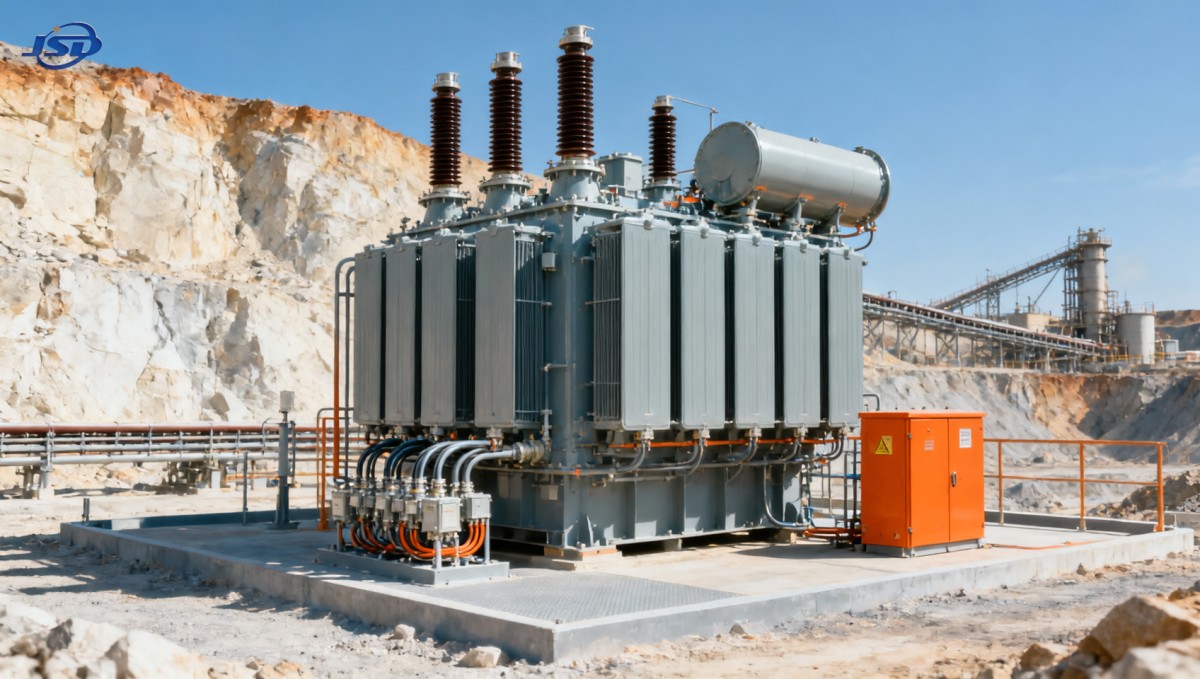
Do not overlook contamination. Fine conductive dust, salt-laden air, process fumes, and chemical exposure can affect external insulation, cable boxes, coatings, and cooling surfaces. The appropriate protection level and surface-treatment requirement should be set against the actual environment and the project’s maintenance capability. Asking for “heavy-duty paint” without a defined coating system or project requirement invites inconsistent offers.
Specify construction, cooling, and maintainability choices
The RFQ should state whether an oil-immersed or dry-type transformer is required, or whether suppliers may recommend either with a clear technical basis. This is a decision shaped by fire risk, location, ventilation, environmental controls, maintenance practice, and space—not only purchase price. If oil containment, fire barriers, or an indoor installation impose particular constraints, those should be visible before quotation.
For oil-immersed distribution units, clarify the preferred cooling designation, whether radiators must be removable, and whether cooling fans are acceptable or undesirable. A remote mine may value a simpler ONAN arrangement because it reduces auxiliary systems and maintenance points. Another installation may need forced cooling because physical space is limited. Neither approach is universally better; the RFQ must communicate the operating priority.
Ask suppliers to identify winding material, core-loss data, load-loss data, temperature-rise limits, total mass, oil volume where relevant, sound level requirements if applicable, and the expected maintenance items. These details make life-cycle cost comparisons more meaningful. A lower initial offer can be less economical if losses are higher across long operating hours or if the design requires more difficult service support in a remote location.
For projects involving DC processes or substantial power electronics, a conventional distribution transformer may not be enough. The RFQ should state the rectifier configuration, harmonic information, required isolation, pulse arrangement where relevant, and any limits on network disturbance. An Isolation and Rectifier Special Transformer can be configured for industrial rectifier duties, with customized low-voltage outputs, three-phase operation, and options such as Dyn11 or Yyn0 connection groups. Its stated range of 50kVA–5000kVA and primary voltages from 6kV to 35kV illustrate why a purpose-designed quotation needs more than a basic voltage ratio. The actual selection still depends on the site’s electrical study and rectifier equipment requirements.
Standards, testing, and documentation should be priced as part of the package
State the governing standard and the edition or project specification where available. IEC 60076 is commonly referenced for power transformers, but an RFQ should not assume that this single reference resolves every interface or test requirement. Local grid rules, owner engineering standards, mine safety requirements, and installation regulations may add further obligations.
Ask bidders to list all routine tests included in their price and identify any type, special, or witnessed tests requested by the purchaser. Rather than demanding every possible test without considering cost and schedule, focus on what genuinely reduces project risk. A witness test may be justified for a critical unit, a technically unusual application, or a first-time supplier. For repeat, standard-duty transformers, robust factory documentation and defined acceptance criteria may be the more proportionate approach.
The documentation schedule should be explicit. Typical requirements may include outline drawings, nameplate data, terminal arrangement drawings, foundation loads, losses, test reports, manuals, packing details, recommended spares, and commissioning guidance. Request document submission dates, not just a final dossier. Early drawings matter because civil works, cable routes, switchgear interfaces, and transport plans can all depend on them.
Make the commercial scope comparable before reviewing price
A quotation comparison becomes misleading when one supplier includes accessories, packing, tests, and site support while another treats them as options. Build a commercial schedule that asks bidders to separately confirm what is included: bushings, cable boxes, marshalling box, temperature indicators, pressure-relief devices, wheels or skid base, lifting lugs, surge arresters if required, neutral earthing equipment, oil, touch-up paint, special tools, spares, and export packing.
Delivery should be assessed in the same disciplined way. Request the manufacturing lead time from approved drawings or purchase order release, the anticipated shipment point, packing method, transport dimensions and weight, and any site assembly requirements. For remote mining projects, a transformer that ships in one piece but cannot safely reach the substation is not a complete solution.
Warranty language also needs detail. Ask when warranty starts, what conditions apply, how defects are handled, whether field service is available, and what response information the supplier can reasonably provide. It is sensible to evaluate technical competence and manufacturing controls alongside price. Manufacturers such as Jinshida Electric Power Technology Co., Ltd. position engineering support, controlled manufacturing processes, and quality management as part of reliable power-equipment delivery; for buyers, the practical question is whether those capabilities are evidenced in the proposed drawings, test plan, document quality, and stated service scope.
Request deviations and clarify the bid before award
One of the most useful lines in an RFQ is also one of the simplest: require a formal list of deviations, exclusions, and assumptions. Suppliers should not be allowed to bury technical exceptions in a footnote or leave them unstated. If no deviation is declared, the bid should be understood to comply with the RFQ and referenced specifications.
Before placing an order, compare bids using a technical clarification sheet rather than price alone. Check rated output under site conditions, impedance, vector group, losses, cooling, insulation level, protection accessories, testing, documentation, dimensions, weights, lead time, and commercial exclusions. A technically cheaper bid may still be the right choice—but only after the differences are visible and accepted by the engineering team.
The strongest RFQ does not try to dictate every manufacturing detail. It defines the mine’s real requirements, identifies the interfaces that cannot be compromised, and leaves room for suppliers to explain a better engineering solution. That balance produces cleaner quotations, fewer late-stage changes, and distribution transformers that can be maintained and relied upon long after the purchase order is closed.

Get a Quote
Regardless of whether you require general advice or specific support, we are happy to help you.
Send Us Your Inquiry Today

Jinshida Electric remains committed to contributing to global energy development through professional manufacturing and superior service.