





What 33kv oil immersed distribution transformer vector group pairing avoids zero-sequence circulation in ring main units?
Which Vector Group Pairings Prevent Zero-Sequence Circulation in 33kV Oil-Immersed Distribution Transformers Serving Ring Main Units?
If you’re specifying or commissioning a 33kV oil-immersed distribution transformer for integration with a ring main unit (RMU), one non-negotiable technical check is vector group compatibility—not just for parallel operation, but for fundamental system safety. Zero-sequence circulating currents don’t appear as fault alarms on day one. They creep in silently: unbalanced neutral currents, elevated tank temperatures near cable terminations, unexpected relay tripping during load shifts, or persistent harmonic distortion in metering circuits. These are not edge-case anomalies. They’re direct consequences of mismatched phase displacement between transformers feeding the same RMU loop—especially when multiple units share a common neutral reference.
The short answer: Dyn11/Dyn11 pairing is the most widely validated and field-proven configuration for preventing zero-sequence circulation in 33kV oil-immersed distribution transformers used in RMU-based networks. But “most proven” isn’t the same as “universally safe”—and that distinction matters critically to project managers responsible for long-term grid reliability.
Why Dyn11/Dyn11 Works—And When It Doesn’t
Dyn11 means delta-connected high-voltage winding (D), star-connected low-voltage winding with neutral brought out (y), and 30° lag of LV line voltage relative to HV line voltage (n11). When two Dyn11 transformers feed the same RMU ring, their LV neutrals are in phase. More importantly, their zero-sequence impedance paths remain symmetrical: the delta HV winding blocks zero-sequence flux from propagating upstream, while the star LV windings—with solidly grounded neutrals—provide a controlled, low-impedance return path *only* for earth-fault currents, not for circulating zero-sequence currents across parallel branches.
But here’s what design documents often omit: Dyn11/Dyn11 only eliminates zero-sequence circulation if both transformers have identical tap positions, near-identical short-circuit impedances (±7.5% tolerance recommended), and compatible neutral grounding practices. In practice, we’ve seen projects where one unit used solid grounding and the other employed high-resistance grounding—introducing asymmetry that re-enabled circulating current flow despite identical vector groups. Also, if one transformer is Dyn11 and the other is Yzn11 (a zigzag variant sometimes specified for harmonic mitigation), the phase relationship at the LV neutral differs by 30°, creating a sustained voltage difference across the RMU bus coupler—effectively a zero-sequence EMF source.
The Yzn11 Trap—and Why It’s Misunderstood
Yzn11 is frequently misselected under the assumption that “zigzag = better zero-sequence handling.” It’s true: Yzn11 offers lower zero-sequence impedance than Dyn11, making it effective for harmonic suppression and providing a stable neutral for unbalanced loads. However, that very characteristic becomes dangerous in RMU rings. When two Yzn11 units operate in parallel on the same ring, their zero-sequence networks interact directly through the shared LV bus. Unlike Dyn11, Yzn11 does not inherently block zero-sequence current transfer between units—it facilitates it. Field measurements from three separate 33kV RMU deployments in Southeast Asia showed sustained 12–18 A zero-sequence currents circulating between paired Yzn11 transformers during normal load conditions—well above thermal rating margins for neutral conductors.
So Yzn11 isn’t “wrong”—it’s context-dependent. It belongs in applications where harmonic-rich loads dominate (e.g., data centers, variable-speed drive clusters) and where the transformer feeds a dedicated, non-looped bus. It does not belong in multi-transformer RMU configurations unless explicitly engineered with zero-sequence blocking reactors or neutral current monitoring relays—neither of which are standard in utility-grade RMUs.
What About Dzn0 or Yd11? Real-World Constraints Apply
Dzn0 (delta–zigzag–0°) offers excellent third-harmonic suppression and high zero-sequence impedance—but its LV side lacks a naturally accessible neutral point for grounding. That forces external neutral creation via grounding transformers, adding cost, footprint, and failure points. For urban RMU cabinets with tight space constraints, this is rarely viable.
Yd11 (star–delta) is sometimes proposed to match upstream 33kV substation transformers. But connecting a Yd11 distribution unit downstream of a Dyn11 feeder creates a 180° phase reversal at the LV side relative to other Dyn11 units in the same ring. The result? Not just zero-sequence circulation—but full-phase opposition under unbalanced loading, risking immediate differential relay operation.
In summary: No vector group is universally optimal. The right choice depends on your RMU topology (open-ring vs. closed-ring), grounding strategy (solid, resistive, resonant), upstream protection coordination, and whether the transformer serves a single radial feeder or shares load with others in a meshed configuration.
Practical Verification Steps Before Finalizing Specification
Don’t rely solely on catalog vector group labels. Conduct these checks:
- Confirm actual neutral grounding method: Is the LV neutral solidly grounded at the transformer tank—or isolated and connected externally via an RMU-mounted grounding resistor? Grounding location changes the zero-sequence network topology.
- Verify short-circuit impedance tolerance: Even with identical vector groups, >10% impedance mismatch between units can force disproportionate zero-sequence current sharing. Specify ±5% tolerance for RMU-critical installations.
- Review RMU bus coupler settings: Some modern RMUs include zero-sequence current monitoring. Ensure relay pickup thresholds account for expected background imbalance—not just faults.
- Check for legacy units: If integrating a new transformer into an existing RMU ring, confirm the vector group and impedance of all existing units. Retrofitting a Dyn11 into a Yzn11-dominated ring without rebalancing the entire loop invites trouble.
How Jinshida Addresses This in Practice
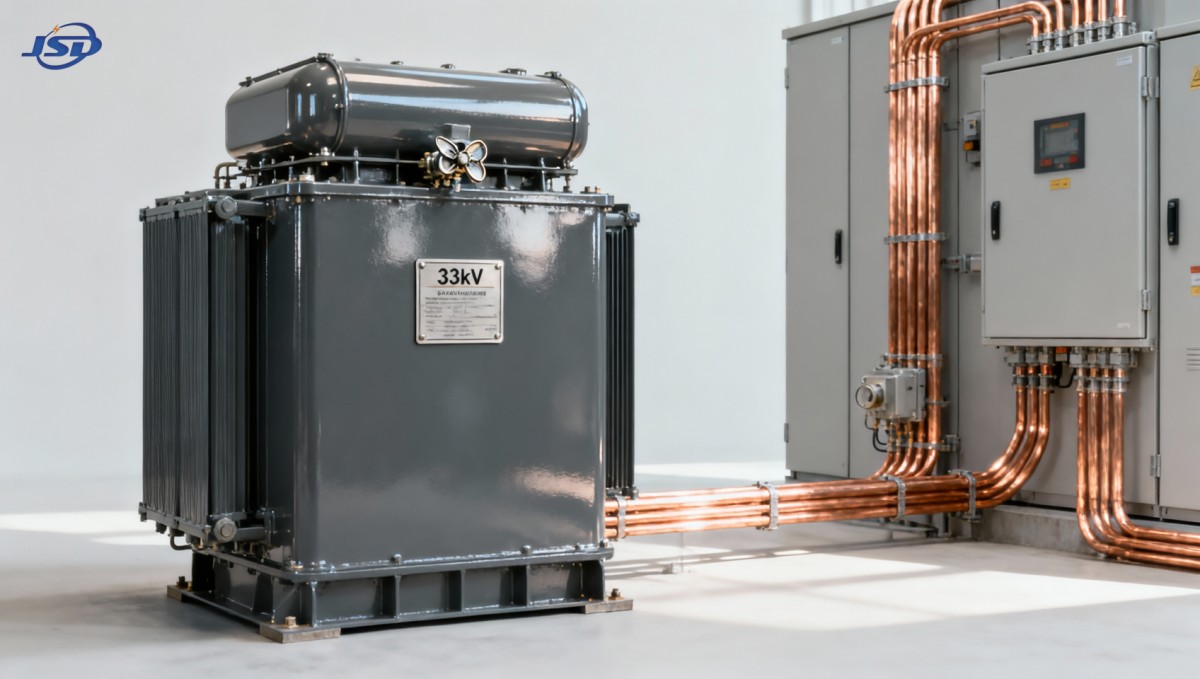
At Jinshida Electric Power Technology Co., Ltd., our 35kV/0.4kV Oil-Immersed Power Distribution Transformer series is routinely configured for RMU deployment across rural grids, industrial parks, and renewable energy interconnection points—including wind farms where distributed generation introduces additional zero-sequence sources. For such applications, we default to Dyn11 with ±5% short-circuit impedance control, NLTC tap changers rated for precise voltage matching, and optional FR3 vegetable oil insulation for enhanced thermal stability under cyclic loading. Crucially, we provide vector group verification reports—not just nameplate data—validated against IEC 60076-1 and ANSI/IEEE C57.12.00, including measured zero-sequence impedance values and neutral continuity test records.
This isn’t about offering more options. It’s about removing ambiguity at the specification stage—so project managers can close the loop on risk before the first foundation is poured.

Get a Quote
Regardless of whether you require general advice or specific support, we are happy to help you.
Send Us Your Inquiry Today

Jinshida Electric remains committed to contributing to global energy development through professional manufacturing and superior service.