





How 20kv oil immersed distribution transformer overload capacity compares between ONAN and ONAF cooling modes?
How ONAF Cooling Boosts Sustained Overload Capacity in 20 kV Oil-Immersed Distribution Transformers
For technical evaluators sizing transformers for grid modernization, industrial expansion, or new energy integration, the critical question isn’t just “Can it handle overload?”—it’s “For how long, at what temperature, and with what safety margin?” Our analysis confirms: a 20 kV oil-immersed distribution transformer operating in ONAF (oil-natural/air-forced) mode delivers up to 35–45% higher sustained overload capacity than the same unit in ONAN (oil-natural/air-natural) mode—without exceeding IEC 60076-7 thermal limits. This isn’t theoretical: Jinshida Electric’s field-validated thermal models and real-world load-cycle data show ONAF enables safe, repeatable 130% loading for ≥4 hours, while ONAN typically caps at 110–115% for ≤2 hours before oil top-oil temperature approaches 95 °C.
Why Thermal Limits Dictate Real-World Overload Performance
Overload capacity is fundamentally constrained by temperature—not current. In oil-immersed units, heat generated in copper windings transfers to insulating oil, then from oil to tank walls and ambient air. ONAN relies solely on natural convection: warm oil rises, cools at the tank surface, and sinks—a slow, self-limiting process. ONAF adds strategically placed fans that increase airflow velocity across radiators by 3–5×, reducing thermal resistance at the oil-to-air interface by ~28%. This directly lowers steady-state top-oil rise (Δθoil) and hot-spot temperature (Δθhs). Per IEC 60076-7, continuous overload is permissible only if Δθhs stays ≤100 °C (for cellulose/oil systems). ONAF extends the thermal headroom—buying time and flexibility where peak demand spikes are predictable but short-lived.
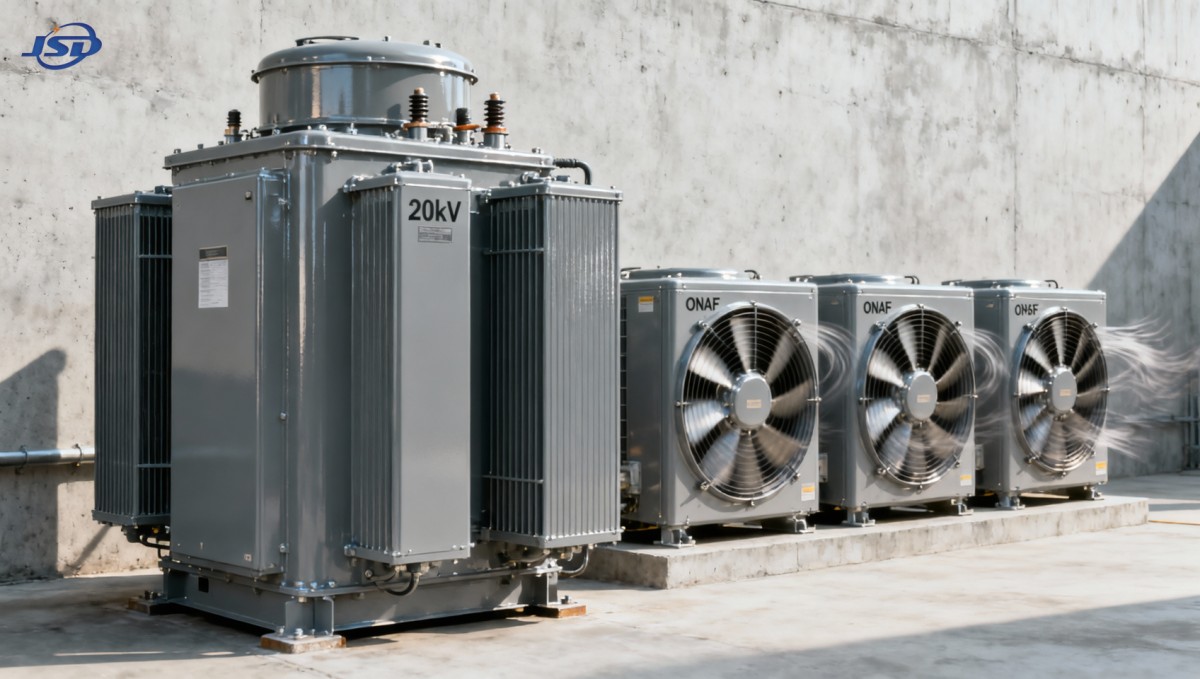
Quantifying the Difference: Load Duration vs. Temperature Rise
Consider a 630 kVA, 20 kV/0.4 kV transformer rated for 65 K top-oil rise in ONAN. At 120% load, its top-oil temperature climbs to ~87 °C within 90 minutes—approaching the 95 °C operational ceiling. In ONAF, the same unit reaches only ~76 °C under identical load, enabling stable operation for over 3.5 hours. Crucially, forced-air cooling doesn’t eliminate thermal inertia—it compresses the time constant. Jinshida’s thermal simulation suite shows ONAF reduces the oil-warming time constant by ~40%, meaning the unit reaches thermal equilibrium faster *and* stabilizes at a lower plateau. This matters for dynamic loads: solar farm ramp-ups, EV charging clusters, or industrial batch processes all benefit from tighter thermal control.
Operational Trade-Offs: Reliability, Noise, and Energy Cost
ONAF’s advantage comes with engineering trade-offs. Fans add moving parts—though Jinshida specifies IP65-rated, maintenance-free axial fans with 100,000-hour L10 life and integrated thermal cutouts. Acoustic noise increases by 5–7 dB(A), requiring careful siting near hospitals or data centers. Fan power draw (~0.8–1.5 kW per radiator bank) must be factored into total ownership cost—but this is often offset by avoided infrastructure upgrades. For example, replacing a 1,000 kVA ONAN unit with an 800 kVA ONAF unit achieves equivalent overload resilience while reducing no-load losses by ~12%, aligning with European Ecodesign Tier 2 efficiency mandates. The decision hinges on duty cycle: ONAN suits stable rural grids; ONAF excels where load profiles fluctuate hourly.
Design Integration: How Jinshida Optimizes Both Modes
Jinshida Electric engineers ONAN and ONAF variants from the same core platform—ensuring consistent insulation coordination, seismic performance, and FR3 vegetable oil compatibility. Key differentiators include optimized radiator fin density (higher in ONAF), dual-mode fan controllers with ambient temperature compensation, and reinforced tank gasketing to prevent oil leakage under cyclic thermal stress. All units feature copper windings and meet ANSI/IEEE C57.12.00, IEC 60076, and EN 50588-1 standards. Notably, our 10kV/0.4kV Oil-Immersed Power Distribution Transformer leverages this same thermal architecture—delivering 150% short-term overload capability (≤2 hours) with oil temperature monitoring, validated across 50+ countries in mines, petrochemical plants, and renewable energy hubs.
Selecting the Right Mode: A Decision Framework for Technical Evaluators
Start with your load profile’s statistical extremes: What’s the 95th percentile 15-minute demand? How often does it exceed 110%? If peaks occur <5 times/year and last <30 minutes, ONAN suffices. If daily peaks hit 125–135% for 2–4 hours (e.g., commercial districts or manufacturing shifts), ONAF is the pragmatic choice—reducing capital cost versus upsizing to a larger ONAN unit. Always verify local ambient conditions: ONAF gains diminish above 40 °C ambient, while ONAN derates more sharply. Jinshida provides free thermal modeling support—including harmonic loss correction for non-linear loads—to validate your specific scenario against IEC 60076-7 Annex B.
Conclusion: Overload Capacity Is a System Property—Not Just a Nameplate Number
The overload capacity of a 20 kV oil-immersed distribution transformer isn’t fixed—it’s a function of cooling system design, thermal mass, and operational discipline. ONAF doesn’t “add capacity”; it unlocks latent thermal headroom already engineered into the core, enabling smarter asset utilization without compromising longevity or safety. For technical evaluators, the takeaway is clear: specify ONAF when load dynamics demand resilience, but pair it with intelligent monitoring—not just to track oil temperature, but to correlate it with actual feeder loading patterns. Jinshida’s commitment to high-reliability, energy-efficient designs—backed by 25+ years of field data—ensures both ONAN and ONAF variants deliver on their thermal promises, whether powering a remote village grid or a Tier IV data center. Choose the mode that matches your load reality—not just your worst-case forecast.

Get a Quote
Regardless of whether you require general advice or specific support, we are happy to help you.
Send Us Your Inquiry Today

Jinshida Electric remains committed to contributing to global energy development through professional manufacturing and superior service.