





Three phase oil immersed power transformers in solar farms: how daily thermal cycling accelerates paper insulation degradation
Why Daily Thermal Cycling in Solar Farms Is the Silent Killer of Transformer Insulation
For after-sales maintenance personnel, a recurring anomaly—rising dielectric loss factor (tan δ), inconsistent DGA results showing elevated CO/CO₂ ratios without fault gases, and premature winding resistance drift—often points not to manufacturing defects or oil contamination, but to something far more insidious: cumulative thermal stress on cellulose insulation. In solar farms, three phase oil immersed power transformers don’t operate like their grid-tied counterparts. They cycle from near-ambient at dawn to full-load temperatures by noon—and back down again before sunset. That’s not just load variation; it’s daily mechanical fatigue imposed on paper insulation that was never designed for this rhythm.
The Real Degradation Mechanism Isn’t Just Heat—it’s Repeated Expansion and Contraction
Cellulose-based insulation (kraft paper, pressboard) degrades via hydrolysis: water molecules break glycosidic bonds in the polymer chain. But hydrolysis accelerates exponentially not only with temperature—but with moisture *mobility*. And thermal cycling is what makes moisture mobile inside solid insulation.
When a transformer heats up, oil expands, pressure rises, and moisture migrates from paper into oil. When it cools, oil contracts, creating localized vacuum pockets at paper-oil interfaces—and drawing moisture *back* into the paper, but unevenly. Each cycle leaves behind micro-scale delamination, fiber swelling, and irreversible bond scission. Studies show that 10°C of daily ΔT over 200 cycles/year inflicts more insulation damage than steady-state operation at 75°C for the same duration. The problem isn’t peak temperature—it’s the *rate* and *repetition* of dimensional change in the solid insulation matrix.
This explains why routine oil tests often miss early warning signs. Dissolved gas analysis (DGA) remains normal until advanced degradation releases levoglucosan or furanic compounds—by which point DP (degree of polymerization) has already dropped below 250. At that stage, mechanical strength is compromised, and risk of turn-to-turn failure under transient overvoltage rises sharply—not from insulation breakdown, but from brittle paper cracking under electromagnetic forces.
What Your Field Data Actually Tells You—And What It Doesn’t
Many maintenance teams rely on oil acidity (neutralization number) and moisture content as primary indicators. But in thermally cycled units, these metrics lag severely. Acid number rises only after significant hydrolysis has occurred—and moisture readings reflect bulk oil, not the moisture trapped deep within paper layers where degradation initiates. A transformer showing 12 ppm water in oil and 0.03 mg KOH/g acid number may already have DP < 300 in critical pressboard spacers.
More telling are longitudinal trends in:
• Winding resistance deviation across phases (indicating localized hot spots and uneven aging)
• Frequency response analysis (FRA) shifts below 1 kHz (sensitive to mechanical loosening in paper-wrapped windings)
• Tan δ increase specifically at 0.1–1 Hz (revealing interfacial polarization effects tied to moisture redistribution)
These require dedicated testing—not annual oil sampling alone. And they’re rarely scheduled proactively unless triggered by an event. That’s the operational blind spot: thermal cycling doesn’t cause sudden failures. It erodes margin, silently, until the first lightning strike or through-fault exposes the weakness.
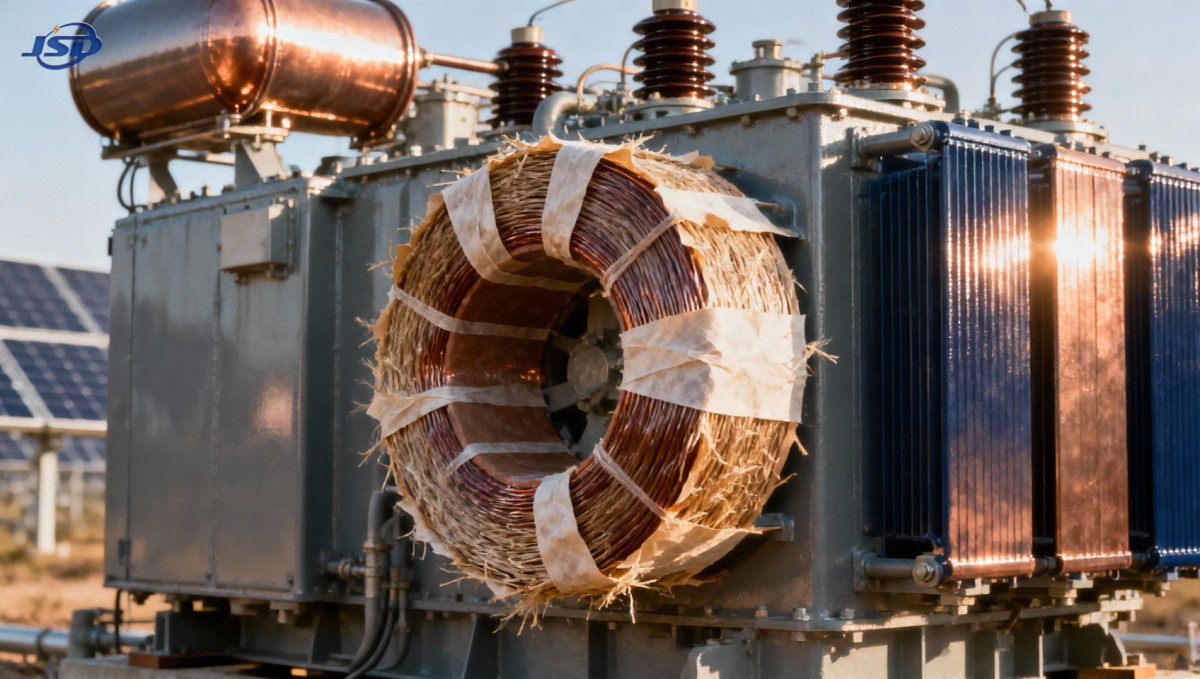
Design Choices That Matter More Than Nameplate Ratings
Not all three phase oil immersed power transformers respond equally to solar farm duty cycles. Key differentiators aren’t always visible on the nameplate:
- Pressboard quality and treatment: Untreated kraft pressboard absorbs moisture faster and swells more aggressively than resin-impregnated or thermally upgraded variants. Look for ASTM D2418 compliance—not just IEC 60641.
- Oil-paper interface geometry: Sharp corners, unsupported paper folds, and tight oil gaps between windings concentrate thermal stress. Units with staggered spacer placement and chamfered pressboard edges show slower DP decay under identical cycling profiles.
- Tank design and cooling strategy: Radiator-mounted fans that activate only above 65°C create steeper thermal gradients than low-speed continuous circulation. Forced oil-directed flow (OFWF) reduces hot-spot rise—but increases oil shear, accelerating oxidation if antioxidant levels aren’t actively monitored.
Manufacturers rarely publish DP decay curves under cycling conditions. But field data from Jinshida deployments in desert and high-latitude solar farms shows units with thermally stabilized paper and optimized oil flow maintain >85% original DP after 8 years of 15–18°C daily ΔT—versus <60% in standard-grade units under identical ambient profiles.
Where Energy Storage Changes the Thermal Load Profile—And Why It Matters
Adding battery storage to a solar farm isn’t just about smoothing output—it directly alters transformer thermal dynamics. A well-designed hybrid system with an 51.2V Stackable LiFePO4 Energy Storage Battery can reduce midday transformer loading peaks by shifting excess generation into storage, then discharging during evening ramp-up. This flattens the daily thermal curve: instead of two sharp spikes (sunrise surge + sunset export), you get sustained, lower-amplitude loading.
That reduction in ΔT amplitude—even by just 5–7°C—delays paper degradation onset by 3–5 years in accelerated aging models. Crucially, it also lowers the frequency of thermal expansion/contraction cycles *at critical stress thresholds*. A unit cycling between 45°C and 70°C suffers less cumulative damage than one swinging between 35°C and 85°C—even if average temperature is identical.
Actionable Maintenance Adjustments—Starting Next Quarter
You don’t need to replace transformers to extend service life. Focus interventions where evidence supports impact:
- Shift oil sampling timing: Don’t sample at midday. Sample at thermal equilibrium—ideally 2 hours after sunset—when moisture has redistributed and dissolved gases have stabilized. This reveals true paper saturation levels.
- Add FRA to baseline commissioning: Capture a reference trace before energization. Repeat annually—not just after faults. Early shifts in low-frequency response correlate strongly with DP loss before tan δ rises.
- Monitor top-oil vs. hotspot temperature delta: A rising difference (>12°C) signals declining oil flow efficiency or internal obstruction—both accelerate localized paper aging. Pair with infrared scanning of tank surfaces to map thermal asymmetry.
- Reassess drying protocols: Vacuum dehydration works for bulk moisture—but doesn’t reverse hydrolytic chain scission. If DP falls below 350, consider onsite oil regeneration with adsorbent bypass—proven to slow further degradation by removing catalytic oxidation byproducts.
Thermal cycling won’t disappear from solar farm operations. But treating it as a secondary concern—rather than the dominant aging driver—means maintenance remains reactive. The shift starts with interpreting your existing data through the lens of cyclic stress, not steady-state limits. Because when insulation fails, it’s rarely the oil that breaks first—it’s the paper, tired from doing the same expansion-and-contract dance, day after day, year after year.

Get a Quote
Regardless of whether you require general advice or specific support, we are happy to help you.
Send Us Your Inquiry Today

Jinshida Electric remains committed to contributing to global energy development through professional manufacturing and superior service.