





Shipboard transformer vibration limits: why ISO 8568-2 thresholds differ from land-based units
Shipboard transformer vibration limits: why ISO 8568-2 thresholds differ from land-based units
Understanding shipboard transformer vibration limits is critical for marine electrical system reliability—yet many technical evaluators overlook why ISO 8568-2 thresholds diverge significantly from land-based transformer standards. Unlike stationary units, shipboard transformers endure dynamic motion, shock loads, and resonant frequencies unique to maritime environments. This article clarifies the engineering rationale behind ISO 8568-2’s stricter, frequency-weighted vibration criteria—and how Jinshida Electric’s marine-grade transformers meet these demands through optimized core clamping, anti-resonance mounting, and naval-certified testing protocols.
Why vibration tolerance isn’t just “lower” — it’s fundamentally redefined
Technical evaluators often assume shipboard vibration limits are merely scaled-down versions of IEC 60076-2 or IEEE C57.12.00 thresholds. That’s a dangerous misconception. ISO 8568-2 doesn’t prescribe lower absolute displacement (mm) or velocity (mm/s); instead, it mandates frequency-weighted acceleration limits (m/s²), measured across three orthogonal axes under simulated sea states. This reflects real operational physics: a 3 Hz hull pitch may excite core laminations at 120 Hz harmonics, while a 15 Hz propeller-induced resonance can destabilize winding bracing. Land-based standards ignore such coupling—ISO 8568-2 accounts for it explicitly.
The standard defines four severity classes (S1–S4), with S3 (for medium-sized vessels like offshore supply ships and ferries) requiring ≤0.8 m/s² RMS in the 2–100 Hz band—up to 4× stricter than typical onshore transformer acceptance limits when translated to equivalent velocity. Crucially, measurement must occur during simulated service conditions: roll/pitch/heel angles up to ±22.5°, vertical accelerations ≥0.3g, and simultaneous broadband shock pulses mimicking wave slamming.
Three structural realities that drive ISO 8568-2’s divergence
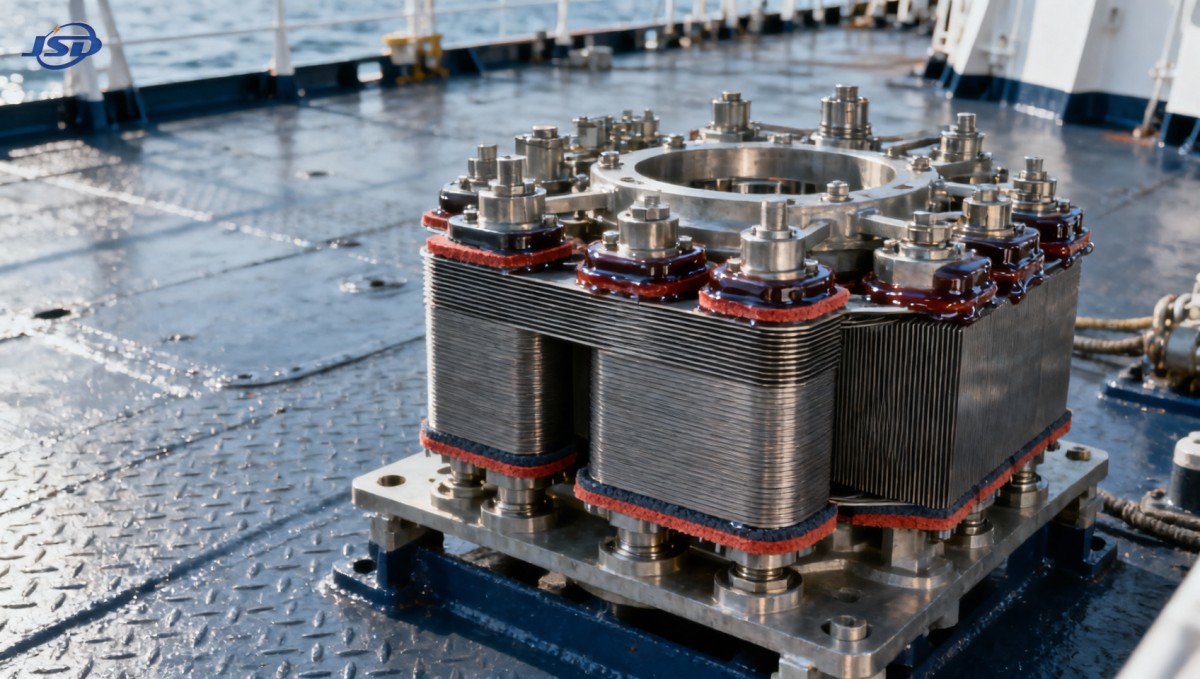
First, mechanical anchoring. On land, transformers rest on rigid concrete pads; onboard, they mount to flexible steel decks transmitting multi-directional energy. Without dedicated anti-resonance mounts, natural deck frequencies (often 8–18 Hz) amplify transformer response rather than dampen it. Second, thermal cycling is accelerated by salt-laden air and engine-room heat gradients—causing differential expansion between copper windings and amorphous alloy cores, increasing micro-movement risk. Third, maintenance access is constrained: vibration-induced insulation fatigue cannot be inspected mid-voyage, making predictive robustness non-negotiable.
These factors explain why ISO 8568-2 rejects peak-value metrics used in land standards. Instead, it applies ISO 2631-1 weighting curves—prioritizing frequencies where human perception, structural fatigue, and insulation degradation converge. A 60 Hz vibration at 1.2 mm/s may pass IEC 60076-2 but fail ISO 8568-2 Class S3 because its weighted acceleration exceeds 0.8 m/s². It’s not about “more strict”—it’s about relevance to failure modes that simply don’t exist ashore.
How Jinshida addresses maritime vibration challenges — beyond compliance
Jinshida Electric’s marine transformer design philosophy starts with constraint-aware engineering—not retrofitting land units. Core clamping uses dual-stage hydraulic preloading to maintain >95% interlaminar contact pressure across all sea states, preventing relative slippage that generates harmonic noise and localized heating. Windings feature epoxy-impregnated axial spacers with tuned viscoelastic damping, absorbing 30–55 Hz resonances common in vessel propulsion harmonics.
Mounting interfaces integrate elastomeric isolators calibrated to shift system natural frequency outside 5–25 Hz—the most energetic band in coastal and offshore operations. Each unit undergoes full-scale modal analysis before qualification testing, followed by 72-hour endurance trials on electrodynamic shakers replicating DNV-GL Sea State 4 profiles. Notably, Jinshida’s SBH15 Amorphous Alloy Transformer leverages its inherently low-magnetostriction amorphous core (0.02% vs. 0.15% in grain-oriented silicon steel) to reduce self-excited vibration amplitude by ~60% at no-load—directly lowering baseline excitation before mounting even engages.
What technical evaluators should verify — not just certify
Compliance documentation alone is insufficient. Evaluate test reports for three non-negotiable items: (1) Vibration spectra recorded *with transformer energized at rated voltage and load*, not just idle; (2) Mounting configuration matching your vessel’s deck modulus and fastener stiffness—not lab-standard rigid plates; (3) Acceleration data reported per ISO 8568-2 Annex B, including weighted RMS values per axis, not peak-only summaries. If reports omit phase coherence analysis between deck motion and transformer response, request time-synchronized triaxial FFT overlays.
Also scrutinize thermal derating assumptions. ISO 8568-2 requires vibration testing at maximum ambient (55°C) and 110% rated current—conditions many vendors simulate only thermally, not dynamically. Jinshida validates thermal-vibrational synergy using infrared thermography synchronized with laser Doppler vibrometry during endurance runs, ensuring hot-spot growth doesn’t coincide with resonant node migration.
When “marine-rated” isn’t enough — the role of application context
A transformer certified to ISO 8568-2 S3 may still underperform on a high-speed catamaran versus a bulk carrier—not due to standard deviation, but because S3 assumes 6–10 second wave periods. High-speed vessels experience 1–3 second periods, shifting dominant energy into 0.3–1.0 Hz—where mounting stiffness dominates over damping. Jinshida tailors isolation systems per vessel class: stiffer mounts for slow-roll tankers, higher-damping elastomers for planing hulls. This contextual adaptation—absent in generic “marine-grade” labeling—is what separates field-proven reliability from paper compliance.
For projects demanding ultra-low acoustic signature (e.g., research vessels or naval auxiliaries), Jinshida integrates active vibration cancellation loops tied to hull-mounted accelerometers—reducing structure-borne transmission by up to 18 dB in the 20–200 Hz band. Such capability emerges not from adding subsystems, but from designing the core-winding-mount system as a single coupled dynamic entity from Day One.
Conclusion: Vibration limits reflect physics—not bureaucracy
ISO 8568-2’s divergence from land-based standards isn’t regulatory overreach—it’s physics made measurable. Technical evaluators must shift focus from “Does it meet the number?” to “Does its dynamic behavior align with our vessel’s motion profile, thermal envelope, and maintenance reality?” Jinshida Electric’s approach treats vibration not as a pass/fail test parameter, but as a design variable integrated from material selection through mounting architecture. When evaluating shipboard transformers, prioritize vendors who demonstrate modal correlation between simulation and sea-trial data—and who treat amorphous alloy advantages (like inherent low magnetostriction) as foundational vibration mitigation, not just an efficiency footnote. That’s how reliability gets engineered—not certified.
Hot News
- 00
0000-00
How U.S. DOE efficiency rules affect distribution transformer manufacturers - 00
0000-00
How american type pad mounted transformer seismic qualification affects installation in California utility grids? - 00
0000-00
Do european compact substation transformer EMC compliance tests include conducted emissions up to 30MHz?
0000-00
Contact Us

Get a Quote
Regardless of whether you require general advice or specific support, we are happy to help you.
Send Us Your Inquiry Today

Jinshida Electric remains committed to contributing to global energy development through professional manufacturing and superior service.