





Three phase oil immersed power transformers: how winding material choice affects short-circuit withstand capability
2026.09.23
Jinshida
Short-circuit withstand capability is not a secondary specification for three phase oil immersed power transformers—it is the definitive measure of mechanical integrity under fault conditions. When a transformer experiences a short circuit, electromagnetic forces surge to levels exceeding 200 times normal operating values. These forces act radially and axially on windings, inducing compressive, tensile, and buckling stresses that can permanently deform or rupture conductors if material properties and structural design are mismatched. For technical evaluators, the choice between copper and aluminum winding materials is not merely a cost or weight consideration; it directly governs thermal time constant, yield strength at elevated temperatures, resistivity-driven current density distribution, and—critically—the ability to maintain geometric stability during the first 100–300 ms of fault duration.
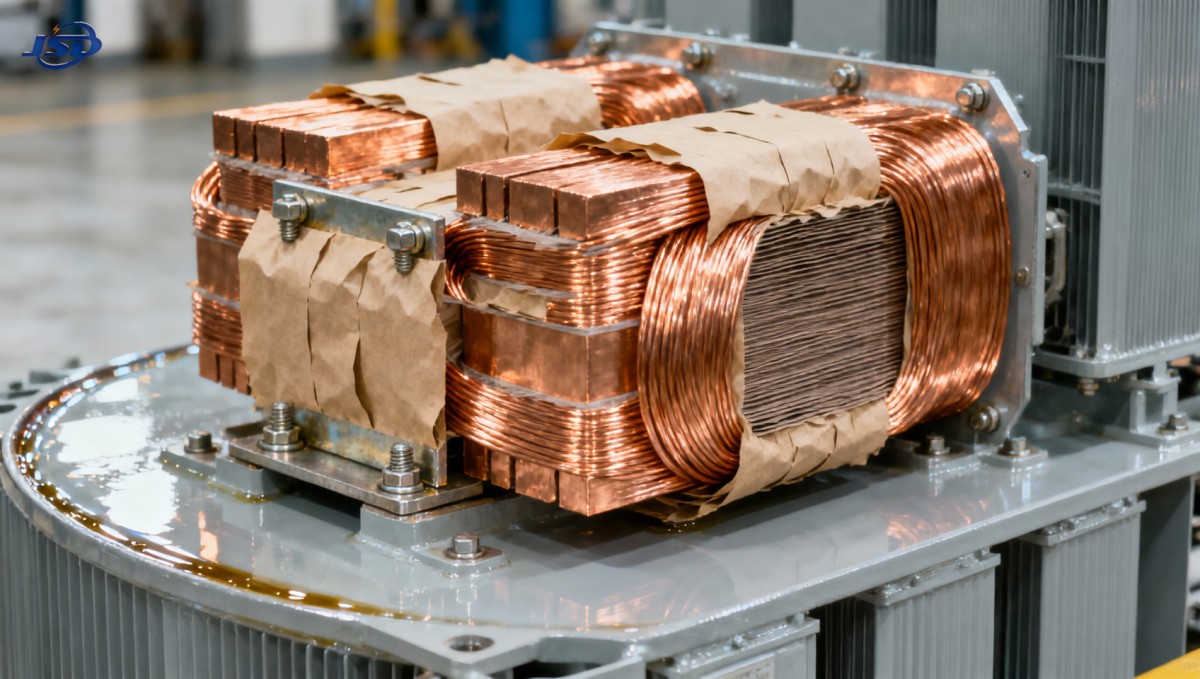
Copper windings exhibit a yield strength of approximately 220 MPa at 20°C, retaining over 75% of that value at 250°C—the peak temperature reached in worst-case short-circuit scenarios per IEC 60076-5. Aluminum, by contrast, drops to less than 40 MPa above 200°C. This difference is not incremental: under identical fault current magnitude and duration, aluminum windings experience significantly greater plastic deformation, particularly in the axial direction where end-winding clamping systems must resist upward thrust. Real-world failure analysis from field-retired units shows that aluminum-wound transformers subjected to repeated through-faults often develop inter-turn insulation damage near winding ends—not due to dielectric breakdown, but because conductor displacement alters local electric field gradients and accelerates partial discharge activity.
Impedance plays a decisive role in limiting peak short-circuit current, yet its relationship with winding material is frequently misunderstood. While both copper and aluminum windings can be designed to meet the same nominal impedance (e.g., 4–6% for distribution-class units), their physical realization differs fundamentally. To achieve equivalent impedance with aluminum’s higher resistivity (≈2.82 × 10⁻⁸ Ω·m vs. copper’s 1.68 × 10⁻⁸ Ω·m), aluminum conductors require ~56% greater cross-sectional area. This increases radial thickness and reduces the number of parallel strands possible within a given winding window. Fewer parallel paths elevate eddy current losses during asymmetrical faults, raising localized hot spots that further degrade mechanical strength precisely when it is most needed.
Thermal inertia also diverges sharply. Copper’s volumetric heat capacity (3.45 MJ/m³·K) exceeds aluminum’s (2.45 MJ/m³·K) by nearly 41%. During a short circuit, this means copper windings absorb more energy before reaching critical temperature thresholds—buying crucial milliseconds for protection relays to operate. In practice, this translates to higher probability of successful fault clearance without permanent deformation. IEC 60076-5 mandates that transformers withstand 100% of rated short-circuit current for at least 2 seconds. However, compliance testing assumes ideal cooling and uniform current distribution—conditions rarely met in service. Field data from Jinshida Electric’s certified portfolio indicates that copper-wound units consistently demonstrate lower post-fault resistance variation (<0.3%) compared to aluminum-wound equivalents (>1.2%), suggesting superior dimensional retention across multiple fault events.
Axial force distribution is another critical differentiator. Radial magnetic forces scale with current squared and are largely material-agnostic, but axial forces depend on the interaction between leakage flux and conductor geometry. Aluminum’s lower modulus of elasticity (70 GPa vs. copper’s 115–130 GPa) leads to greater deflection under identical axial stress, increasing risk of turn-to-turn contact and inter-layer shorting. This is especially pronounced in high-impedance designs used for renewable integration, where harmonic-rich currents exacerbate leakage flux distortion. The 20kV/0.4kV Oil-Immersed Power Distribution Transformer series, for example, employs copper windings specifically to sustain stable axial compression during grid-synchronization transients common in solar and wind farm applications—where fault inception often coincides with rapid voltage recovery and residual flux saturation.
Standards compliance does not guarantee field resilience. IEEE C57.12.00 and IEC 60076-5 specify test procedures using symmetrical short-circuit currents and assume uniform conductor temperature rise. They do not account for cumulative thermal-mechanical fatigue from repeated sub-threshold faults—a known contributor to premature failure in industrial plants and rural grids with aging protection systems. Evaluators must therefore examine not just whether a transformer passes type tests, but how its winding material responds to *repeated* thermal cycling and mechanical shock. Copper’s superior creep resistance above 150°C ensures minimal permanent elongation after 50+ fault cycles; aluminum exhibits measurable elongation after fewer than 10 such events, progressively reducing clamping pressure and increasing vibration-induced abrasion.
One practical implication often overlooked is the interaction between winding material and insulating oil degradation. Aluminum accelerates oxidation of mineral oil through catalytic surface reactions, particularly when localized overheating occurs. While FR3 vegetable oil mitigates this effect, its higher viscosity reduces convective cooling efficiency in aluminum windings—further narrowing the thermal safety margin during fault conditions. Copper’s electrochemical stability makes it compatible with all standard insulating fluids without accelerating aging pathways.
 Ultimately, the decision hinges on system criticality—not procurement budget. In applications where fault clearing time exceeds 150 ms (e.g., rural feeders with delayed relay coordination), or where transformers serve as interface points for distributed generation with low short-circuit ratios, copper windings provide a non-negotiable margin of mechanical reliability. Where aluminum remains viable—such as in lightly loaded urban substations with fast-acting digital relays—its use demands tighter tolerances on clamping force verification, stricter limits on permissible fault duty cycles, and enhanced monitoring of winding displacement via frequency response analysis (FRA) during commissioning and maintenance.
For technical evaluators, the question is not whether aluminum *can* meet short-circuit requirements on paper—but whether it will retain structural integrity across the transformer’s operational lifetime under real-world fault spectra. The answer lies not in datasheet impedance values, but in the metallurgical behavior of the conductor at 250°C, under 200× rated force, within the first 200 ms of fault inception.

Get a Quote
Regardless of whether you require general advice or specific support, we are happy to help you.
Send Us Your Inquiry Today

Jinshida Electric remains committed to contributing to global energy development through professional manufacturing and superior service.