





Substation oil immersed power transformers: why tap changer location matters for maintenance access and safety
Tap changer location isn’t just about design—it’s about your next maintenance shift
You’ve opened the tank cover, disconnected the grounding strap, and double-checked the lockout-tagout sequence. But before you even reach for the oil sampling valve—let alone the tap changer mechanism—you’re already working around a layout decision made years ago. For maintenance teams working with substation oil immersed power transformers, tap changer location isn’t a footnote in the datasheet. It’s the difference between a 90-minute inspection and a 4-hour outage. Between spotting early signs of contact wear and missing them until the next thermal scan. Between standing clear during an oil-arc event—and being within the splash radius.
We see it regularly in field reports: technicians improvising platforms to access changers mounted low on the tank wall, bending awkwardly over hot oil surfaces, or removing entire cooling radiators just to reach a bolt pattern. That’s not operational efficiency. That’s risk accumulation—one bolt, one gasket, one misaligned gear at a time.
Where placement goes wrong—and why it sticks
Most issues trace back to three common compromises:
- Front-panel mounting behind radiators: Looks clean on the assembly drawing—but forces removal of multiple radiator units for every tap change. Adds oil loss, air ingress risk, and re-filling verification steps.
- Bottom-mounted changers on large units: Technically compliant with IEC 60216 clearance rules—but requires full oil draining or hot-oil bypass setups for any internal inspection. Not feasible during partial outages.
- Side-mounted changers behind bushing supports: Blocks visual alignment checks and limits torque tool access. Leads to inconsistent contact pressure and premature wear—especially under frequent load-tap-changing cycles.
None of these are “wrong” in isolation. But they become liabilities when maintenance isn’t part of the original engineering conversation. At Jinshida Electric Power Technology Co., Ltd., our R&D team includes field service engineers—not just designers. That means tap changers on our substation oil immersed power transformers are positioned for actual hands-on work: at waist-to-chest height, with ≥600 mm radial clearance, and aligned so that standard torque wrenches, infrared scopes, and oil sampling ports can all be accessed without disassembly.
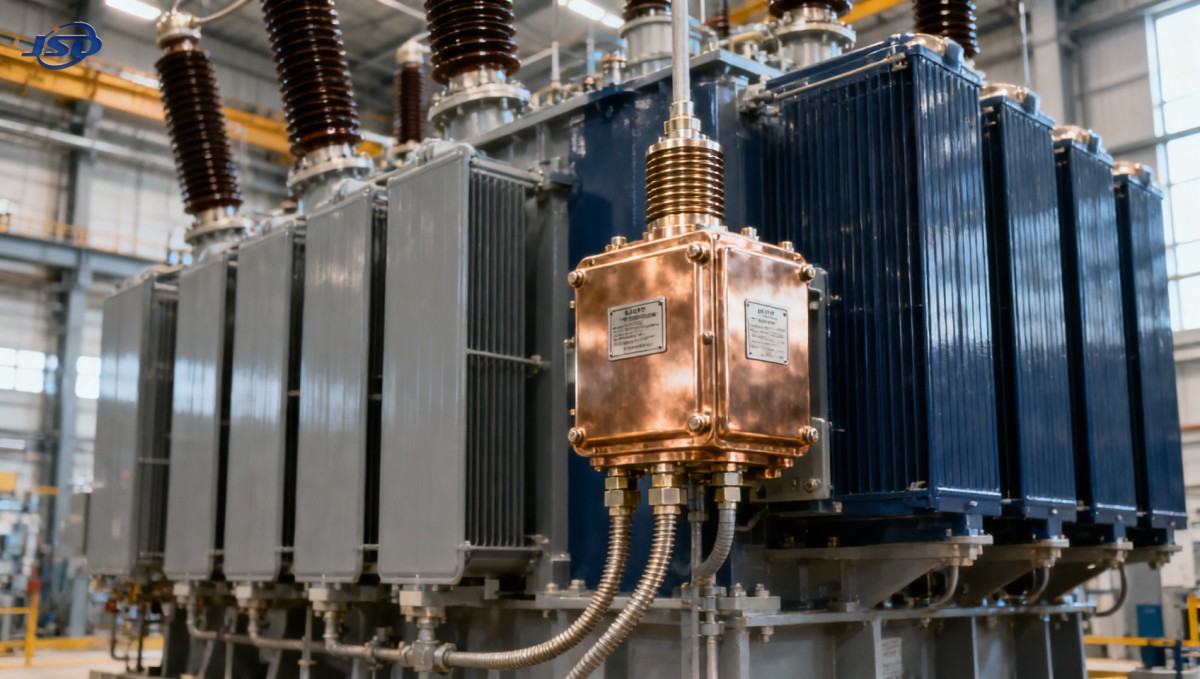
What “accessible” really means in practice
It’s not just about reach. It’s about workflow integrity:
- Oil sampling without contamination: Tap changers with integrated sample valves—positioned above the oil level but below the conservator—eliminate the need for temporary hoses or secondary containers. No more guessing whether that faint metallic sheen is from the valve seat or old transformer oil residue.
- Thermal imaging during operation: A side-mounted changer with unobstructed line-of-sight allows IR scans while energized (within safe distance). You’ll catch hot spots on contacts or transition resistors before they trigger alarms.
- Visual inspection without mirrors or borescopes: When the drive shaft, cam, and contact stack are visible in direct light—not reflected through a 45° angled viewport—you spot pitting, carbon tracking, or misalignment in under 60 seconds.
This attention to physical interface carries through to documentation too. Our service manuals include annotated photos—not just schematic diagrams—showing exact hand positions, recommended tool angles, and torque sequence logic specific to each mounting configuration. Because if the manual assumes you have three arms and a periscope, it’s not helping your crew.
When oil-immersed isn’t the only option—and why that matters
Not every application demands oil insulation. In urban substations, indoor switchgear rooms, or locations with strict fire codes, dry-type alternatives eliminate oil handling entirely—along with the associated risks of spillage, degradation, and dielectric testing complexity. That’s where solutions like our 11kV Three-Phase Cast Resin Dry-Type Distribution Transformer come into focus. With F1-class fire resistance, no oil leakage risk, and minimal routine maintenance, it shifts the reliability burden from fluid management to solid-state integrity—making tap changer access less critical, but still engineered for clarity and safety.
That doesn’t mean we ignore tap design in dry-types. On the SCB10-12 series, the no-load tap changer is front-mounted, fully insulated, and rated for operation up to 120% load under forced-air cooling. Its position allows direct visual verification of tap position indicators—even with the enclosure door closed—reducing exposure during routine checks. And because epoxy resin casting eliminates oil sampling needs, the maintenance priority becomes thermal monitoring and winding resistance trending—not fluid analysis timelines.
Standards help—but they don’t replace judgment
IEC 60216 and IEEE C57.12.00 define minimum clearances and mechanical endurance. But they say nothing about whether a technician can comfortably hold a multimeter probe steady while kneeling on a 30° sloped substation floor. They don’t specify how many gaskets must be replaced after accessing a bottom-mounted unit—or whether the replacement set was included in the spare parts kit.
That’s why Jinshida’s quality system includes not just factory acceptance tests, but field validation protocols. Every new substation oil immersed power transformer design undergoes a simulated maintenance drill: real tools, real PPE, real time constraints. If the procedure takes longer than 2.5 hours for a standard tap check—including oil sampling, visual inspection, and contact resistance measurement—we revisit the mounting geometry. Not because the standard requires it—but because your schedule does.
Next steps: Ask the right questions before the next order
If you’re evaluating a new unit—or reviewing legacy assets for life extension—don’t stop at “Is it compliant?” Ask instead:
- Can the tap changer be inspected and sampled without draining oil or removing radiators?
- Are torque specifications marked directly on the drive housing—not just in Appendix D of the manual?
- Does the manufacturer provide a documented maintenance access protocol—not just a dimensional drawing?
- If switching to dry-type, does the tap changer retain the same visual and electrical verification pathways as your existing fleet?
At Jinshida Electric, we build for the moment the transformer stops delivering power—not just the moment it starts. That means designing for the technician who arrives at 2 a.m. with a flashlight, a torque wrench, and zero margin for error. Because reliability isn’t measured in decades of uptime. It’s measured in how quickly and safely you get back online.

Get a Quote
Regardless of whether you require general advice or specific support, we are happy to help you.
Send Us Your Inquiry Today

Jinshida Electric remains committed to contributing to global energy development through professional manufacturing and superior service.