





Selecting a Distribution Transformer for Mining Operations With Heavy Loads
A mining site rarely presents a clean, predictable electrical load. A crusher starts under high torque, conveyor sections accelerate in sequence, pumps cycle with process demand, and ventilation may need to run without interruption. Add remote locations, dust, altitude, heat, moisture, and long feeder runs, and a simple nameplate comparison is no longer enough.
Selecting a distribution transformer for mining operations requires project managers to look beyond nominal voltage and kVA capacity. The unit must tolerate demanding load behavior, maintain acceptable voltage at critical equipment, fit the site’s environmental realities, and leave room for the mine plan to evolve. A sound decision at the design stage can reduce nuisance trips, limit equipment stress, and make the power system easier to operate during the years when production pressure is highest.
Start with the mine’s actual electrical profile, not the connected-load list
Connected load is useful, but it is not the same as operating demand. A load schedule may show motors, substations, workshops, lighting, dewatering systems, and auxiliary services, yet the transformer sees the combined effect of what runs at the same time. For mining projects, that combined effect can change sharply by shift, production phase, ore type, weather, and equipment availability.
Before choosing transformer capacity, build a load profile that distinguishes between continuous demand, intermittent demand, starting demand, and essential loads. This exercise should involve electrical engineering, process personnel, and operations representatives. The project manager’s role is often to make sure that no major operational assumption is hidden inside a spreadsheet.
- Continuous loads may include ventilation fans, dewatering pumps, process control, lighting, and base plant services.
- Variable process loads often include crushers, mills, conveyors, screening systems, compressors, and slurry pumps.
- Short-duration peaks can result from direct-on-line motor starts, simultaneous conveyor starts, welding equipment, or large switching events.
- Critical loads are those that must remain energized for safety, environmental control, asset protection, or controlled shutdown.
A transformer selected only on average demand may run close to its thermal limit during production peaks. Conversely, an oversized unit can create unnecessary capital cost and may operate inefficiently for long periods at light load. The goal is not simply “more capacity.” It is a practical capacity margin based on realistic load coincidence, anticipated starts, ambient conditions, harmonic content, and expansion plans.
Heavy loads are about heat, voltage dip, and repetition
Mining loads can be hard on a transformer even when the recorded average kW appears reasonable. Repeated high-current events increase winding temperature, while motor starting current can cause voltage dips that affect controls, contactors, variable-speed drives, and other connected equipment. The issue becomes more visible on remote sites where cable routes are long and the source network is relatively weak.
For each major motor group, review the starting method: direct-on-line, star-delta, soft starter, variable-frequency drive, or another controlled approach. A large direct-on-line motor does not automatically rule out a particular transformer rating, but it must be assessed with the upstream network impedance, feeder impedance, motor starting sequence, and allowable voltage dip.
Load cycling deserves equal attention. A transformer may handle occasional peaks, yet frequent high-load cycles in elevated ambient temperatures can accelerate insulation aging. Specify an appropriate thermal design and confirm how the manufacturer evaluates the expected duty cycle. Ask for a clear explanation of temperature rise, overload assumptions, cooling arrangement, and the loading basis used for the offered rating.
Where nonlinear loads are significant, such as VFD-fed motors, rectifiers, UPS systems, or certain processing equipment, harmonics should be evaluated early. Harmonic currents create additional losses and heating. The answer may involve transformer derating, a transformer designed for harmonic duty, filtering, improved drive configuration, or a broader power-quality study. Treating harmonics as a late-stage commissioning issue is usually more expensive than addressing them during design.
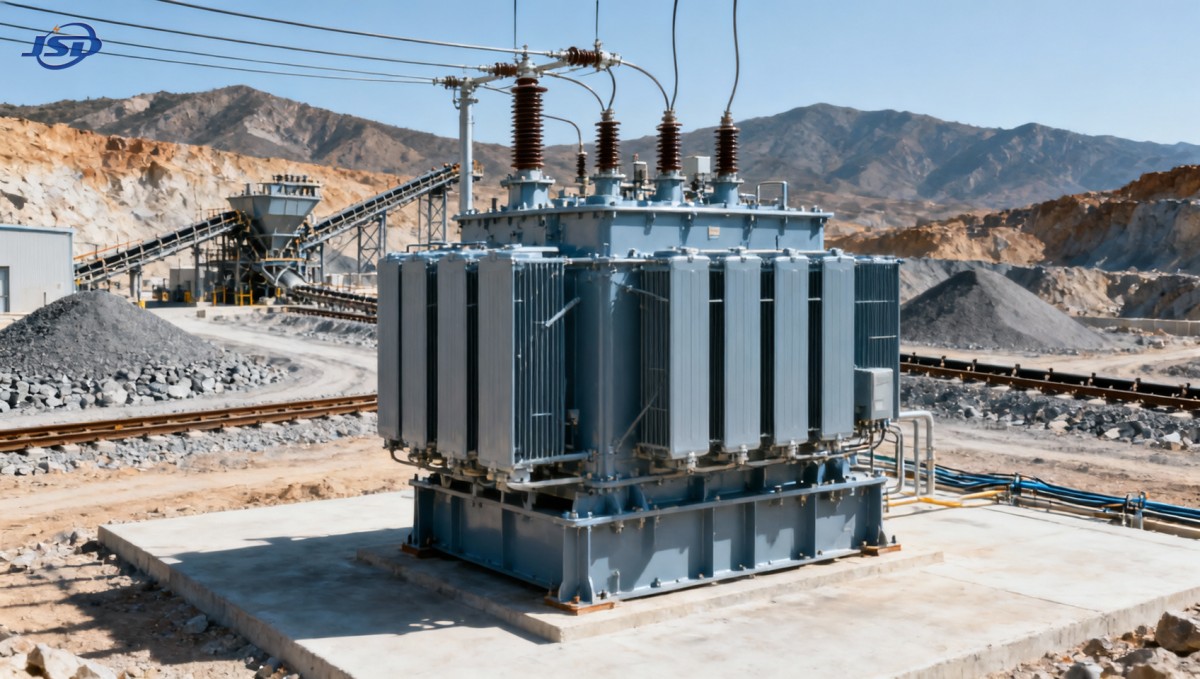
Match the transformer design to the physical mine environment
A mine may be dry and dusty, humid and corrosive, exposed to extreme sun, subject to salt-laden air, or located at high altitude. Underground and surface installations bring different challenges, but both require an environmental review that is specific rather than generic.
For outdoor surface substations, consider solar loading, wind-driven dust, rainfall, drainage, access for maintenance, and the risk of accidental impact from mobile plant. Transformer enclosures, radiators, cable boxes, and control panels all need a protection strategy suited to the location. In dusty areas, cooling surfaces can gradually lose effectiveness if cleaning access is ignored.
Altitude matters because thinner air reduces cooling capability and dielectric performance. If the site is significantly above sea level, the transformer and associated switchgear may need altitude-related derating or design adjustments. High ambient temperature creates a similar concern: a rating valid under moderate conditions may not provide the same operating margin during the hottest part of the year.
For corrosive environments, the project specification should address coating systems, fasteners, gland plates, external hardware, and the long-term condition of cooling equipment. These details can seem minor in procurement discussions, but they influence whether maintenance remains routine or becomes a recurring outage risk.
Oil-immersed or dry-type: make the choice around the installation
There is no universal answer to the oil-immersed versus dry-type question. Both technologies can serve mining facilities well when applied in the right location and supported by suitable protection and maintenance practices.
Oil-immersed distribution transformers are commonly selected for outdoor substations and higher-capacity duties because they offer effective cooling and are widely used in industrial power systems. Their design requires appropriate oil containment, fire-risk planning, environmental controls, and access for inspection and testing. For remote mines, serviceability and the availability of condition-monitoring options are especially relevant.
Dry-type transformers can be attractive where fire safety, indoor installation, or spill concerns drive the specification. However, they still need suitable ventilation and protection from dust, moisture, and aggressive contaminants. A dry-type unit placed in a poorly ventilated, dusty enclosure may not deliver the maintenance advantage the project expected.
The decision should therefore follow the installation context: indoor or outdoor location, fire strategy, site environmental rules, access limitations, required voltage level, cooling conditions, and maintenance capability. Asking only which type is “better” tends to produce an incomplete answer.
Voltage ratio and impedance must work with the whole distribution system
A distribution transformer sits between the incoming supply and the equipment that keeps production moving. Its primary and secondary voltage ratings must match the network architecture, but the selection should also account for tap range, vector group, neutral arrangement, earthing method, and protection coordination.
Tap changing is particularly important where the utility or generating source voltage varies, or where long feeders create meaningful voltage drop. Off-circuit taps may be sufficient for stable systems; applications with wider voltage variation may need a more deliberate voltage-regulation strategy. The right approach depends on how often conditions change and whether downstream equipment has tight voltage tolerances.
Transformer impedance is another parameter that deserves project-level review. Higher impedance can help limit fault current, which may simplify downstream switchgear duties. Yet it can also worsen voltage drop during motor starting. Lower impedance may support stronger voltage performance but can increase available fault current. This is not a catalog selection item; it should be coordinated with short-circuit calculations, motor-starting studies, and protection settings.
For mines supplied by on-site generation, renewable sources, or a weak grid connection, system studies become even more valuable. Operating modes may change between utility supply, generator supply, and islanded microgrid conditions. A transformer that performs well in one mode must not create protection or voltage-control problems in another.
Build reliability into the specification, not just the contingency plan
Downtime at a mine has consequences beyond lost production. An outage can interrupt dewatering, ventilation, communications, material handling, or safe plant shutdown. For this reason, the transformer selection process should identify which loads can tolerate an interruption and which cannot.
Depending on the mine’s operating philosophy, resilience may involve parallel transformers, a sectionalized bus arrangement, spare capacity, a standby unit strategy, or separate supply paths for essential services. Parallel operation should be planned carefully: voltage ratio, impedance, vector group, tap position, and capacity relationships must be compatible. Simply placing two transformers near each other does not create useful redundancy.
Protection and monitoring should reflect the transformer’s importance. Typical considerations include overcurrent and earth-fault protection, temperature monitoring, pressure or gas-related protection for applicable oil-filled designs, surge protection, and remote alarm integration. The most useful monitoring arrangement is one that the site team can act on. A sophisticated data point that is not connected to maintenance routines adds little value.
Consider energy storage where it changes the transformer duty
Not every mining power challenge should be solved by increasing transformer size. If demand peaks are brief but frequent, or if the site has renewable generation and intermittent process loads, energy storage may reduce peak demand seen by the transformer and improve operating flexibility. It can also support controlled transitions, backup functions for selected loads, and smoother use of on-site solar generation.
For example, a containerized system such as the 500kW/1MWh Air Cooling Container Energy Storage System can be considered as part of a wider power-management strategy. Its LiFePO4 battery configuration, 500 kW PCS capacity, 1 MWh nominal energy capacity, optional EMS, and support for parallel expansion make it relevant for peak shaving, backup power, microgrids, and renewable-energy integration. It is not a replacement for correct transformer sizing; rather, it can alter the load profile that the transformer must serve.
When assessing this option, define the operating objective in measurable terms. Is the system intended to shave a fifteen-minute peak, support a critical load through a transfer event, absorb solar energy during low process demand, or reduce generator cycling? The required power and energy duration are different in each case. Coordination between the energy storage controls, transformer protection, and site EMS is essential.
A procurement checklist that prevents costly ambiguity
A strong technical specification gives suppliers the information needed to propose a transformer suited to the actual project. It also makes bids easier to compare. Include the rated power and voltages, frequency, vector group, impedance target or acceptable range, tap requirements, insulation and temperature-rise expectations, site altitude, ambient temperature range, pollution and corrosion conditions, installation method, cable entry arrangement, and required accessories.
Do not leave losses and efficiency as vague preferences. Request guaranteed no-load and load-loss values at the defined reference conditions, then evaluate lifecycle cost alongside purchase price. Mining operations with long daily operating hours can benefit materially from lower losses, particularly where electricity is expensive or generation fuel must be transported to site.
Also ask practical questions: Can the transformer be transported on the available mine roads? Is lifting information clear? Are terminals accessible after installation? What routine tests can site personnel perform? What spare parts are recommended? How quickly can technical support respond when operating conditions change? These questions are less glamorous than kVA and voltage ratings, but they are often remembered first during an outage.
Make the final decision using a weighted project view
For a project manager, the best distribution transformer for mining operations is rarely the lowest-cost item or the largest unit offered. It is the one that fits the mine’s real load behavior, electrical studies, environmental exposure, maintainability expectations, and continuity requirements. A weighted evaluation matrix can help keep that balance visible, comparing technical compliance, thermal margin, efficiency, environmental suitability, delivery practicality, service support, and total cost of ownership.
Jinshida Electric Power Technology Co., Ltd. approaches power equipment selection with the understanding that dependable distribution is built through both manufacturing quality and application knowledge. For mining projects, early technical dialogue is particularly valuable: it allows the transformer design, protection scheme, future expansion plan, and any energy-storage strategy to be considered as one operating system rather than as separate procurement packages.
The most reliable choice begins with a simple discipline: model how the mine will actually run, test the electrical assumptions against harsh site conditions, and specify the transformer around that reality. When those steps are taken before equipment is ordered, the power system is better positioned to support safe, steady production when the operation needs it most.

Get a Quote
Regardless of whether you require general advice or specific support, we are happy to help you.
Send Us Your Inquiry Today

Jinshida Electric remains committed to contributing to global energy development through professional manufacturing and superior service.