





Selecting Medium Voltage Transformer Capacity for Commercial Building Peak Demand
A commercial building’s transformer capacity should be selected from a verified peak-demand profile, not from connected load alone and not from a simple rule of thumb based on floor area. A transformer that is too small can overheat, limit tenant fit-outs, and leave no room for operational changes. One that is oversized may increase capital cost, no-load losses, footprint requirements, and coordination complexity without improving service reliability.
For project managers, the practical question is not simply “How many kVA do we need?” It is: what load will the building place on the medium-voltage supply at its highest credible operating condition, how long will that condition last, and what future changes must the electrical infrastructure absorb without a major replacement?
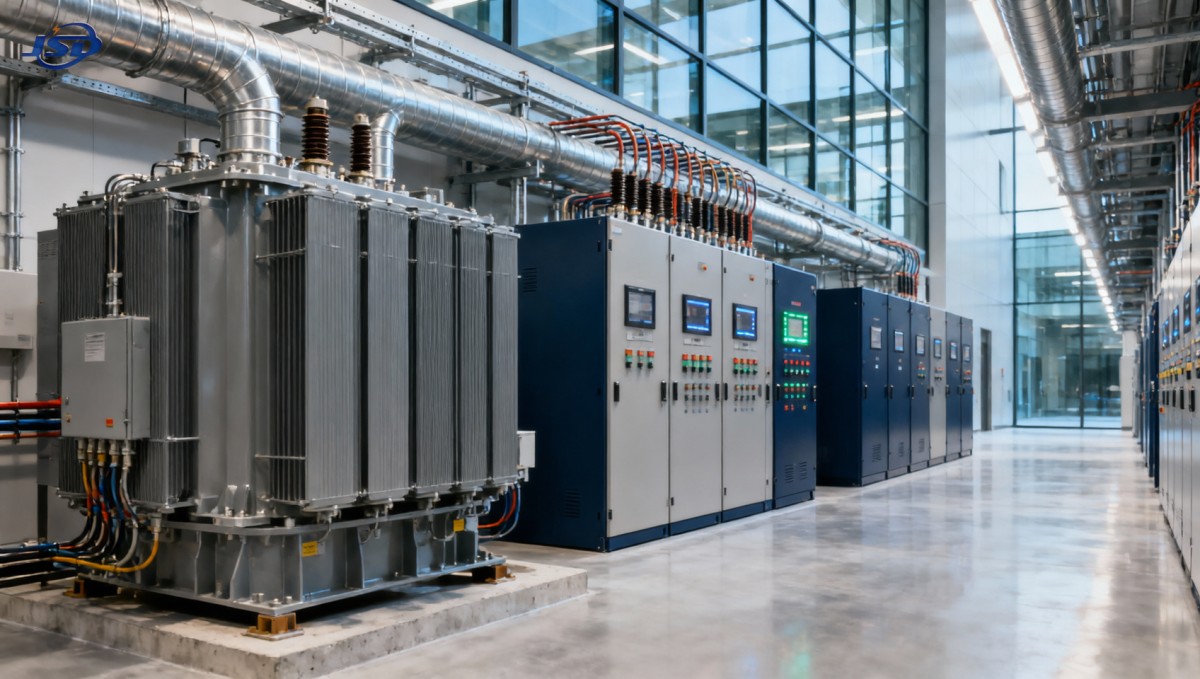
A well-sized medium voltage transformer for commercial buildings is therefore a capacity decision, a resilience decision, and often a phasing decision. The nameplate rating must support the building’s actual electrical behavior, local utility requirements, planned growth, and the chosen approach to backup generation or energy storage.
Start With Coincident Peak Demand, Not the Sum of Every Load
The first mistake in transformer sizing is adding every motor, lighting circuit, receptacle load, HVAC unit, elevator, kitchen appliance, and tenant allowance at full nameplate power. That method produces a connected-load total, which can be useful as an inventory, but it rarely represents the building’s real demand at the service entrance.
Commercial loads do not all operate at full output at the same time. Cooling equipment may peak during hot weather, while heating systems may dominate in a different season. Elevators operate intermittently. Tenant office loads vary by occupancy and operating hours. Restaurants, data rooms, retail refrigeration, EV charging, and medical equipment can create highly concentrated demand, but their coincidence with other major loads must be assessed rather than assumed.
The design team should build a load schedule that separates at least four categories:
- Base building load, including common lighting, pumps, lifts, ventilation, security, and landlord systems.
- Tenant or process load, including allowances for leased areas and specialized occupancies.
- Seasonal HVAC demand under the applicable design condition.
- Intermittent and emerging loads, such as EV charging, commercial kitchens, data rooms, rooftop plant, and future electrical heating.
Each category needs an appropriate demand factor and diversity assumption. Those assumptions should come from the intended occupancy, equipment duty cycle, local electrical code, and the engineer’s documented basis of design. A mixed-use building with retail and offices may show a different demand profile from a hotel, hospital outpatient facility, logistics center, or high-rise residential complex with commercial services at ground level.
Where an existing facility is being expanded, interval meter data is more valuable than estimates. Review at least the highest demand periods and identify the conditions behind them: ambient temperature, occupancy, operating schedule, tenant activity, and any temporary load restrictions. A recorded peak that occurred during an unusual event should not automatically set the transformer rating; nor should a seemingly modest annual peak be treated as proof that future capacity is unnecessary.
Convert the Load Model Into Transformer kVA Correctly
Transformer capacity is normally expressed in kVA or MVA, while building demand is often discussed in kW. The conversion depends on power factor:
Transformer kVA = peak real power in kW / expected power factor
For example, a calculated coincident building demand of 1,200 kW at an expected power factor of 0.90 requires approximately 1,333 kVA before considering operating margin, ambient conditions, harmonics, redundancy, and expansion. Selecting a 1,250 kVA unit because it appears close to the kW value would be an obvious mismatch. Selecting the next larger standard rating may be appropriate, but only after the design constraints are checked.
Power factor deserves more attention than it often receives during early project planning. Modern commercial buildings may include variable-speed drives, LED lighting drivers, UPS systems, chargers, and power-electronic HVAC equipment. Some devices improve displacement power factor, yet their waveform characteristics can still affect the transformer. The target is not merely a favorable kW-to-kVA calculation. The transformer must tolerate the full electrical load profile over its intended life.
Do not treat the transformer’s nominal rating as the building’s usable planning capacity. The selected unit may need derating because of high ambient temperature, elevation, enclosure arrangement, ventilation limitations, or harmonic heating. Site conditions can materially change the available thermal margin, particularly for indoor substations or compact outdoor installations where heat rejection is constrained.
Reserve Capacity Deliberately Rather Than Adding an Arbitrary Percentage
Most commercial projects need spare capacity, but a blanket “add 25 percent” approach can produce either a costly oversize transformer or a misleading sense of security. Expansion margin should correspond to identified changes that the building is likely to accommodate.
Useful questions include:
- Will tenant spaces be delivered as shell-and-core with substantial future electrical fit-out risk?
- Are EV chargers planned in phases, and what is the maximum number that the electrical service must ultimately support?
- Could gas-fired heating, domestic hot water, or cooking later be electrified?
- Is a data-intensive tenant, laboratory, food-service operation, or medical use plausible for designated areas?
- Will rooftop photovoltaic generation, battery storage, or microgrid controls change the transformer loading direction or fault-duty assumptions?
The answers may support a larger initial transformer, a second transformer position, a bus arrangement that permits future extension, or simply reserved space and cable pathways. These choices are not interchangeable. A larger single transformer provides more immediate capacity, but it may not improve outage resilience. A spare transformer bay can support a later expansion, but only if the medium-voltage switchgear, low-voltage main distribution, protection scheme, and civil works were designed to accept it.
For a multi-tenant office or retail development, reserving physical and electrical provisions for growth can be more rational than installing a transformer far above the expected first-phase load. Conversely, a facility with a known high-demand tenant or a difficult future shutdown window may justify capacity upfront because later replacement would disrupt core operations and require significant utility coordination.
Peak Shaving Can Change the Capacity Decision, but It Does Not Eliminate It
Energy storage can reduce short-duration demand peaks and may allow a project to avoid selecting a larger transformer solely for occasional coincident loads. This can be relevant where EV charging, cooling plant starts, or scheduled process loads create sharp demand intervals rather than sustained high loading.
For example, a 500 kW battery energy storage system can discharge during a defined peak period, reducing the transformer’s measured demand by up to its available discharge power, subject to controls, state of charge, inverter limits, and the duration of the peak. A containerized solution such as the 500kW/1MWh Air Cooling Container Energy Storage System is intended for commercial and industrial peak shaving, backup support, photovoltaic storage, and microgrid applications. Its 500 kW power rating and 1 MWh energy capacity illustrate an important sizing distinction: the power rating determines how much transformer demand can be reduced at one moment, while the energy capacity determines how long that reduction can be sustained.
That distinction prevents a common planning error. A 500 kW system cannot necessarily offset 500 kW for an entire operating day. At a nominal one-hour full-power discharge, a 1 MWh system’s usable duration will depend on operating limits, reserve requirements, battery state of charge, degradation allowance, and the energy-management strategy. If a building’s demand exceeds transformer capacity for several hours every afternoon, a short-duration battery may defer the problem but not solve it unless it is sized and controlled for that duty.
Storage should also not be used to mask a transformer that lacks sufficient capacity for credible contingency or normal operating conditions. The project team must establish whether the battery is a demand-management asset, a backup source, part of a microgrid, or a combination of these roles. Each role affects protection, transfer logic, utility interconnection, transformer loading, and the level of redundancy required.
Check Harmonics, Motor Starting, and Load Shape Before Finalizing the Rating
Average demand can look acceptable while the transformer is exposed to unfavorable electrical stress. Commercial buildings increasingly contain nonlinear loads: UPS-fed equipment, IT power supplies, variable-frequency drives, chargers, LED drivers, and certain medical or commercial process equipment. Harmonic currents add losses and heating in transformers and associated conductors. A conventional kVA calculation may therefore be insufficient when a large share of the load is power-electronic.
The design should identify significant harmonic sources early and determine whether the transformer requires a suitable harmonic rating, derating, shielding arrangement, neutral capacity, or another specified construction feature. The right requirement depends on the measured or predicted spectrum and load mix, so generic “K-rated” language should not substitute for an engineering assessment.
Motor starting is another issue that can be overlooked. Chillers, pumps, air-handling units, and fire pumps may create high transient currents. Modern soft starters and variable-frequency drives can reduce starting impact, but the project should verify the actual starting method, sequencing logic, and voltage-drop limits. The transformer must support acceptable voltage performance at the farthest critical loads, not just carry the steady-state load on paper.
Consider the daily shape as well. A transformer that sees a short, manageable peak followed by moderate load operates differently from one that remains near rated capacity for long periods. Thermal behavior, loading guides, and manufacturer data should be applied to the expected duty cycle. Sustained loading near the rating leaves little room for unusually hot weather, temporary tenant loads, loss of cooling, or changing power factor.
Choose the Resilience Architecture Before Choosing a Single Nameplate
Capacity alone does not define reliability. A single 2,500 kVA transformer and two 1,250 kVA transformers may provide similar aggregate capacity, but they create very different outage and maintenance scenarios.
One transformer may suit a building where a planned shutdown is acceptable, site area is limited, and the utility service is straightforward. Two transformers may be justified when the facility has critical systems, distinct occupancy zones, staged construction, or an operating model that cannot tolerate a single transformer outage. However, a dual-transformer arrangement only provides meaningful redundancy when downstream switchgear, bus ties, cable ratings, protection settings, and standby power arrangements support the intended transfer or load-sharing operation.
Project managers should request a clear answer to these questions during design review:
- What loads must remain available after loss of one transformer?
- Can those loads be supplied by the remaining transformer without exceeding its allowed emergency duty?
- Will the low-voltage distribution permit safe isolation and restoration without an extended shutdown?
- Which loads are backed by generators or batteries, and which are simply shed?
- Are maintenance access, replacement routes, and lifting provisions practical for the selected transformer size?
The resulting architecture often drives the capacity selection more strongly than an isolated demand calculation. Critical-life-safety loads, revenue-sensitive operations, and tenant commitments should be translated into an explicit electrical continuity requirement rather than left as a general request for “reliability.”
Coordinate With the Utility and the Full Distribution System
A transformer selection is incomplete until it is coordinated with the serving utility and the building distribution system. Utility service voltage, available fault current, metering arrangement, service capacity, connection requirements, and protection expectations can affect the transformer configuration and medium-voltage switchgear selection. These factors should be established before equipment procurement, not treated as a late-stage approval exercise.
On the secondary side, verify that the main switchboard, bus duct, feeders, breakers, and protective devices are rated for the transformer’s available fault contribution and intended operating configuration. Increasing transformer size can raise secondary fault current beyond equipment ratings or require changes to protective coordination. The transformer may fit the load calculation while creating a problem at the low-voltage main board.
Voltage selection also matters. A larger kVA rating at the same secondary voltage increases current, which can drive larger conductors, busbars, and breaker frames. In larger buildings, distribution voltage and transformer placement may deserve review alongside capacity. A decision made only around transformer price can transfer cost and installation difficulty into the rest of the electrical system.
A Practical Decision Sequence for Project Teams
Before releasing a transformer specification, assemble the design demand model, expected power factor, future-load assumptions, load-duration profile, harmonic assessment, site derating conditions, and resilience requirement in one decision record. Then test the leading transformer options against that record rather than choosing the largest rating that fits the budget or the smallest rating that passes a preliminary calculation.
The final selection should state its basis plainly: normal coincident peak demand, planned growth capacity, allowable loading under contingency, conditions requiring battery support or load shedding, and the distribution equipment limits that were checked. When those assumptions are visible, the project team can assess changes in tenant mix, electrification plans, or utility conditions without reopening the entire design.
A properly selected medium-voltage transformer is not simply a larger electrical asset at the service entrance. It is the capacity boundary that determines how comfortably the building can operate, expand, and recover from disruptions over the life of the project.

Get a Quote
Regardless of whether you require general advice or specific support, we are happy to help you.
Send Us Your Inquiry Today

Jinshida Electric remains committed to contributing to global energy development through professional manufacturing and superior service.