





Outdoor potential transformers in desert regions: how sand abrasion reduces porcelain bushing lifespan by 40%
Outdoor potential transformers in desert regions face a uniquely aggressive form of degradation: airborne sand abrasion. Unlike corrosion or moisture ingress—issues often addressed in standard design guidelines—sand abrasion is a mechanical wear process that directly erodes the surface integrity of porcelain bushings. Field data from arid-grid deployments consistently show that porcelain bushings in high-sand environments lose dielectric strength and surface hydrophobicity up to 40% faster than identical units installed in temperate, low-dust zones. For maintenance personnel, this isn’t just a theoretical concern—it manifests as premature tracking, increased leakage current during dry-wind events, unexpected flashovers after sandstorms, and shortened inspection intervals that strain resource planning.
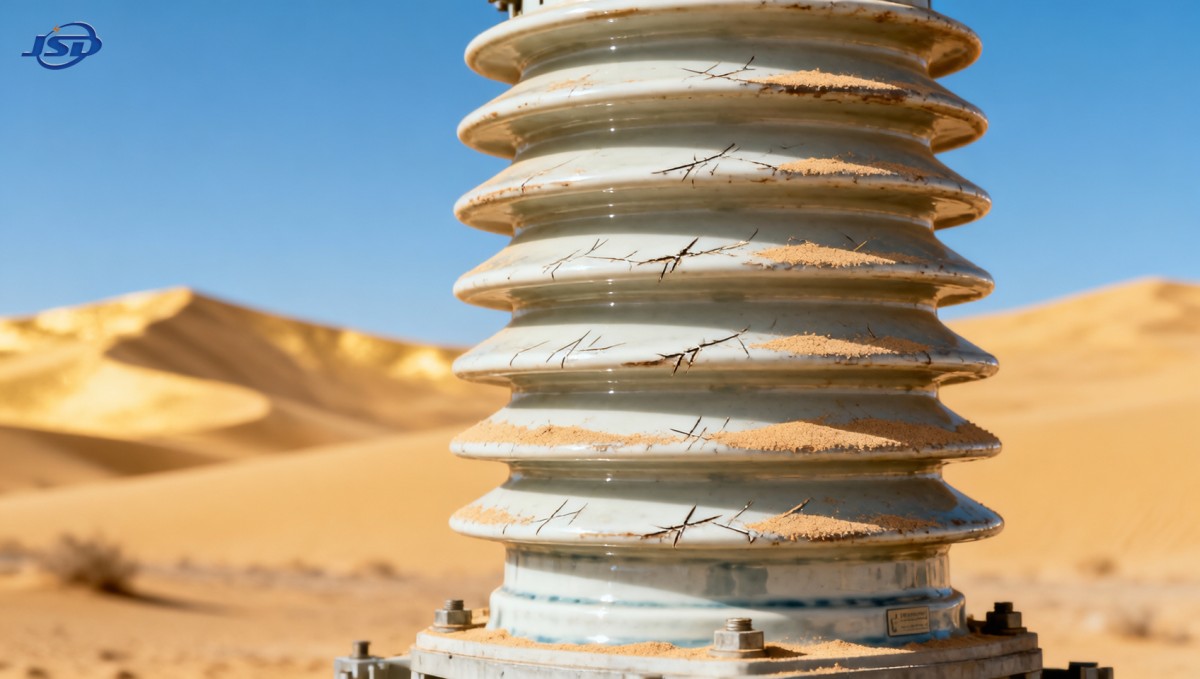
The root cause lies in the kinetic energy of suspended silica particles. When wind speeds exceed 5 m/s—a common condition across major desert transmission corridors—sand grains impact bushing surfaces at velocities sufficient to micro-fracture glaze layers. Each impact removes sub-micron fragments; over time, this creates a roughened, porous topography that traps contaminants, accelerates wetting under dew or light rain, and lowers the critical flashover voltage. Crucially, this wear is non-linear: initial surface damage accelerates subsequent erosion, meaning the final 20% of service life may be consumed in less than 10% of calendar time. If you’re observing increased infrared hotspots near bushing flanges, inconsistent partial discharge readings across phases, or recurring cleaning cycles with diminishing effectiveness, sand abrasion is likely the dominant aging mechanism—not aging per se, but accelerated material loss.
Why Standard Porcelain Bushings Fall Short
Most outdoor potential transformers use Class A or Class B porcelain bushings conforming to IEC 60137 or GB/T 4109. These standards define electrical, thermal, and mechanical performance under controlled lab conditions—not sustained 24/7 exposure to 10–100 µm quartz particles traveling at 15–25 km/h. The problem isn’t compliance failure; it’s application mismatch. Standard porcelain has a Vickers hardness of ~600 HV, while quartz sand measures ~1200 HV. Repeated impacts therefore abrade, not indent. Glaze thickness on typical bushings ranges from 80–150 µm—enough for decades in suburban substations, but insufficient for annual sand loads exceeding 50 g/m² in active dune fields.
Maintenance teams often misinterpret early signs. A slight whitening or matte finish on the porcelain is commonly dismissed as “dust accumulation,” when in fact it signals subsurface microcracking. Similarly, minor chipping at the weathershed edge is frequently attributed to handling damage during installation, rather than cumulative sand impact. This leads to delayed intervention: by the time visible pitting appears, surface resistivity may already have dropped below 10⁹ Ω, increasing risk of dry-band arcing even at nominal operating voltage.
Material and Design Adjustments That Matter
Effective mitigation requires changes at both the material and system level—not just thicker porcelain, but engineered resistance to mechanical wear. Alumina-reinforced porcelain (Al₂O₃ ≥ 92%) increases surface hardness to ~1500 HV, reducing mass loss per impact by ~65% in accelerated sand-jet testing (ASTM G76). More critically, bushings with extended, overlapping weathersheds—designed to deflect horizontal particle trajectories—cut direct impingement on vertical creepage paths by up to 70%. These aren’t incremental upgrades; they shift the failure mode from progressive erosion to stable surface wear, extending functional life beyond the 40% reduction baseline.
Sealing geometry also plays a role. Conventional flange-to-porcelain joints create micro-gaps where sand accumulates and abrades during vibration. Units with monolithic ceramic-to-metal seals—achieved via vacuum-fired metallization—eliminate this interface entirely. While such designs increase manufacturing complexity, they remove a known weak point where abrasive ingress initiates internal tracking paths invisible to visual inspection.
Operational Countermeasures for Maintenance Teams
You cannot eliminate desert winds—but you can reduce their impact on bushing longevity through targeted interventions:
- Inspection timing matters: Conduct visual and UV corona inspections within 48 hours of major sandstorms—not weeks later. Early-stage erosion shows clearest under UV as localized fluorescence quenching at micro-fracture sites.
- Cleaning method affects durability: Avoid high-pressure water jets (>50 bar) or abrasive cloths. Use deionized water with soft silicone sponges, applied parallel to creepage path direction to avoid dragging particles across the surface.
- Monitor surface resistance—not just insulation resistance: A dedicated surface resistivity tester (e.g., IEC 62631-3-1 compliant) reveals degradation before megger readings drop. Values below 5 × 10⁸ Ω warrant re-evaluation of bushing replacement schedule.
- Track local sand load data: Integrate particulate sensors (PM₁₀/PM₂.₅) into substation SCADA. Correlating bushing PD activity with real-time dust concentration identifies threshold wind speeds that trigger accelerated wear—enabling predictive maintenance windows.
When Replacement Isn’t the Only Option
In some cases, full transformer replacement is operationally disruptive or cost-prohibitive—especially during peak construction seasons or emergency grid restoration. For temporary or transitional power needs in high-abrasion zones, integrated solutions reduce exposure time while maintaining reliability. The Mobile Temporary Compact Substation is designed for precisely such scenarios: its outdoor-rated IP33 enclosure includes bushing shields with aerodynamic deflectors, and its rapid-deployment architecture allows relocation away from persistent sand-drift zones without requiring civil works or long lead times. While not a permanent fix for aging infrastructure, it provides operational flexibility where fixed assets are undergoing bushing retrofit or where new installations require immediate commissioning under adverse environmental constraints.
Selecting Next-Generation Units
When specifying new outdoor potential transformers for desert deployment, go beyond standard ratings. Require test reports for sand erosion resistance per IEC 60587 (inclined-plane tracking) *with added sand loading*, not just clean-water testing. Verify that bushing creepage distance exceeds minimum IEC requirements by ≥25%—not as a safety margin, but as a wear reserve. Confirm that manufacturer warranty terms explicitly cover sand-induced surface degradation, not just electrical failure. And critically: insist on field validation data—not lab simulations—from at least three installations in comparable arid climates with ≥3 years of operational history.
There is no universal “desert-grade” transformer. What works on the Arabian Peninsula may underperform in the Taklamakan due to differences in sand particle shape, mineral composition, and diurnal temperature swing. Your maintenance protocol must reflect that reality: treat bushing surface condition as a primary KPI, not a secondary observation. Track erosion depth annually using calibrated profilometry during outage windows. Map local wind patterns against bushing orientation—and rotate units where feasible to equalize exposure. These steps won’t eliminate sand abrasion, but they will convert an uncontrolled 40% lifespan reduction into a managed, predictable wear rate—one you can budget for, plan around, and mitigate with precision.

Get a Quote
Regardless of whether you require general advice or specific support, we are happy to help you.
Send Us Your Inquiry Today

Jinshida Electric remains committed to contributing to global energy development through professional manufacturing and superior service.