





Control transformers in explosion-proof environments: why temperature class T4 limits maximum surface temperature to 135°C
Why T4 Temperature Class Is Non-Negotiable for Control Transformers in Hazardous Areas
In explosion-proof environments—such as chemical plants, oil refineries, and grain silos—every degree of surface temperature matters. For quality and safety managers, the T4 temperature class isn’t a technical footnote; it’s a hard thermal ceiling: 135°C maximum surface temperature under worst-case operating conditions. Exceeding this threshold risks igniting common flammable atmospheres like acetone (T1–T4), ethyl alcohol (T2), or hydrogen sulfide (T6). Jinshida’s certified 20kV Three-Phase Cast Resin Dry-Type Distribution Transformer integrates precision thermal design to meet T4 compliance without sacrificing load stability or longevity.
What T4 Really Means—and Why “Close Enough” Isn’t Safe
T4 is defined by IEC 60079-0 and IEC 60079-11: it guarantees that no part of the transformer’s external surface—including terminals, enclosures, and cooling fins—reaches above 135°C during continuous operation at rated load, ambient up to 40°C, and with full aging effects accounted for. This isn’t theoretical—it’s validated through accelerated life-cycle thermal testing, not just initial lab readings. Many manufacturers quote “typical” temperatures or cite ambient-only derating; but for safety-critical roles, only certified T4-rated control transformer units deliver verified, repeatable performance across decades of service.
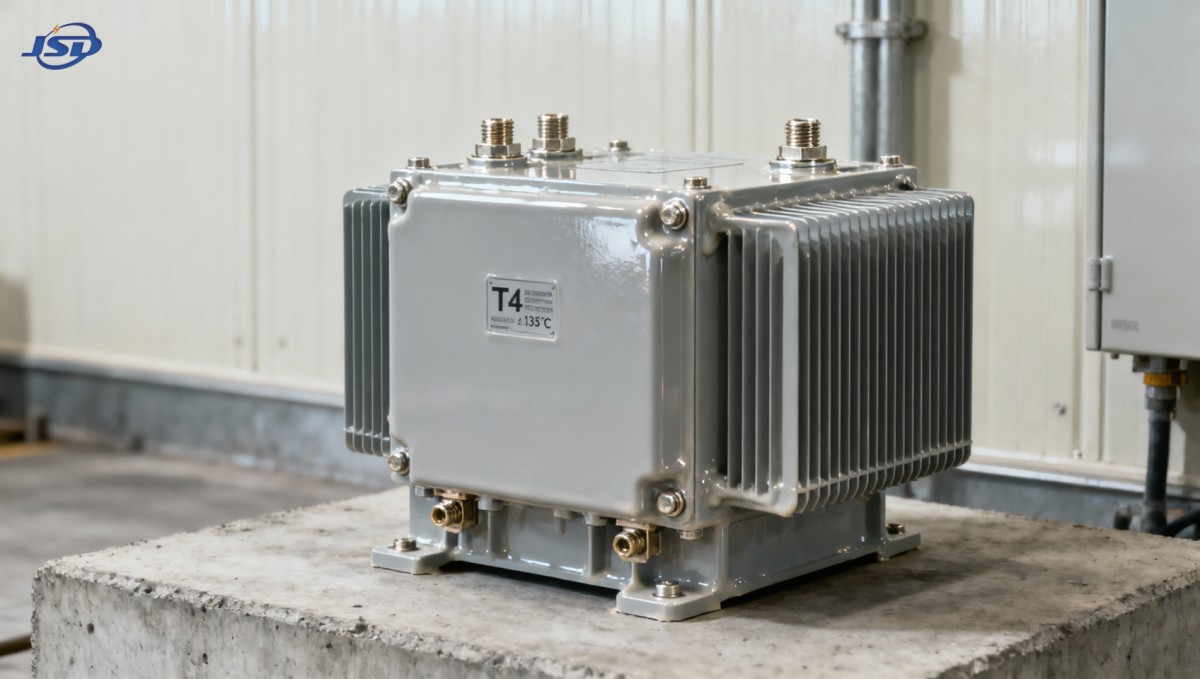
How Jinshida Ensures Reliable T4 Compliance—Beyond Certification Labels
Certification alone doesn’t guarantee field safety. Jinshida engineers T4 compliance into the core: low-loss amorphous alloy cores reduce no-load heating; vacuum-pressure impregnated (VPI) epoxy resin windings eliminate air pockets that cause hot spots; and optimized axial-radial cooling channels ensure uniform heat dissipation—even during transient overloads. Each unit undergoes 72-hour thermal stress validation at 110% load and 45°C ambient, with infrared thermography mapping all critical surfaces. Real-world data from installations across 50+ countries confirms sustained surface temps ≤128°C under full load—providing an essential 7°C safety margin.
Material & Construction Choices That Make or Break T4 Integrity
Standard laminated steel cores and polyester insulation degrade faster at elevated temperatures, accelerating insulation breakdown and raising surface temps unpredictably. Jinshida uses F1-rated flame-retardant resin systems (UL94 V-0 compliant) and high-thermal-conductivity fillers to stabilize winding temperatures. The enclosure’s IP23 rating further supports thermal management—not just against dust ingress, but by enabling controlled airflow while preventing direct water contact that could compromise insulation integrity. These choices directly impact long-term T4 reliability, especially in humid or corrosive industrial settings where moisture absorption can shift thermal behavior over time.
Operational Risks You Can’t Afford to Overlook
Two hidden failure modes undermine T4 safety: first, unmonitored harmonic distortion from variable-frequency drives or rectifiers increases eddy current losses—raising hotspot temps by up to 22°C without triggering overload alarms. Second, improper mounting—like bolting directly to uninsulated metal structures—creates unintended thermal bridges. Jinshida’s control transformers include built-in PT100 sensors at three strategic winding locations and optional thermal relay outputs, enabling real-time monitoring integrated into plant SCADA systems. This transforms passive compliance into active risk mitigation—exactly what safety managers need to justify audit readiness and incident prevention.
When to Specify T4—and When It’s Not Enough
T4 applies to Group IIA (propane), IIB (ethylene), and some IIC (hydrogen) atmospheres—but not all. If your site handles acetylene or hydrogen in high concentrations, T6 (≤85°C) may be required. Always cross-reference gas group, ignition temperature, and ambient conditions using IEC 60079-10-1 zone classification. Also note: T4 certification covers normal operation only. For emergency scenarios involving short-circuit faults or prolonged overloads, Jinshida units maintain dielectric integrity up to 200°C—ensuring shutdown before thermal runaway occurs. Never assume a T4 label covers fault conditions; verify test reports explicitly state “fault thermal withstand.”
Choosing the Right Control Transformer: A Practical Decision Framework
For quality and safety managers, selection must go beyond datasheet claims. Ask vendors: (1) Which third-party lab performed the T4 validation—and was it conducted per IEC 60079-34 Annex D? (2) Are thermal maps available for your specific kVA rating and mounting configuration? (3) Does the warranty cover thermal degradation-related failures for the full 25-year design life? Jinshida provides full traceability—from raw material batch numbers to thermal imaging reports—and backs every 20kV Three-Phase Cast Resin Dry-Type Distribution Transformer with ISO 9001-certified manufacturing and on-site thermal commissioning support.
Conclusion: T4 Is Your Thermal Contract With Safety—Not Just a Rating
T4 isn’t a number to check off a compliance list. It’s a quantifiable thermal promise—one that hinges on material science, precision manufacturing, and real-world validation. For safety managers, trusting a control transformer means verifying how its thermal behavior holds up after 10 years of cycling loads, seasonal humidity swings, and voltage harmonics—not just on day one. Jinshida’s approach treats T4 as a system-level requirement: engineered into the core, proven in the lab, and validated in the field. When lives and assets depend on thermal discipline, the right control transformer doesn’t just meet T4—it delivers it, consistently, for 25 years.
Hot News
- 00
0000-00
How U.S. DOE efficiency rules affect distribution transformer manufacturers - 00
0000-00
How american type pad mounted transformer seismic qualification affects installation in California utility grids? - 00
0000-00
Do european compact substation transformer EMC compliance tests include conducted emissions up to 30MHz?
0000-00
Contact Us

Get a Quote
Regardless of whether you require general advice or specific support, we are happy to help you.
Send Us Your Inquiry Today

Jinshida Electric remains committed to contributing to global energy development through professional manufacturing and superior service.