





Offshore transformer cooling methods: why forced oil-air is preferred over natural convection in platform applications
Why Forced Oil-Air Cooling Isn’t Just an Upgrade—It’s a Platform Necessity
On an offshore platform, every square meter counts—and so does every degree of temperature rise. When project managers specify cooling for an offshore transformer, the choice between natural convection (ONAN) and forced oil-air (FOA) isn’t about preference. It’s about thermal headroom, load resilience, and long-term service continuity under salt-laden winds, high ambient temperatures, and unpredictable duty cycles.
Natural convection relies on passive oil circulation driven by thermal gradients alone. It works reliably in land-based substations with generous clearance, stable ambient conditions, and predictable loading. But on a platform—where space is constrained, ventilation paths are limited, and ambient air may hover near 45°C during summer operations—ONAN often hits its limits before the transformer reaches 70% of rated load. Oil temperature rises faster, hot spots develop near windings, and thermal aging accelerates. That’s not theoretical: IEC 60076-2 defines maximum top-oil temperature limits (95°C for mineral oil, 105°C for ester-based fluids), and exceeding them—even intermittently—cuts insulation life in half for every 8–10°C above threshold.
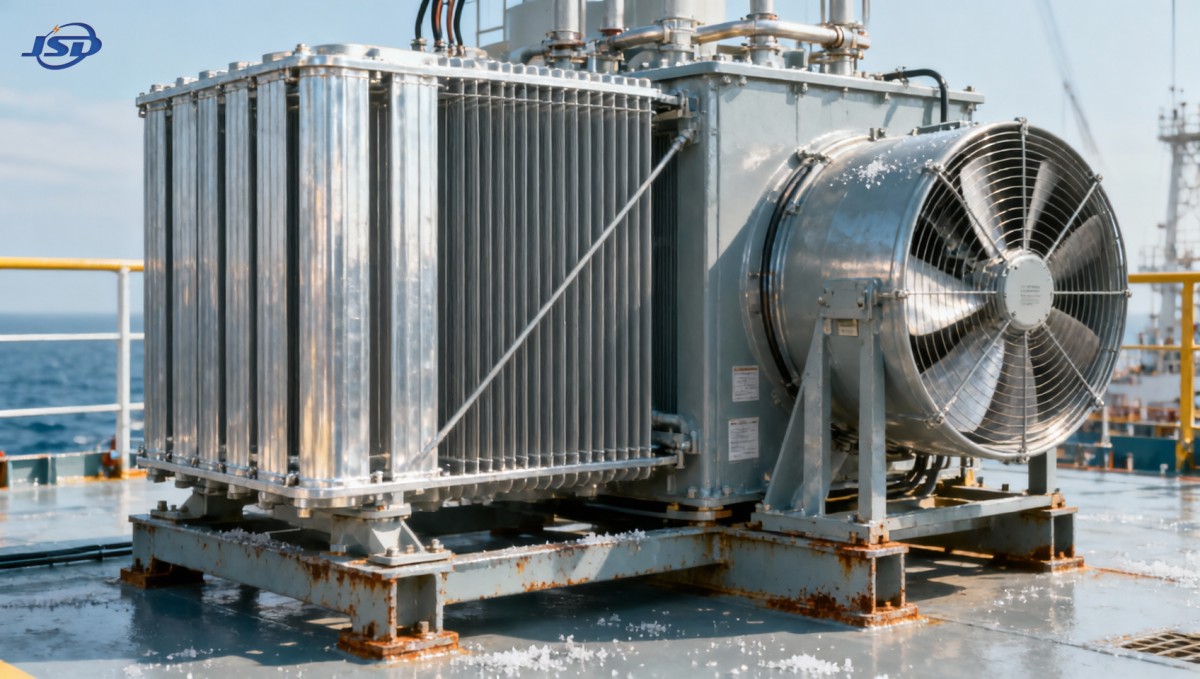
FOA changes the equation. By actively circulating oil through externally mounted radiators and forcing ambient air across finned surfaces, it decouples cooling performance from platform airflow dynamics. The result? Up to 35% higher heat dissipation capacity compared to equivalent ONAN units—without increasing footprint. More critically, FOA maintains tighter oil temperature control across variable loads, which matters when your transformer supplies critical process power to a floating production unit or feeds a subsea umbilical termination box that can’t tolerate voltage sag.
What “Offshore-Ready” Really Means Beyond the Label
“Offshore-rated” isn’t a single certification—it’s a convergence of design, material, and validation choices. Corrosion resistance starts at the surface: aluminum radiators must meet ISO 9223 C5-M severity class requirements, while steel enclosures need hot-dip galvanizing plus epoxy-polyester dual-coating. But corrosion protection goes deeper. Sealing integrity matters more than aesthetics: gaskets must retain compression over decades of thermal cycling and vibration, and breather systems need desiccant cartridges rated for >2,000 hours in 95% RH marine air—not just lab-tested at 75% RH.
Then there’s thermal adaptability. A fixed-speed fan system may suffice in temperate waters—but in the Gulf of Mexico or the South China Sea, where ambient swings from 15°C to 48°C within 24 hours, variable-speed fans tied to oil inlet temperature provide smoother response and reduce mechanical stress on bearings and motor windings. Jinshida Electric’s FOA designs integrate this adaptive logic as standard—not as an add-on—because uncontrolled thermal transients accelerate insulation degradation far more than steady-state loading.
That attention to real-world behavior extends to materials. For example, specifying FR3 vegetable oil isn’t just about biodegradability—it improves thermal stability and moisture tolerance. In humid, salt-laden environments, FR3 absorbs up to 15× more water before saturation than mineral oil, reducing risk of dielectric breakdown during sudden load surges. And because it’s non-toxic and non-flammable (ASTM D92 flash point >360°C), it lowers fire safety overhead—especially relevant where emergency egress routes are narrow and fire suppression systems rely on limited nitrogen reserves.
Where Standardization Meets Site-Specific Reality
Standards like IEC 60076-11 (dry-type), IEC 60076-12 (oil-immersed), and API RP 14E all set minimums—but they don’t define what’s sufficient for *your* platform. A transformer passing IEC 60076-12 doesn’t automatically meet the thermal derating curve required by your facility’s HVAC model. Likewise, CE marking confirms compliance with EU directives—but doesn’t guarantee compatibility with your existing SCADA interface or harmonic filter bank.
This is where engineering integration matters more than spec sheet alignment. Jinshida Electric’s approach treats each offshore transformer as part of a system—not an isolated component. Their technical team routinely reviews platform-specific constraints: available mounting space, local seismic zone classification (ISO 22762-2), ambient salinity data (per ISO 9223), and even the prevailing wind direction’s impact on radiator airflow shadowing. That’s why their 10kV/0.4kV Oil-Immersed Power Distribution Transformer includes options like IP65-rated fan housings, copper windings with Class H insulation, and built-in temperature sensors compatible with Modbus RTU—so integration happens before commissioning, not during.
One often-overlooked detail: maintenance access. FOA units require periodic radiator cleaning and fan inspection. But on a platform, crane availability, personnel lift capacity, and confined-space entry protocols dictate how much time and labor a “maintenance-free” claim actually saves. Jinshida’s S-M series transformers are designed with modular radiator banks that can be removed individually—no full-unit isolation needed—and fan motors positioned for tool-less replacement. That’s not marketing language. It’s feedback from engineers who’ve spent weeks waiting for weather windows to service equipment on North Sea platforms.
When Load Profile Changes, Your Cooling Strategy Should Too
Modern offshore assets rarely run at steady state. Wind farm interconnections introduce cyclical loading. FPSO process pumps cycle on/off. Even digital twin-driven predictive maintenance increases short-duration peak loads. Natural convection simply can’t respond to these transients—the oil mass inertia delays thermal equilibrium, and surface-area limitations prevent rapid heat rejection.
FOA handles this differently. With oil flow rates adjustable via pump speed and air volume controlled by fan frequency, thermal response becomes dynamic. A well-designed FOA system can maintain top-oil temperature within ±3°C across 30–100% load range—critical when your transformer also supplies uninterruptible power to control systems monitoring hydrogen sulfide levels or pressure relief valves.
And longevity isn’t just about years on paper. It’s about how many thermal cycles the insulation survives. FOA’s tighter temperature band reduces cumulative thermal stress—extending verified field life beyond 25 years, especially when combined with copper windings and FR3 oil. That’s not speculative: units deployed in Southeast Asian offshore terminals since 2016 show no measurable decline in winding resistance or dielectric strength, per annual dissolved gas analysis (DGA) reports aligned with IEC 60599.
Next Steps Aren’t About Choosing a Method—They’re About Validating Fit
If you’re finalizing specs for a new platform build or retrofitting aging infrastructure, start with three concrete inputs: your site’s worst-case ambient profile (not average), your expected load duration curve (including 15-minute peaks), and your maintenance window constraints. Then ask vendors not “Does it meet IEC?” but “How was thermal performance validated against *our* ambient and loading profile?”
Jinshida Electric provides thermal modeling support—not just datasheets—for offshore applications, using boundary conditions derived from actual platform sensor logs, not generic assumptions. Their manufacturing process includes partial discharge testing at 1.5× rated voltage and extended thermal cycling (−25°C to +60°C, 200 cycles) before shipment—because offshore reliability isn’t confirmed at handover. It’s proven before the first bolt is torqued.

Get a Quote
Regardless of whether you require general advice or specific support, we are happy to help you.
Send Us Your Inquiry Today

Jinshida Electric remains committed to contributing to global energy development through professional manufacturing and superior service.