





How to tell if a combined transformer fits rural distribution projects
Selecting the right combined transformer is rarely a simple specification exercise in rural distribution work. On paper, a unit may meet voltage class, rated capacity, and basic standards. In the field, the same unit can still underperform because the project environment is shaped by scattered loads, long feeder distances, uneven growth in demand, limited maintenance access, and tighter cost control than most urban upgrades.
For project managers and engineering leads, the real question is not whether a combined transformer is technically usable, but whether it fits the operating logic of the rural network it will serve. A good fit reduces installation complexity, avoids repeated civil work, stabilizes end-user voltage quality, and lowers the chance of early replacement. A poor fit often shows up later as overload complaints, protection coordination issues, difficult maintenance, or higher losses than expected.
This is why evaluation should begin with the project context rather than the catalog. In rural distribution projects, the most useful selection method is to test the transformer against actual load behavior, grid topology, site conditions, compliance requirements, and lifecycle service realities.
What “fit” really means in a rural distribution project
A combined transformer is usually chosen because it integrates multiple functions into a compact distribution solution, helping simplify deployment in places where land, construction conditions, and installation efficiency matter. That makes it attractive for rural power supply upgrades, agricultural production zones, village expansion, roadside commercial growth, and mixed residential-use areas.
But “fit” should be judged on five practical questions:
- Can it handle the real load pattern, not just the calculated average load?
- Can it maintain acceptable voltage performance at the end of long rural feeders?
- Can it be installed and serviced under local site constraints?
- Does it align with local utility standards, procurement rules, and protection practices?
- Will it remain adequate if the village, industrial cluster, or agricultural demand grows faster than forecast?
If these questions are not answered early, the project team may end up selecting a technically compliant unit that is operationally mismatched.
Start with the load profile, not the nameplate capacity
One of the most common mistakes in rural distribution is sizing a transformer based only on current connected load or a rough diversity factor. Rural demand is often less stable than urban planners expect. A village feeder may combine household lighting, irrigation pumps, grain processing equipment, cold storage, small workshops, telecom towers, and seasonal loads that do not appear consistently in historical data.
That matters because combined transformer suitability depends heavily on how load peaks occur.
If the area has strong seasonal agricultural use, peak loading may be brief but intense. If the village is seeing gradual commercial growth, the issue may be not overload today but accelerated saturation within two or three years. If there are many motor-driven loads, the problem may not be steady-state capacity at all, but starting current and voltage drop.
For project decisions, a more useful approach is to separate the load into categories:
- Base residential load
- Daytime productive or commercial load
- Seasonal agricultural load
- Intermittent motor load
- Expected new connections within the project horizon
A combined transformer that looks sufficient under average loading may be undersized once these categories are considered together. On the other hand, oversizing without justification can increase capital cost and no-load losses, especially where demand growth remains uncertain.
Project managers should therefore ask for a load assessment that includes peak coincidence, motor load characteristics, and a realistic growth allowance rather than a single total kVA figure.
Voltage performance is often a bigger issue than raw capacity
In many rural projects, the main service complaint is not transformer failure but poor voltage quality at the customer end. Long low-voltage lines, dispersed users, and fluctuating agricultural equipment can make a distribution area appear adequately supplied while still delivering weak voltage performance.
This is where a combined transformer should be judged as part of the distribution system, not as an isolated asset.
If the transformer is installed too far from clustered end users, or if the low-voltage supply radius is too large, customers at the far end may experience undervoltage during peak demand. If motor loads start simultaneously, the effect becomes more severe. In those cases, simply increasing transformer capacity may not solve the problem. The layout, feeder segmentation, conductor sizing, and reactive power management may be more relevant.
For rural applications, teams should check:
- The expected voltage drop across the low-voltage network at peak demand
- The distance between the transformer and the dominant load centers
- The share of motor or pump loads that create short-term voltage disturbance
- Whether the selected configuration supports local voltage quality targets and utility requirements
If these checks are skipped, a transformer can pass procurement review yet still fail to improve the user experience that justified the project in the first place.
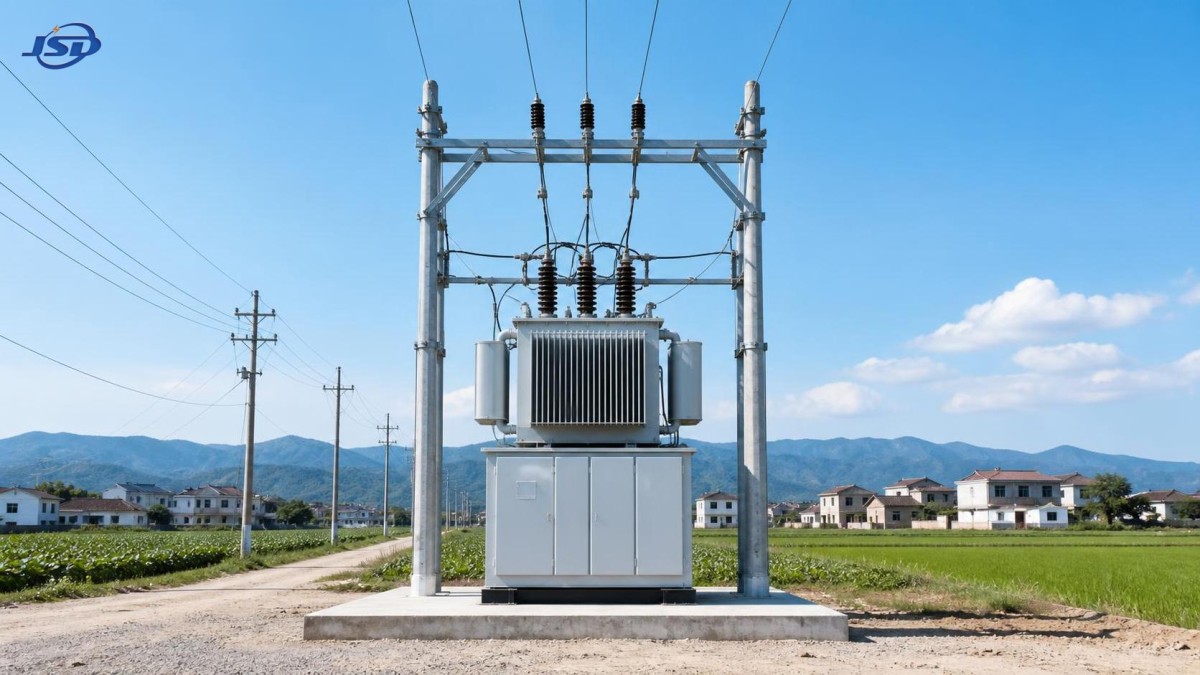
Installation conditions can make or break the decision
Rural projects rarely enjoy ideal construction conditions. Access roads may be narrow, lifting equipment may be limited, site leveling may be difficult, and civil works may need to be completed in short weather windows. In mountainous or remote areas, transport constraints alone can change the preferred equipment configuration.
This is one reason combined transformer solutions are often considered: they can reduce on-site assembly complexity and save space. Even so, compactness should not be treated as an automatic advantage. The team still needs to verify whether the selected unit matches actual installation conditions.
Points worth checking include:
- Transport dimensions and road access restrictions
- Foundation requirements and drainage conditions
- Clearance for operation and maintenance
- Local ambient temperature, dust, humidity, flooding risk, and corrosion exposure
- Security risks such as accidental contact, vandalism, or livestock interference
These issues are especially important when a project is trying to standardize deployment across multiple villages. A transformer model that works well in one county may become inefficient in another if terrain and access conditions differ. Project managers should resist assuming that a successful previous installation automatically transfers well to a new rural environment.
Protection and network compatibility deserve early review
Many delays in distribution projects do not come from the transformer itself but from integration problems. A combined transformer may be well manufactured and correctly sized, yet still create complications if its switching, protection, or connection arrangement does not align with the local utility’s operating practices.
In practice, compatibility questions usually show up in three areas.
The first is primary and secondary connection compatibility. The selected unit must match the network voltage level, grounding arrangement, and feeder interface requirements. This sounds basic, but errors still occur when project teams rely on generic specifications and do not verify the exact local distribution architecture.
The second is protection coordination. Rural systems often have limited fault level and different fault clearing priorities than dense urban networks. Protection settings need to work with upstream and downstream devices, especially where there is a mix of old and new infrastructure.
The third is metering and operation visibility. Some projects now expect easier fault localization, load monitoring, or future digital upgrades. If the transformer is being selected only as a passive asset, the project may miss an opportunity to reduce later retrofit costs.
For managers, the key point is simple: do not treat the combined transformer as a standalone procurement package. Treat it as a node in a protection and operations system.
Rural growth uncertainty should shape the specification
Rural distribution planning has changed in many markets. Demand is no longer driven only by household electrification. Agricultural modernization, rural industry relocation, distributed energy adoption, cold-chain logistics, water infrastructure, and transport electrification can all change the load mix faster than expected.
That creates a planning tension. If the transformer is chosen only for today’s load, replacement may come too early. If it is chosen for an aggressive growth scenario that never materializes, the project may carry avoidable cost and efficiency penalties.
The better approach is to define the project horizon clearly. Is the unit expected to serve a stable village for ten years with minor growth? Is it supporting a rural revitalization zone where new commercial load is likely? Is there a known pipeline of irrigation electrification or processing facilities?
Once that horizon is defined, teams can judge whether the selected combined transformer offers enough margin without drifting into unjustified overdesign. This is also where modularity, spare capacity, and network expansion strategy need to be discussed alongside procurement cost.
Environmental and reliability conditions matter more in remote areas
In urban and industrial settings, maintenance teams may respond quickly to abnormal heating, oil leakage, bushing issues, or protection trips. In remote rural areas, the same fault can lead to longer outages because travel time, spare availability, and service coordination are more difficult.
That is why reliability in rural projects should not be judged only by factory test compliance. Project teams should pay attention to how the transformer will behave under local operating stress over time.
Questions worth raising include:
- How sensitive is the unit to overload cycles common in seasonal agriculture?
- What insulation and sealing performance is expected under heat, humidity, or dust exposure?
- How easy is it to inspect, repair, or replace key components in the field?
- What is the expected availability of spare parts and technical service?
- Are routine maintenance requirements realistic for the local operator?
These questions are not secondary. In rural distribution, maintainability often has as much practical value as peak performance.
Compliance is not just a paperwork issue
Where public utility projects or grid-connected rural programs are involved, compliance requirements can directly affect schedule and acceptance. Relevant technical standards, type test reports, quality documentation, and local utility approval procedures must be checked before the project commits to a model.
Applicable standards vary by market, and project teams should verify the specific requirements in the destination country or utility framework. If a certification, test item, or grid code reference is unclear, it should be marked as 【待核实】 rather than assumed.
For overseas procurement or cross-border project execution, compliance review should also cover practical issues such as documentation language, inspection protocols, packaging for long-distance transport, and acceptance criteria at site. Many project risks appear late simply because technical approval and logistics planning were handled separately.
Total project value is decided by lifecycle performance, not purchase price alone
In cost-sensitive rural projects, there is always pressure to reduce initial equipment expenditure. That is understandable, especially when budgets are spread across multiple villages or substations. But the lowest purchase price does not automatically produce the best project outcome.
A more disciplined comparison should include:
- Initial equipment and installation cost
- Expected no-load and load losses
- Maintenance demand over the asset life
- Outage risk and service response implications
- Upgrade or replacement likelihood if demand grows
For project managers, this matters because rural distribution assets are often expected to remain in service for long periods with limited intervention. A cheaper unit that creates repeated voltage complaints, difficult maintenance, or premature overload can end up increasing both direct and reputational cost.
Signs that a combined transformer is probably the right choice
In practical terms, a combined transformer is more likely to fit a rural distribution project when several conditions are true at once: the load center is identifiable but not densely urbanized, installation space or civil work efficiency matters, the network benefits from a compact integrated solution, and the forecast load growth is moderate but real. It is also a good candidate where reducing field assembly time and simplifying deployment across multiple similar sites can improve project delivery.
By contrast, caution is needed when the area has highly volatile future demand, unusually long low-voltage supply distances, difficult protection coordination with legacy infrastructure, or environmental conditions that place heavy stress on compact equipment arrangements. In those cases, the selection should be validated against network redesign options rather than treated as a straightforward equipment substitution.
The best selection process is cross-functional
The strongest rural projects are usually not the ones with the most detailed equipment brochure, but the ones where planning, engineering, procurement, and operations align early. A combined transformer should be reviewed not only by design engineers, but also by the people responsible for construction sequencing, utility interface, future maintenance, and budget control.
If the project team can answer a few basic questions with confidence, the decision becomes much more reliable: What does the load actually look like? Where will voltage problems appear first? Can the unit be transported, installed, and maintained realistically? Does it fit the local grid and protection philosophy? And will it still be adequate when the rural area develops beyond today’s baseline?
That is ultimately how to tell whether a combined transformer fits a rural distribution project. Not by whether it meets a generic specification, but by whether it supports the network’s real operating conditions, the project’s delivery constraints, and the area’s next stage of growth.

Get a Quote
Regardless of whether you require general advice or specific support, we are happy to help you.
Send Us Your Inquiry Today

Jinshida Electric remains committed to contributing to global energy development through professional manufacturing and superior service.