





How to judge production consistency at an electrical transformer factory
When evaluating an electrical transformer factory, production consistency tells you more than a polished brochure ever will. A factory may show impressive equipment, a busy workshop, and a confident sales team, yet still struggle with batch-to-batch variation, unstable lead times, or uneven workmanship. For transformer buyers involved in grid, industrial, renewable energy, or infrastructure projects, that gap matters. A transformer is not judged only on the day it passes inspection. It is judged months or years later, when loading conditions change, ambient temperatures fluctuate, and the unit is expected to behave exactly as specified.
That is why production consistency is a practical decision factor, not just a quality slogan. It affects technical risk, spare parts planning, installation schedules, commissioning confidence, and warranty exposure. If you are assessing a supplier, the real question is simple: can this manufacturer repeatedly build the same level of transformer, not just a good sample?
Consistency starts long before final testing
Many evaluations focus too heavily on final routine tests. Those tests matter, of course, but they only show the end result for one unit. A more experienced review begins earlier, with process control. In an electrical transformer factory, consistency is usually built through repeatable design release, stable material sourcing, controlled winding and assembly steps, drying and insulation handling, and disciplined testing records.
If a factory cannot explain how engineering changes are managed, how coil dimensions are controlled, or how insulation materials are tracked from receipt to production, that is already a warning sign. Transformers are sensitive to cumulative variation. A small deviation in conductor handling, core stacking pressure, insulation cleanliness, or drying time may not always cause immediate failure, but it can change losses, temperature rise, noise, partial discharge behavior, or long-term reliability.
This is one reason technically mature manufacturers put real effort into process discipline. Companies such as Jinshida Electric Power Technology, which position themselves around R&D, manufacturing, and application of transmission and distribution equipment, are generally evaluated not only by product range but by whether their technical team and quality system can hold that discipline across different project types. Grid work, industrial plants, new energy sites, and infrastructure projects rarely tolerate unstable manufacturing output.
What to look for on the factory floor
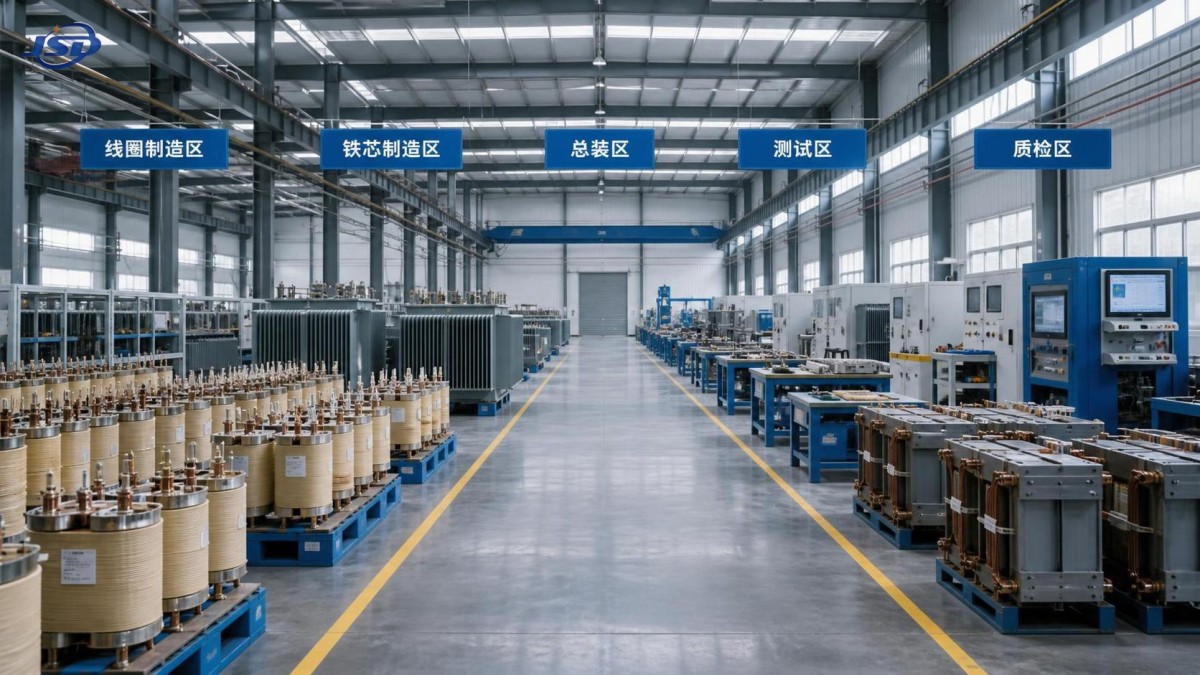
A site visit is still one of the fastest ways to judge consistency. Not because you need to inspect every machine, but because production habits are visible. In a well-run transformer plant, materials are identifiable, work orders are traceable, tools are organized, and in-process checks are not hidden in someone’s notebook.
Pay attention to a few details that often reveal more than the presentation room:
- Whether conductor, core, insulation paper, pressboard, and accessories are clearly segregated by batch or project
- Whether winding areas are reasonably clean and protected from contamination
- Whether operators follow written process instructions instead of relying only on personal habit
- Whether there is evidence of in-process verification, not only end-of-line inspection
- Whether rework areas are controlled and documented
A factory with advanced equipment but weak shop-floor control can still produce inconsistent transformers. On the other hand, a plant does not need to look flashy to be reliable. Some of the best-run facilities appear fairly practical, but their process discipline is hard to miss.
One more point: ask to see work in different stages, not just finished units. Consistency problems often hide inside the process, especially around coil winding, lead routing, core-clamp assembly, drying, and tanking.
The material chain often decides whether output stays stable
In transformer manufacturing, production consistency is tightly linked to supplier control. Copper or aluminum conductors, core steel, insulation systems, bushings, tap changers, and sealing components all affect final performance. If a factory changes vendors too frequently, accepts broad incoming variation, or lacks clear qualification criteria for key components, consistency becomes difficult no matter how experienced the assembly team is.
This does not mean every component must come from one source. In practice, dual sourcing is often necessary. The issue is whether equivalent materials are technically validated and whether substitutions are controlled. During evaluation, ask how the factory handles alternate suppliers, how incoming materials are checked, and whether design or process adjustments are needed when a key component source changes.
A reliable answer is usually specific. Vague statements like “we use high-quality materials” do not tell you much. You want to hear how traceability works, who approves substitutions, and what records exist when a project requires repeat orders months later.
Test reports matter, but compare them the right way
Routine test reports are useful only if you read them across multiple units, not in isolation. One test report can confirm compliance for a single transformer. A set of reports from different production batches can show whether the factory holds stable electrical and mechanical characteristics over time.
For power and distribution transformers, buyers commonly review values such as winding resistance, ratio, vector group, no-load loss, load loss, impedance, insulation resistance, induced and applied voltage test results, and where relevant, temperature rise or partial discharge data. The exact test scope depends on transformer type, rating, project specification, and applicable standards. What matters in assessment is not chasing perfect uniformity where design tolerances naturally exist, but identifying unexplained spread.
If two nominally identical units show noticeably different workmanship or test trends, ask why. Sometimes the answer is harmless, such as a customer-specific accessory change. Sometimes it points to deeper instability in core assembly, conductor processing, or drying conditions. A capable factory should be able to explain the reason without sounding defensive.
Engineering control is where many assessments go too shallow
A transformer factory may manufacture well and still become risky if engineering control is weak. Production consistency depends on stable drawings, controlled bills of materials, revision management, and clear communication between design, purchasing, and workshop teams. This is especially important when orders are customized for local grid requirements, renewable energy integration, special impedance requests, or installation constraints.
Ask how the factory controls document revisions. If the same model is ordered twice, can they confirm whether the design is identical? If a customer requests a small change, can they isolate that change without affecting unrelated details? In practice, many manufacturing errors do not come from poor craftsmanship. They come from old drawings, unclear approvals, or informal modifications made under schedule pressure.
This is where a professional technical team matters. A manufacturer that combines R&D capability with disciplined manufacturing is generally better positioned to keep project-specific customization from turning into production drift. That balance is not easy. Factories serving global markets have to adapt to different standards and application conditions while still protecting internal repeatability.
Delivery reliability is part of production consistency too
Some buyers separate quality consistency from delivery consistency, but in transformers they are closely linked. A factory that regularly compresses schedules, reschedules drying cycles, or rearranges production lines to chase urgent orders can introduce avoidable variation. Late-stage rush is rarely a good sign in this industry.
During assessment, ask how production planning works when order mix changes. Does the factory have a stable workflow for standard distribution units and more engineered power transformers? Can they explain bottlenecks around winding capacity, oven or drying resources, testing stations, and tank fabrication? You do not need every internal metric, but you do need enough visibility to judge whether promised lead times are based on actual capacity or sales optimism.
A factory that supports grid construction, industrial manufacturing, new energy, and infrastructure projects should be able to explain how it keeps scheduling discipline across these different demand patterns. That is a better signal than simply offering the shortest quotation lead time.
Questions worth asking before supplier approval
If you are narrowing down a supplier list, a few direct questions can quickly separate mature manufacturers from weaker ones:
- How are key materials and components traced from receipt to finished transformer?
- What process steps are considered critical, and how are they verified?
- How are engineering changes approved and communicated to production?
- Can the factory provide test records from multiple similar units, not only one sample?
- How are nonconformities, rework, and supplier deviations documented?
- What happens when project requirements differ by market or application?
The quality of the answers matters as much as the answers themselves. Experienced teams usually speak in specifics. Weak teams often stay at the level of broad promises.
What not to overvalue
It is easy to be impressed by size. A large workshop, a wide product catalog, or a modern showroom can create confidence, but none of those alone prove consistent production. Likewise, a low defect claim without context is not very useful if you cannot review traceable records. Even a well-known export orientation should not replace technical verification. Global ambition is meaningful only when supported by controlled manufacturing and dependable service response.
The better approach is balanced: review the factory’s technical depth, process stability, material discipline, testing culture, and ability to support the kind of projects you actually buy for. A company focused on quality-first manufacturing, continuous process improvement, and reliable power applications is moving in the right direction, but the assessment still has to come back to evidence inside the plant and inside the records.
In the end, judging production consistency at an electrical transformer factory is less about finding a perfect factory and more about finding a controlled one. If the manufacturer can explain its process, show traceability, demonstrate repeatable test behavior, and connect engineering decisions to workshop execution, you are looking at a lower-risk partner. If those links are weak, no amount of presentation polish will make the supply base stable when your project depends on it.

Get a Quote
Regardless of whether you require general advice or specific support, we are happy to help you.
Send Us Your Inquiry Today

Jinshida Electric remains committed to contributing to global energy development through professional manufacturing and superior service.