





How to Specify a Hermetically Sealed Distribution Transformer for Humid Sites
How to Specify a Hermetically Sealed Distribution Transformer for Humid Sites
Specifying a hermetically sealed distribution transformer for humid sites requires more than selecting the right voltage and capacity. Technical evaluators must assess moisture resistance, sealing performance, insulation system, corrosion protection, cooling design, and applicable standards to ensure reliable long-term operation.
This guide explains how to define a transformer that maintains dielectric integrity, limits maintenance exposure, and supports stable power distribution where condensation, rainfall, salt air, or persistent humidity create operational risk.
Start With the Actual Moisture Exposure Profile
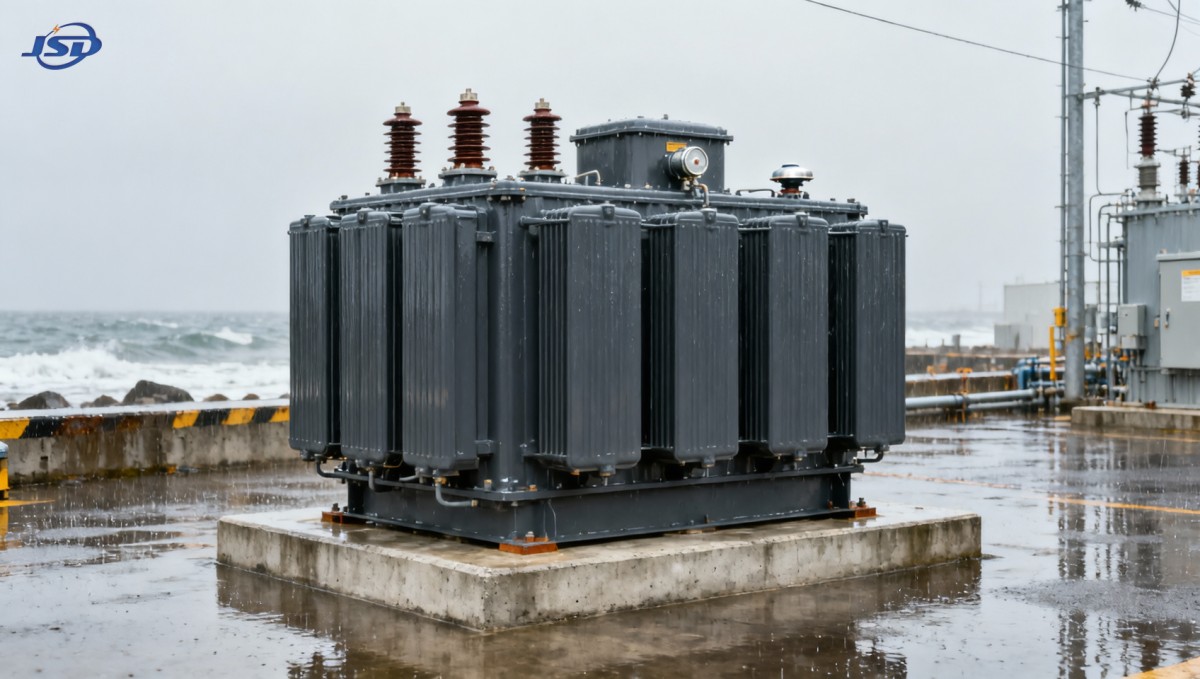
A humid site is not a single environmental category. Evaluators should distinguish between tropical humidity, coastal salt mist, indoor condensation, flood-prone locations, chemical moisture, and intermittent wet operating conditions.
The required specification should reflect measurable environmental data rather than a general statement that the transformer will operate outdoors or in a damp climate.
Collect annual relative humidity, temperature ranges, rainfall intensity, altitude, airborne contaminants, wind-driven salt exposure, and expected wetting cycles before selecting a hermetically sealed distribution transformer.
Also identify whether the transformer will be installed on a concrete pad, pole platform, skid, enclosed substation, containerized power room, or industrial process area.
Installation details affect corrosion risk, cable entry design, drainage requirements, clearances, access for testing, and the likelihood that standing water reaches the transformer base.
For coastal projects, salt spray can cause corrosion even when humidity remains within ordinary design values. Corrosion protection therefore requires independent review alongside moisture protection.
For indoor substations, the main concern may be condensation caused by temperature cycling. A sealed transformer can reduce moisture ingress, but room ventilation still matters.
Ask the project owner whether equipment may remain de-energized for extended periods. Cooling during shutdown can create pressure changes and condensation risk in poorly protected equipment.
Define What Hermetic Sealing Must Achieve
A hermetically sealed distribution transformer uses a fully closed tank system to isolate insulating oil and internal components from atmospheric moisture and oxygen.
Unlike conservator-type designs, a sealed transformer does not normally breathe ambient air during ordinary thermal expansion and contraction of insulating liquid.
This arrangement helps preserve oil dielectric strength, slows oxidation, reduces sludge formation, and protects cellulose insulation from moisture-driven deterioration over the transformer service life.
However, the specification should not simply request “hermetic design.” It should define the enclosure concept, pressure behavior, leak-tightness expectations, and verification tests required for acceptance.
Common sealed-tank designs use corrugated tank walls or radiators that accommodate oil expansion. The tank must manage operating pressure without permanent deformation or leakage.
Specify the acceptable positive and negative pressure range according to the manufacturer’s design and the relevant standard. Pressure relief protection remains necessary despite the sealed configuration.
Technical evaluators should request details of all sealing interfaces, including cover gaskets, bushings, inspection openings, valves, gauges, cable boxes, and pressure-relief assemblies.
Gasket material should suit the expected temperature range, insulating oil type, ultraviolet exposure, and chemical atmosphere. In humid locations, low-quality gaskets become long-term leakage points.
State whether vacuum filling, nitrogen blanketing, dry-air handling, or other moisture-control procedures are required during factory processing, shipping, installation, and commissioning.
Specify Insulation Performance, Not Only Rated Voltage
Moisture threatens the paper-and-oil insulation system before it causes visible external damage. The specification should therefore address dielectric quality and insulation aging directly.
Require transformer oil to meet the applicable new-oil standard and define limits for breakdown voltage, moisture content, acidity, interfacial tension, and dissolved gas condition at dispatch.
For mineral-oil transformers, moisture content should be controlled through vacuum drying and filling procedures. The supplier should confirm the factory method used to dry active parts.
Cellulose insulation is especially sensitive because absorbed water accelerates thermal aging and reduces mechanical strength. Sealing protects this material only when initial dryness is properly controlled.
Request evidence that winding insulation, pressboard, spacers, leads, and core insulation are dried before final assembly. Factory process documentation can be more meaningful than marketing claims.
The insulation level must also match the system overvoltage environment. Confirm rated lightning impulse withstand, power-frequency withstand, neutral arrangement, and surge-arrester coordination for the installation.
Humidity does not eliminate electrical stress. In fact, wet external conditions can make insulation coordination, creepage distance, bushing selection, and surge protection more important.
For installations with frequent switching, long cable feeders, renewable generation, or capacitor banks, evaluate transient overvoltage exposure before finalizing winding insulation and protective device requirements.
Select a Tank, Coating, and Hardware System for Corrosion
Sealing protects internal insulation, but exterior corrosion protection determines whether the tank remains structurally sound and leak-tight throughout its intended service life.
Specify tank steel quality, minimum plate thickness, welding procedures, surface preparation grade, coating system, dry-film thickness, and expected corrosion category for the project environment.
For severe coastal, tropical, or industrial locations, a multi-coat system may be justified. The coating specification should identify primer, intermediate layer, finish coat, and repair procedure.
Consider ISO 12944 corrosion categories when defining paint performance. A generic outdoor paint requirement is rarely sufficient for salt-laden air or chemically aggressive facilities.
Pay particular attention to weld seams, lifting lugs, radiator joints, fasteners, cable-box interfaces, earthing terminals, and base channels. These areas often fail before large tank surfaces.
Galvanized or stainless hardware may improve durability, but material combinations must be assessed for galvanic corrosion. Fastener selection should suit the tank coating and ambient contaminants.
Specify a sloped or drainage-friendly top arrangement where practical. Standing water around fittings and cover joints increases coating damage and creates corrosion initiation points.
For flood-prone sites, define the required mounting elevation and clarify whether the transformer must tolerate temporary water exposure. A sealed tank does not make external terminals submersible.
Check Cooling Capacity Under Humid and Hot Conditions
High humidity itself does not substantially reduce transformer heat transfer, but humid sites are frequently hot, poorly ventilated, solar-exposed, or surrounded by equipment that raises ambient temperature.
Specify rated power according to the maximum ambient temperature, altitude, loading pattern, harmonic content, and enclosure conditions instead of relying only on a standard nameplate rating.
A typical oil-immersed distribution transformer may use ONAN cooling, where heat moves through natural oil circulation and natural air flow over tank corrugations or radiators.
Ensure that the selected cooling surface remains effective after accounting for installation clearances, walls, vegetation, adjacent transformers, dust accumulation, and direct solar radiation.
Request guaranteed temperature-rise values and confirm the applicable measurement method. Lower temperature rise can provide useful thermal margin for humid regions with demanding seasonal loading.
Where nonlinear loads are expected, evaluate harmonic losses separately. Harmonics increase eddy-current losses and can require derating, improved conductor design, or a transformer designed for the duty.
For outdoor installations, specify whether solar shielding, canopy design, or site orientation will be used. Any canopy must preserve free airflow and avoid trapping hot, moist air.
Cooling performance should be coordinated with insulation thermal class and expected loading cycle. A transformer that runs cooler generally ages more slowly and retains greater reliability margin.
Specify Bushings, Cable Interfaces, and Accessories Carefully
In humid environments, external insulation components can become the weakest link. Bushings and cable terminations require suitable creepage distance, weather resistance, and reliable sealing at interfaces.
Choose porcelain, composite, or epoxy bushings based on voltage class, pollution severity, mechanical loading, ultraviolet exposure, and maintenance practices available at the installation site.
For heavily polluted coastal zones, increased creepage distance may be necessary. Specify the pollution level using the relevant IEC or local standard classification rather than vague wording.
Cable boxes should have appropriate ingress protection, corrosion-resistant hardware, and clear drainage arrangements. Verify that gland plates, cable glands, and terminal compartments match actual cable types.
Specify terminals for conductor material, cross-section, connection method, and fault duty. Aluminum and copper interfaces need compatible connectors and installation procedures to prevent overheating.
Essential accessories commonly include a pressure-relief device, oil level indicator where applicable, temperature indicator, filling valve, drain valve, earthing terminals, lifting points, and rating plate.
For remote assets, consider condition-monitoring contacts for pressure relief, oil temperature, low oil level, or transformer alarms. Select only signals that the site can actually use.
Unnecessary accessories add sealing interfaces and maintenance obligations. The best specification balances monitoring value against complexity, exposure points, and the owner’s maintenance capability.
Use Standards and Factory Tests as Procurement Controls
A technically defensible procurement document should identify the standards governing design, testing, nameplate data, tolerances, routine inspection, and any project-specific additional tests.
IEC 60076 is widely used for power transformer requirements, while IEEE standards or national standards may apply depending on the project location and owner specifications.
Confirm the applicable standard edition early. Requirements for temperature rise, insulation tests, sound level, short-circuit capability, and accessories can differ among standards and contract documents.
Routine tests should normally cover ratio measurement, winding resistance, vector group verification, impedance, applied voltage, induced voltage, insulation resistance, and leak testing as applicable.
For a hermetically sealed distribution transformer, request a documented pressure or leak-tightness test. Define the test medium, duration, pressure value, acceptance criterion, and inspection records.
Depending on project criticality, additional tests may include temperature-rise testing, lightning impulse testing, sound measurement, short-circuit withstand evidence, dissolved gas baseline analysis, and coating inspection.
Factory acceptance should include dimensional verification, accessory checks, terminal marking, paint quality inspection, documentation review, and confirmation that shipment protection preserves the sealed condition.
Do not rely on a test certificate alone. Review whether the tested configuration matches the ordered rating, voltage ratio, tap arrangement, bushing type, cooling design, and accessories.
Evaluate Losses, Reliability, and Whole-Life Cost Together
Initial purchase price is only one part of transformer value. Evaluators should compare no-load losses, load losses, expected loading profile, energy cost, maintenance demands, and outage consequences.
Low no-load loss is particularly important for transformers energized continuously at modest loading. Low load loss becomes increasingly valuable where utilization is high or load duration is long.
Ask suppliers to provide guaranteed losses at stated reference temperatures. Compare offers using a transparent capitalization method rather than selecting the lowest equipment price without operating-cost analysis.
Hermetic construction can reduce maintenance exposure because periodic breather inspection and silica-gel replacement are generally unnecessary. That benefit is valuable at remote or difficult-to-access humid sites.
Nevertheless, sealed design does not remove the need for inspection. Operators should check external corrosion, oil leakage, bushing cleanliness, terminal temperatures, ground connections, and protective-device condition.
Define the expected service life, warranty conditions, spare-parts availability, response time, and local technical support. These commercial details influence practical reliability after commissioning.
For temporary humid-site power, transformer selection may be connected with mobile energy resources. A 50kW/100kWh Portable Trailer Energy Storage System can support temporary loads, backup supply, or commissioning activities where grid availability is limited.
Such systems do not replace the transformer’s site-specific design requirements, but they can reduce outage exposure during construction, maintenance, emergency restoration, or staged energization work.
Turn the Evaluation Into a Clear Technical Specification
A strong specification converts environmental risk into measurable requirements. It should state the site data, electrical ratings, sealing construction, corrosion category, insulation criteria, tests, and documentation deliverables.
Begin with rated power, primary and secondary voltage, frequency, vector group, impedance, tap range, insulation level, neutral treatment, fault level, and required efficiency or loss guarantees.
Then define the humid-site provisions: fully sealed tank, specified leak test, gasket requirements, corrosion-protection system, pollution-class creepage distance, enclosure details, and drainage or mounting requirements.
Include a schedule of guaranteed technical particulars. Suppliers should complete identical fields, allowing evaluators to identify assumptions, deviations, exclusions, and differences in performance objectively.
Require suppliers to declare manufacturing location, quality system, routine test capability, inspection access, manufacturing lead time, packaging method, and field-service support before contract award.
Clarify shipping requirements because impacts, damaged coatings, loose accessories, and improper storage can compromise performance before installation. Sealed equipment still needs protected handling and storage.
During bid evaluation, give meaningful weight to technical compliance. A lower-priced unit may become more expensive when coating quality, heat margin, testing evidence, or service support is inadequate.
Finally, document approved deviations in writing. Ambiguous acceptance of alternative materials, test methods, or environmental assumptions can create disputes and reliability gaps after delivery.
Conclusion: Specify for Moisture Control and Durable Operation
The right hermetically sealed distribution transformer protects the insulation system from atmospheric moisture while providing the electrical performance required by the connected distribution network.
For humid sites, the highest-value decisions concern verified sealing, internal dryness, corrosion resistance, external insulation, heat management, tested construction, and installation conditions rather than capacity alone.
Technical evaluators should use site data to create measurable requirements, compare supplier guarantees consistently, and confirm that factory tests validate the actual ordered configuration.
When these requirements are addressed together, the selected transformer is better positioned to deliver efficient, stable, and safe service throughout demanding humid-environment operating conditions.

Get a Quote
Regardless of whether you require general advice or specific support, we are happy to help you.
Send Us Your Inquiry Today

Jinshida Electric remains committed to contributing to global energy development through professional manufacturing and superior service.