





How split core current transformers simplify retrofit installations in live switchgear
2026.09.23
Jinshida
When you’re standing in front of a live 10 kV switchgear cabinet—wires humming, meters blinking, and a production line ticking down to its next scheduled maintenance window—you don’t have the luxury of guessing. You need current data *now*, not after a week-long shutdown. That’s where conventional current transformers fall short: they demand cable disconnection, system isolation, and often, full de-energization. For project managers overseeing grid modernization, industrial retrofits, or new energy integration—especially in mission-critical environments like underground coal mines or hazardous tunnel sites—the cost isn’t just financial. It’s operational continuity, safety compliance, and stakeholder trust.
Split core current transformers change that calculus—not by promising perfection, but by delivering practicality. They’re not an afterthought. They’re the quiet enabler behind faster commissioning, safer fieldwork, and smarter measurement upgrades in energized infrastructure.
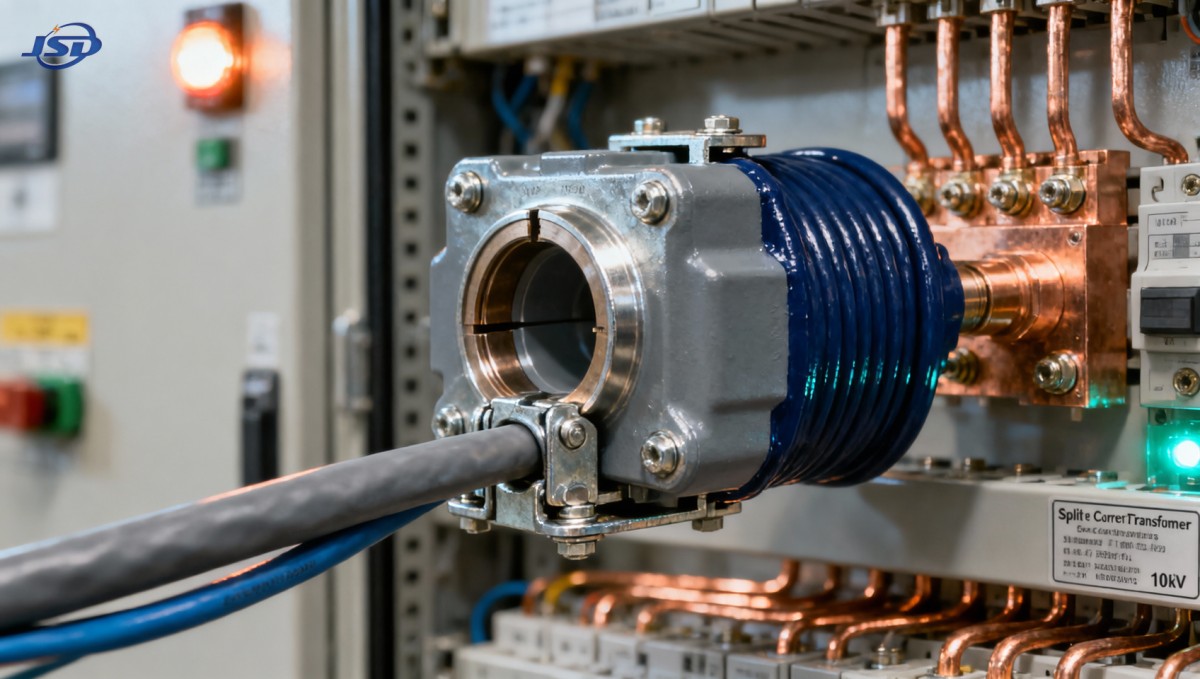
Unlike solid-core CTs that require conductor removal or busbar disassembly, split core models open like a hinge—literally. A precision-machined ferrite or nanocrystalline core splits into two interlocking halves, clamped snugly around an existing cable or busbar. No cutting. No splicing. No lockout-tagout delays beyond what’s strictly necessary for physical access. The installation is measured in minutes, not days. And because the magnetic path remains intact and calibrated during manufacturing, accuracy holds—typically within ±0.5% at rated current, with phase error under 0.5° for metering-grade variants.
What makes this especially valuable in retrofit-heavy sectors—like mining, heavy industry, or aging utility substations—is how it aligns with real-world constraints. Think about a ventilation shaft in a deep mine, where power must remain uninterrupted for life-support systems. Or a steel mill’s rolling line, where every hour offline costs tens of thousands. In these contexts, “just shut it down” isn’t an option—it’s a risk vector. Split core CTs shift the risk from operational disruption to technical execution: choosing the right turn ratio, verifying insulation clearance, confirming ambient temperature limits, and ensuring proper grounding of the secondary circuit. These are manageable engineering checks—not systemic bottlenecks.
Jinshida Electric’s approach reflects that pragmatism. Our split core current transformers are engineered not in isolation, but alongside the broader ecosystem of power equipment used in demanding environments. For instance, when integrating monitoring into a Mining Flameproof Transformer—a unit designed for underground coal mines and explosive atmospheres—our CTs are selected to complement its thermal profile, mechanical robustness, and installation footprint. That means low-profile housings that fit within tight cable trays near explosion-proof junction boxes; IP67-rated enclosures that withstand dust, moisture, and vibration; and secondary windings rated for long cable runs back to remote SCADA cabinets—without signal degradation.
Accuracy doesn’t fade with convenience. We use high-permeability grain-oriented silicon steel cores (where applicable) and proprietary winding tension control to minimize hysteresis and remanence effects—critical when measuring partial loads or harmonics common in VFD-fed motors or rectifier-based mine hoists. Calibration is traceable to national standards, and each unit undergoes individual thermal cycling and dielectric testing before shipment. Not as a checkbox—but because a 3% error in current reading on a 500 kVA transformer can misrepresent loading by over 15 A, skewing thermal modeling and predictive maintenance triggers.
Installation isn’t just about snapping it shut. There’s nuance. Core alignment matters: misaligned halves create air gaps that inflate ratio error and reduce sensitivity at low currents. Cable positioning matters: centering the conductor within the aperture ensures symmetrical flux distribution. Even torque on the clamping screw affects performance—too loose, and vibration loosens the fit; too tight, and you distort the core geometry. That’s why our field kits include alignment guides, torque-limiting tools, and quick-reference cards translated into five languages—including Mandarin, Spanish, and Arabic—for multinational project teams working across time zones and technical dialects.
And yet, the biggest advantage isn’t technical—it’s psychological. When engineers walk onto site knowing they *can* install without halting operations, confidence rises. When procurement teams see fewer schedule contingencies baked into contracts, budget flexibility improves. When safety officers review the method statement and see zero mandatory de-energization steps beyond localized isolation, approval moves faster. That ripple effect—of reduced friction, clearer accountability, and tighter coordination—is where split core CTs earn their ROI.
It’s also worth noting where they *don’t* replace alternatives. For new switchgear builds with planned CT mounting points, toroidal or wound-core units still offer marginally better accuracy and lower cost at scale. For ultra-high-precision protection relaying (e.g., differential schemes), solid-core CTs with known saturation characteristics remain standard. But for the vast middle ground—retrofitting energy meters, adding arc-flash monitoring, enabling IoT-based load profiling, or validating harmonic distortion in live feeders—split core is rarely the compromise. It’s the most responsible choice.
 That responsibility extends beyond hardware. Jinshida supports it with application engineering—not just datasheets. Our team routinely reviews single-line diagrams, helps size secondary burden, validates compatibility with existing metering protocols (Modbus RTU, IEC 61850-9-2 LE, DNP3), and even co-signs commissioning checklists with clients’ QA departments. This isn’t vendor hand-holding. It’s shared ownership of system integrity.
In the end, simplifying retrofit installations isn’t about making things easier—it’s about removing artificial barriers between intention and implementation. It’s about letting project managers focus on what they do best: orchestrating complexity, managing trade-offs, and delivering outcomes—not troubleshooting installation logistics. When a split core current transformer arrives on site, pre-calibrated and ready to clamp, it carries more than magnetic flux. It carries certainty. And in power infrastructure, certainty is the first component of resilience.
Whether you're upgrading legacy substations in Southeast Asia, deploying solar farm interconnection monitors in the Middle East, or hardening mine power distribution against harmonic resonance—knowing your measurement layer can go live *with* the system, not *after* it, changes everything. Not just how fast you move. But how confidently you decide.

Get a Quote
Regardless of whether you require general advice or specific support, we are happy to help you.
Send Us Your Inquiry Today

Jinshida Electric remains committed to contributing to global energy development through professional manufacturing and superior service.