





How ambient temperature affects battery storage system life
It often starts with a simple complaint during routine operation: the battery seems to charge more slowly than usual, available runtime feels shorter on hot afternoons, or alarms appear more frequently after a cold night. In many sites, the first suspicion falls on battery quality, charger settings, or load fluctuation. But quite often, the surrounding temperature is the quiet factor behind all of it.
For anyone responsible for a battery storage system, temperature is not just a comfort issue for the room or enclosure. It directly affects chemical activity inside the cells, the stress placed on internal components, charging acceptance, and even the pace of long-term aging. If that relationship is not understood early, small day-to-day temperature problems can turn into avoidable maintenance work, unstable backup performance, and shortened service life.
A common mistake is to think of temperature only in terms of extremes. Many people pay attention when the battery room becomes very hot or when winter conditions are severe, yet overlook repeated daily temperature swings, poor ventilation around cabinets, or heat generated by nearby equipment. Those conditions may not look dramatic, but over time they can create uneven aging from one section of the system to another.
Why ambient temperature changes battery aging so much
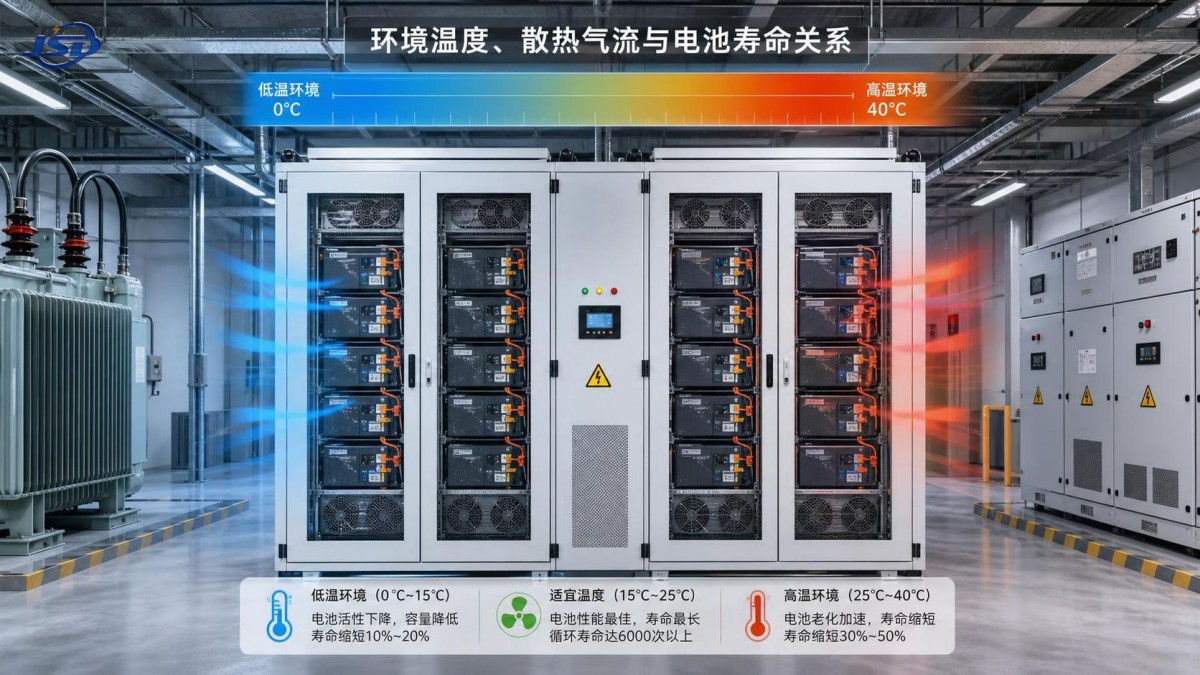
Batteries depend on chemical reactions. Those reactions do not happen at the same rate under all temperatures. When the environment gets hotter, internal reactions generally speed up. That can temporarily improve short-term performance, but it also tends to accelerate side reactions that wear the battery down. In practical terms, the system may appear active and responsive in warm conditions while quietly losing life faster than expected.
Cold conditions create a different kind of strain. Chemical reactions slow down, internal resistance rises, and charging becomes less straightforward. A battery that looks fully installed and electrically normal may still deliver less usable energy simply because the temperature is too low for efficient reaction inside the cells. Operators sometimes interpret this as sudden capacity loss, when in fact part of the issue is temperature-related performance suppression.
The problem becomes more complicated when temperatures do not stay stable. Repeated heating and cooling cycles can cause materials inside the battery to expand and contract. Over time, that movement adds stress to internal structure, connections, seals, and balance behavior. Even when no immediate fault appears, the battery may age less evenly, making system management harder later.
What hot environments usually look like in daily operation
High ambient temperature rarely announces itself with only one obvious sign. More often, it shows up through a pattern: stronger ventilation demand, warmer cabinet surfaces, increased cooling equipment runtime, drifting charge behavior, or certain modules running consistently hotter than others. In indoor installations, batteries may also absorb heat from transformers, inverters, switchgear, or building walls exposed to direct sun.
In these settings, the battery storage system can experience several linked effects:
- Faster calendar aging during storage or standby periods
- Higher risk of thermal imbalance between modules or racks
- More stress during charging, especially if room cooling is poor
- Reduced reliability of surrounding electronics and monitoring devices
One detail people often miss is heat accumulation after load events. The room temperature might seem acceptable in the morning, but after extended operation the heat from the battery and neighboring equipment can remain trapped. If airflow paths are weak, the battery may spend many hours above its preferred range without anyone noticing until alarms become frequent.
In backup power applications, this matters even more. A site may rely on batteries for bridging power while other equipment starts or switches over. In some facilities, an Open Type Diesel Generator Set is part of that broader continuity plan. Even in that kind of setup, the battery still needs a controlled temperature environment, because short transition duties and standby readiness are both affected by heat stress.
Cold exposure causes a different set of misunderstandings
When temperatures drop, many operators first notice weaker discharge performance. The battery may seem to “run out” earlier, especially under heavier loads. This does not always mean permanent damage has already happened. In many cases, the low temperature temporarily reduces the battery’s ability to release energy efficiently. The distinction matters, because the right response is not always replacement. Sometimes the better fix is environmental control, charging adjustment, and waiting for the battery to return to a suitable temperature before judging condition.
Charging in cold conditions needs extra care. If a battery is charged aggressively while cell temperature is low, the charging process may become inefficient or harmful depending on battery chemistry and system design. That is one reason operators should not assume that a charger setting that works well in a warm season is equally safe during winter. Temperature-compensated charging and manufacturer-recommended operating limits are important for long-term life.
Outdoor or semi-conditioned installations create another challenge: the room sensor may not reflect actual cell temperature. A wall-mounted reading can look acceptable while batteries placed near an external panel, floor slab, or draft path are much colder. That gap between reported air temperature and actual battery condition often explains confusing performance differences across the same installation.
When the issue is not the battery itself
Not every temperature-related problem comes from the battery room HVAC system alone. Sometimes the real cause is layout. Cabinets packed too tightly, blocked air inlets, dust on filters, cable congestion around vents, or hot equipment placed too close together can all create local heat pockets. In transformer and distribution environments, surrounding power equipment may influence the thermal behavior of the battery area more than expected.
It is also common to see temperature problems introduced during upgrades. A site adds new electronics, modifies enclosure partitions, or changes operating schedules, and airflow patterns shift without anyone formally reviewing thermal impact. The battery then starts aging under different conditions even though no one intended to change the storage environment.
This is why troubleshooting should begin with observation before replacement. If one part of the system regularly runs warmer or colder than the rest, replacing batteries alone may only hide the symptom for a while.
A practical way to investigate temperature-related lifespan loss
If you suspect ambient temperature is affecting service life, start with the simplest questions. When do the problems appear: after midday heat, during overnight cold periods, after long charge cycles, or after heavy discharge events? The timing can reveal more than a single alarm code.
Then compare multiple points rather than relying on one reading. Check room air temperature, enclosure temperature, and if available, module-level sensor values. Look for differences between top and bottom positions, center and edge racks, or units near walls and nearby heat sources. Temperature non-uniformity is often as important as the average value.
Next, review ventilation behavior. Are fans running properly? Are filters clean? Is conditioned air reaching the battery area, or being diverted elsewhere? In some installations, cooling equipment is technically on, but the actual air path does little for the battery cabinets.
Charging records are also worth reviewing. If the system repeatedly charges hard during the hottest part of the day, heat load can stack up. If charging resumes immediately when batteries are still very cold, performance and aging concerns may follow. Operators do not always control every parameter, but understanding the pattern helps when adjusting schedules or discussing settings with technical support.
It also helps to inspect the broader backup arrangement. In facilities where batteries coordinate with other standby equipment, thermal management should be considered across the whole power continuity chain. For example, if generator starting sequences, room layout, or ventilation pathways were altered after adding an Open Type Diesel Generator Set, it is worth confirming that the battery area did not become an unintended heat trap.
Reasonable steps that usually improve battery life
The first goal is stability, not perfection. A battery usually benefits more from a controlled, consistent environment than from a space that swings from cool to hot and back again. If you can reduce daily peaks, eliminate local hot spots, and keep charging behavior aligned with actual temperature conditions, you are already addressing the factors that most often shorten life.
Improvement measures often include:
- Keeping the installation area clean so airflow is not restricted
- Maintaining enough clearance around cabinets and vents
- Separating batteries from nearby heat-producing equipment where possible
- Using temperature-aware charge control according to equipment guidance
- Reviewing enclosure and room sensor placement for accuracy
- Watching for seasonal changes rather than reacting only to alarms
For outdoor or mixed-use power sites, insulation, shading, and ventilation can make a real difference when applied thoughtfully. That does not always mean major reconstruction. Sometimes moving a sensor, restoring an airflow path, or changing when charging occurs can reduce repeated thermal stress.
Another useful habit is trend review. A single acceptable temperature reading does not prove conditions are good over time. If your monitoring system can show patterns across days or weeks, use it. Operators who look at trends often spot gradual summer heat buildup or winter underheating before the battery condition visibly worsens.
Knowing when temperature is becoming a lifespan problem
Some signs deserve quicker attention. If capacity seems to fade unevenly between modules, if balancing becomes more frequent, if one zone of the battery runs consistently outside the rest, or if charge and discharge behavior changes with weather more than with load, ambient conditions should move high on the suspect list.
Another warning sign is recurring intervention without a lasting fix. If fans are cleaned, settings are reset, or individual units are serviced but the same seasonal pattern returns, the root issue may be environmental rather than component-specific. Replacing parts in that situation can become expensive and frustrating without solving the actual cause.
It is also worth involving technical personnel when the battery area sits close to transformers, power conversion devices, or enclosed standby systems. Heat interaction between neighboring equipment is easy to underestimate, especially where electrical rooms were designed around available space rather than ideal thermal separation.
A more useful way to think about battery temperature
Many people ask whether heat or cold is “worse.” In practice, that question is less helpful than asking whether the battery is spending too much time outside its intended operating conditions, whether temperatures are uniform across the installation, and whether charging behavior matches those conditions. A battery storage system usually lasts longer when its environment is predictable, monitored, and treated as part of the electrical design rather than just the room it happens to sit in.
If you are trying to protect battery life, start by looking at the ordinary things: where the heat comes from, where cold air enters, how temperatures vary across the day, and whether your readings reflect the battery or only the room. Those checks are often more valuable than assumptions, and they make later maintenance decisions far more accurate.

Get a Quote
Regardless of whether you require general advice or specific support, we are happy to help you.
Send Us Your Inquiry Today

Jinshida Electric remains committed to contributing to global energy development through professional manufacturing and superior service.