





Epoxy resin potential transformers: how partial discharge inception voltage drops after 15 years of service
Epoxy resin potential transformers (ERPTs) are engineered for long-term dielectric stability under continuous AC stress, yet field data consistently shows a measurable decline in partial discharge inception voltage (PDIV) after approximately 15 years of service. This is not a uniform or linear degradation—it reflects the interplay between material aging kinetics, thermal cycling history, moisture ingress pathways, and mechanical stress accumulation within the epoxy matrix and at critical interfaces such as conductor-epoxy, bushing-base junctions, and internal void boundaries.
PDIV reduction is rarely attributable to bulk epoxy decomposition alone. Instead, it emerges from localized deterioration: microcrack formation along filler-resin interfaces due to coefficient-of-thermal-expansion (CTE) mismatch; hydrolytic cleavage of silane coupling agents at silica-alumina filler surfaces; and progressive oxidation of aromatic rings in the diglycidyl ether of bisphenol-A (DGEBA) backbone under combined electrical and thermal stress. These mechanisms lower the effective breakdown strength of the weakest dielectric path—not necessarily the shortest geometric distance, but the route where electric field enhancement, surface charge trapping, and gas evolution converge.
Crucially, PDIV loss correlates more strongly with operational history than calendar age. Units operating in coastal substations with frequent humidity excursions above 80% RH show up to 30% greater PDIV drop than inland counterparts at the same service age—particularly when ventilation design allows condensation on internal epoxy surfaces during night-time cooling. Similarly, ERPTs installed downstream of harmonic-rich loads (e.g., rectifier-fed industrial feeders) exhibit accelerated aging in the primary winding’s epoxy-encapsulated section, where high-frequency voltage components induce enhanced interfacial polarization and space charge buildup at the copper-epoxy boundary.
Diagnostic testing must therefore move beyond single-point PDIV measurement. A 15-year-old ERPT showing 65 kV PDIV under standard IEC 60270 conditions may still be fit-for-service if the discharge pattern remains stable, phase-resolved, and confined to non-critical zones—such as near the secondary terminal shield where field grading is inherently less stringent. However, a sudden shift from surface-type discharges to internal cavity discharges—detected via ultra-high-frequency (UHF) sensors or phase-resolved partial discharge (PRPD) mapping—indicates progression into irreversible insulation damage. In such cases, even marginal PDIV values above specification thresholds do not guarantee safe operation, because discharge energy is now coupling directly into the bulk resin rather than dissipating harmlessly along graded surfaces.
Mechanical integrity also plays a decisive role. Epoxy’s glass transition temperature (Tg) typically ranges from 110°C to 130°C in ERPTs. Repeated exposure to sustained load cycles pushing operating temperatures above 90°C—especially when combined with rapid ambient cooling—induces cyclic thermo-mechanical strain. Over time, this degrades interfacial adhesion at the epoxy-core interface, creating delamination gaps that act as low-dielectric-strength cavities. These gaps are invisible to visual inspection but appear as high-amplitude, repetitive PD pulses with specific phase-angle clustering in PRPD plots. Their presence invalidates conventional “no visible cracking” acceptance criteria.
Moisture management cannot be assumed from housing IP rating alone. While most ERPT enclosures meet IP54 or higher, capillary wicking through vent seals, micro-porosity in cast resin, and hygroscopic absorption by aged silica fillers gradually elevate internal water content. Once water concentration exceeds ~0.3% by weight in the epoxy matrix, PDIV drops sharply—not because water conducts, but because it lowers the ionization potential of trapped gases and promotes hydrolysis-driven microvoid expansion. This effect is reversible only in early stages; beyond ~0.8% water content, chemical bond scission becomes dominant and irreversible.
For units requiring extended service life beyond 15 years, mitigation strategies must be application-specific. Rerouting ventilation paths to eliminate condensation-prone zones, installing desiccant breathers with real-time humidity monitoring, and applying targeted field-applied silicone gel at known weak interfaces (e.g., base flange joints) have demonstrated measurable PDIV stabilization in pilot deployments. Thermal imaging during load cycling helps identify localized hotspots correlating with interfacial debonding—these locations should be prioritized for UHF sensor placement during condition monitoring.
When backup power resilience is critical—for instance, in hospitals, communication stations, or grid control centers—integrating complementary measurement redundancy becomes essential. A Silent Canopy Diesel Generator Set with intelligent controller synchronization can maintain auxiliary supply to monitoring systems during main grid disturbances, ensuring uninterrupted PD detection and thermal logging during transient overloads that accelerate aging. Its IP54-rated enclosure and enclosed water cooling support reliable outdoor deployment adjacent to substation yards without compromising measurement continuity.
Calibration drift in aged ERPTs further complicates interpretation. While PDIV decline signals insulation health, reduced secondary output accuracy—often misattributed solely to burden mismatch—can originate from micro-deformation of the epoxy-embedded secondary winding under long-term electrostatic stress. This alters turn-to-turn capacitance distribution and introduces phase-angle errors that compound with temperature-dependent permittivity shifts in the resin. Therefore, PDIV assessment must be paired with ratio and phase error verification at multiple voltage levels, not just rated voltage.
Finally, replacement decisions should avoid binary thresholds. An ERPT with PDIV at 78% of its original value after 15 years may remain operationally sound if its statistical dispersion across repeated tests remains narrow (< ±1.5 kV), no new discharge sources appear in successive UHF scans, and thermal cycling profiles show no acceleration in hotspot growth rate. Conversely, an ERPT maintaining 85% PDIV but exhibiting increasing discharge repetition rate and spectral broadening warrants immediate re-evaluation—even if it passes routine acceptance tests.
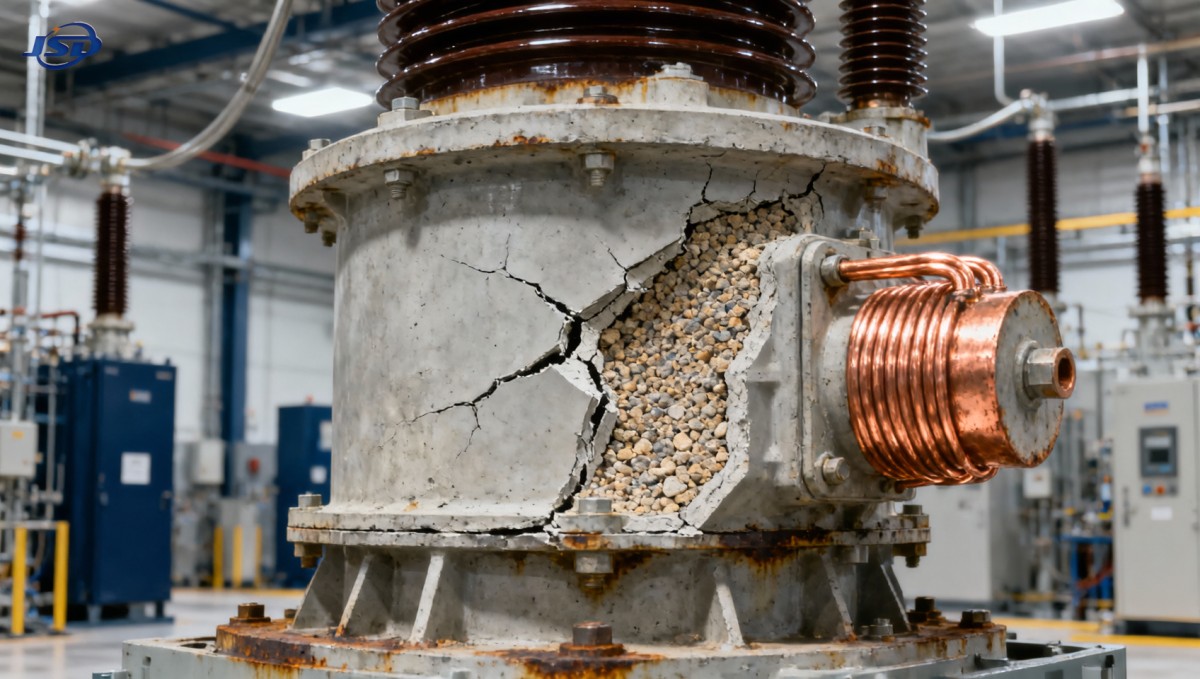
The central insight is that PDIV is not a standalone pass/fail metric but a dynamic indicator embedded within a system of interacting aging vectors. Its decline after 15 years signals not inevitable failure, but a transition point where empirical service history, localized defect morphology, and environmental loading history become indispensable inputs for risk-informed maintenance planning—rather than generic time-based replacement schedules.

Get a Quote
Regardless of whether you require general advice or specific support, we are happy to help you.
Send Us Your Inquiry Today

Jinshida Electric remains committed to contributing to global energy development through professional manufacturing and superior service.