





Corrosion resistant marine transformers: what IP and C4/C5 ratings actually mean for offshore uptime
2026.09.23
Jinshida
IP and C4/C5 aren’t interchangeable — and confusing them costs uptime
For quality control and safety managers responsible for offshore power systems, a “corrosion resistant marine transformer” isn’t defined by marketing language — it’s validated by two independent, non-overlapping standards: IP (Ingress Protection) and ISO 12944 corrosion categories. Yet in procurement reviews, we routinely see specifications where an IP66 rating is mistakenly assumed to imply C5-M compliance — or worse, where C4 labeling is accepted for a platform located 12 km offshore in the North Sea. That mismatch doesn’t just risk premature failure. It undermines inspection credibility, delays commissioning, and introduces unquantified safety exposure during maintenance cycles. Let’s clarify what each rating *actually* governs — and why both must be verified separately, with traceable test evidence.IP ratings protect against physical intrusion — not chemical attack
The IP code (e.g., IP66, IP55) defines resistance to solid objects and liquids — nothing more. The first digit (0–6) indicates protection against dust and particulates; the second (0–8), against water ingress under defined conditions (spray, hose, immersion). For marine transformers, IP66 is common: full dust-tightness and protection against powerful water jets from any direction. But here’s what IP does *not* tell you: - It says nothing about salt-laden air exposure duration. - It doesn’t address chloride-induced pitting on copper windings or aluminum enclosures. - It doesn’t require accelerated corrosion testing — only mechanical sealing integrity. A transformer rated IP66 may have standard-grade steel fasteners, untreated busbar clamps, or non-epoxy-coated laminations — all of which corrode rapidly in marine atmospheres, even if no water enters the enclosure.C4 and C5 define *electrochemical durability* — not enclosure tightness
ISO 12944-2 (the international standard for protective paint systems) defines corrosion categories based on environmental severity — not equipment design. C4 and C5 are the relevant levels for marine and offshore applications: - **C4**: “High” corrosion risk — applies to industrial coastal areas and sheltered offshore locations (e.g., harbors, near-shore platforms). Typical time-to-first-rust on untreated carbon steel: 1–2 years. - **C5-I** (Industrial) and **C5-M** (Marine): “Very high” risk — exposed offshore structures, splash zones, and continuously salt-laden atmospheres. Time-to-first-rust on untreated steel: <1 year. Crucially, C4/C5 classification applies to the *entire system*: enclosure, cooling fins, terminal boxes, mounting hardware, and internal structural components. It’s verified through: - Salt-spray testing (ISO 9227) for ≥1,440 hours (C5-M requires ≥2,000 hrs), - Cyclic corrosion testing (ISO 16701) simulating wet/dry/salt/UV exposure, - Material traceability — e.g., stainless steel grades (A4/316 vs. A2/304), zinc-aluminum alloy coatings, or epoxy-powder-coated castings. A C5-M certified transformer isn’t just “more coated.” Its material selection, surface preparation, coating thickness (typically ≥200 µm DFT for critical zones), and joint-sealing methodology are all engineered to resist electrochemical degradation — not just keep rain out.Where real-world failures begin: the gap between spec and application
We’ve reviewed post-failure reports from three offshore wind substations commissioned between 2020–2022. All units carried “marine-grade” labels and IP66 ratings — but none documented ISO 12944 category validation. Root causes included: - Aluminum radiator fins developing micro-pitting within 18 months, leading to coolant leakage and thermal derating, - Zinc-plated terminal studs showing white corrosion product after 14 months — compromising torque retention and contact resistance, - Non-C5-rated control cabinet hinges seizing due to salt crystallization, delaying emergency access. None were IP failures. All were corrosion resistance shortfalls — directly tied to using C4-level protection where C5-M was required. That’s why Jinshida’s corrosion resistant marine transformers undergo dual certification: third-party verification of both IP66/IP67 enclosure integrity *and* ISO 12944-5 C5-M performance. This means every batch includes salt-spray test reports with photographic evidence of critical zones (busbar connections, hinge assemblies, gasket interfaces), plus material certificates for all metallic components.What to verify — before signing off on delivery
Don’t rely on datasheets alone. As a QC or safety manager, request these four documents — and cross-check them against actual unit markings: 1. **Full IP test report**, signed by an ILAC-accredited lab (e.g., TÜV Rheinland, SGS), specifying test duration, pressure, and nozzle angle — not just “meets IP66.” 2. **ISO 12944-5 corrosion category certificate**, explicitly stating C5-M (not “C5” generically) and referencing the paint system standard used (e.g., EN 1090-2 for structural parts). 3. **Material traceability matrix**, listing substrate, primer, topcoat, film thickness per zone, and fastener grade (e.g., A4-80 stainless, not A2). 4. **Photographic evidence of production-line coating inspection**, showing uniform coverage on weld seams and recessed areas — where corrosion initiates first. If any document is missing, redacted, or references generic “marine coating,” treat it as non-compliant — regardless of supplier reputation.When energy storage integrates with marine power infrastructure
Offshore substations increasingly incorporate on-site energy storage for grid stability and black-start capability. While not subject to the same corrosion demands as main power transformers, battery systems still operate in shared environments — often mounted adjacent to transformers in ventilated enclosures or outdoor cabinets. Their reliability depends on compatible environmental hardening. For example, the 51.2V Wall-mounted LiFePO4 Energy Storage Battery is designed for residential and light commercial use — with an IP21 rating suitable for indoor, dry locations. It is *not* rated for C5-M exposure. Deploying it in an unconditioned offshore switchroom without additional climate control or secondary enclosures risks BMS sensor drift, electrolyte seal degradation, and thermal management inefficiency — especially when ambient humidity exceeds 85% RH for extended periods. This underscores a broader principle: corrosion resistance isn’t transferable across equipment types. A C5-M transformer doesn’t “protect” nearby lower-rated devices. Each component must meet its own environmental duty — verified independently.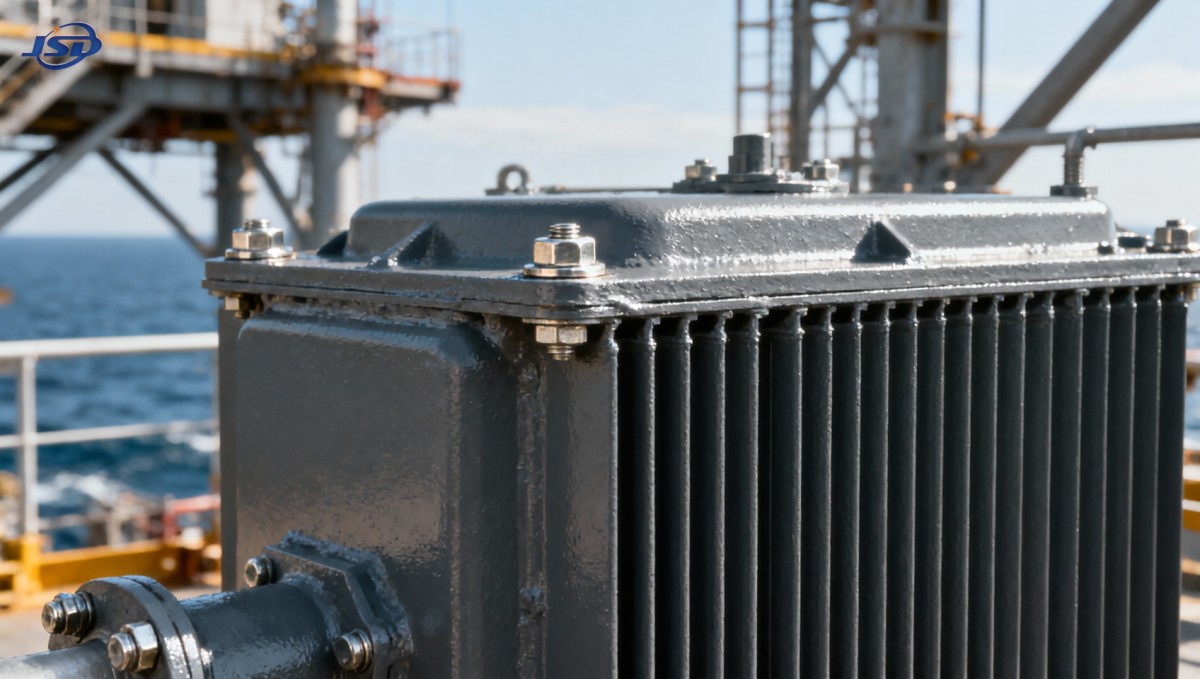
Avoiding the “compliance theater” trap
Some suppliers provide “marine packages” — a checklist of upgrades (stainless hardware, conformal coating, upgraded gaskets) — without formal ISO 12944 testing. That’s not certification. It’s engineering judgment — valuable, but insufficient for auditable safety assurance. True C5-M compliance requires evidence that the *as-built unit*, not just a prototype, withstands cyclic corrosion stress. That means test reports tied to serial-numbered production batches — not generic lab data from 2018. Jinshida’s approach reflects this rigor: every offshore-bound transformer ships with a test dossier including salt-spray results, coating thickness measurements per ISO 2808, and third-party verification of material substitutions. No exceptions. Because for QC and safety teams, “it should be fine” isn’t a defensible position — and unplanned downtime on a floating platform isn’t measured in hours, but in operational windows lost to weather and vessel availability. You’re not selecting a transformer. You’re validating a runtime guarantee — in an environment where repair isn’t scheduled maintenance. It’s uptime, hardened.
Get a Quote
Regardless of whether you require general advice or specific support, we are happy to help you.
Send Us Your Inquiry Today

Jinshida Electric remains committed to contributing to global energy development through professional manufacturing and superior service.